Friday, April 8, 2022

The New Passion Series: Almost Finished

The second Passion series that I began in the fall of 2016 is about to conclude.  I am working on the last 2 panels of the series now.


Emanuel with Job and Isaiah


Jesus Enters the City


The Last Supper


Jesus Prays Alone


Jesus Is Arrested


Jesus Before the Priests


Jesus Before the Magistrate


Jesus Before the People


Jesus Before the Soldiers


Jesus Is Beaten


Jesus Goes To His Death


Jesus Dies


Jesus Is Dead (Lamentation)


Jesus Among The Dead


Jesus Rises


Jesus Appears to Mary Magdalene


Jesus Appears To His Friends

(my photo; this has not yet been archivally photographed)


Emmaus

(my photo; this painting has not yet been archivally photographed)


Jesus Returns to God

(unfinished)


The Trinity

(unfinished)


Sunday, April 3, 2022

Remembering Bill Paulsen

 Bill Paulsen died March 15 after many years of ill health.  His funeral took place March 23, the day before his 78th birthday.  His passing affected scores -- maybe hundreds -- of people around the world, and it certainly affected me.
For much of his life, Bill served as a Lutheran pastor.  Though his grandparents were Norwegian immigrants, he was not born into the Lutheran church.  He began life as a Methodist and eventually converted to Lutheranism.  He brought to his long years of service as a Lutheran pastor the zeal of a convert.  He served a congregation in Berlin for a couple of years in the early 1970s, and then for many years until his retirement, he lead a Lutheran congregation in south Brooklyn.

"Zeal of a convert" are words that give us pause.  They evoke the image of a hard dour determined Servant of the Lord.  Bill Paulsen may have been determined in his service to the Lord, but he was hardly dour.  Many of us who knew him remember his vast collection of jokes of varying quality and taste that nevertheless kept us all laughing.  I remember riding with him on a train through Germany howling with laughter as we played one of his favorite games, taking the opening words of famous hymns and adding the phrase "...under the sheets." "Oh for a thousand tongues to sing under the sheets!"  Bill could be what I would call "aggressively friendly."  He made a point of going up to people no matter where or what and just talking to them.  He had a talent for immediately disarming people and making them feel comfortable around him.  I watched him use this talent memorably on many occasions.   In particular, I remember seeing him disarm famously surly cab drivers in Paris and winning them over.  One cab driver got himself lost taking us back to the hotel.  The angry and frustrated driver ended up refunding our fare and thanking us profusely for being so understanding after Bill spoke to him.  I note that his talent for fearless friendliness served him very well in those years when he was partially disabled and frequently dependent on the kindness of friends and strangers.  However, I think that's a talent he had all his life.  So many long and durable friendships that he enjoyed began with such active friendliness and lasted over decades and even generations.  That active friendliness lead him to summon the courage and inner strength to rescue  people in desperate situations on occasion (no, I'm not talking about myself, but about people who really were in seriously dire straits and owe their lives to him).

There was a serious spiritual purpose behind Bill's charm and bonhomie.  He believed very strongly in the "freedom of the Gospel,"  that the Gospel was emphatically not another calamity piled onto the backs of sinful humanity by an implacably angry deity, but liberty from all that guilt and grief.  The necessary work of salvation has already been accomplished for us by Christ, by God Himself.  There was nothing we could do to add or subtract from that salvation because Christ is faithful even when we are faithless.  Instead of self-indulgently counting our sins on a rosary of thorns, or beating other people over the heads with inventories of their sins, we should enjoy the freedom Christ gives us and share that joy with others.  "We're full of glory and full of shit at the same time" Bill always said.  The Gospel is the assurance that we will get through the Valley of the Shadow of Death and dwell reunited with all who we love and more in the Risen Christ.  And we will get to that other side despite ourselves since God has already done the necessary work on our behalf.
Bill Paulsen preached this and he lived it.

As much joy as he found in the Gospel, Bill's life saw an abundance of suffering beginning with a lonely childhood and the death of his older brother in a car accident.  He certainly shared in a lot of pain and grief his parishioners suffered over the years.  He spent his last years in constant physical pain from deteriorating knee and hip joints and a growing list of ailments.  I remember one African cab driver in Paris helping him get into the cab describe Bill as "the bravest of men" because of the constant pain he endured.  Of course as would anyone living in such conditions, the pain caused him grief and despair, but the despair never ruled over him.

I traveled with Bill twice to Europe to help him with carrying luggage and other things he was too incapacitated to manage on his own.  The worst was helping him up and down stairs, and getting him on and off trains.  But I count those travels among the greatest and most fortunate blessings of my life.  I met so many wonderful and remarkable people through him in Europe and at home, beginning some great friendships.  I saw wonderful and sublime things with him on my travels.  I would always remember him gratefully for that alone.  I will remember him for that and for his great and very generous friendship, and hope to see him again some day among the saints in light.


Bill with Peter Meyer at the Christuskirche in Nuremberg, 2016


Bill with old friends in Berlin from his days as a pastor there, 2016


Bill with Erika Markgraf, another Lutheran pastor, in Coburg, 2016


Bill with the late Kristal Tsang in Lübeck, 2016


Bill with his family in Svelvik, Norway, 2014


Bill in Oslo at the home of Lasse and Erik in 2014


Erik and Lasse in 2014 at home with Bill in Oslo


Bill in Amsterdam with Knight Hoover, a friend, and Raymonde Oudenrijn in 2014


Bill with Gelli and Kristal Tsang in Wiesbaden, 2016


Bill holds forth with the Hellgermans and friends in Telgte in 2014


Bill with Yours Truly at the Hotel Dieu in Beaune, France in 2014, photo by Jean-Yves Bonamour


Bill and I with friends at the former Dublin 6 in New York in I think 2018.
Left to right, Jon Vinson, Warren Blyden, Jacqui Taylor-Basker and her son, Yours Truly, and Bill Paulsen.


Christmas Day with Bill and lots of friends in his apartment in Brooklyn Heights in 2013


Wednesday, March 16, 2022

Bill Paulsen


Bill Paulsen died yesterday morning.  He was a dear friend and traveling companion.  May he rest in peace and rise in glory.

Here he is in the chapel of the Hotel Dieu in Beaune in France in 2014.


Saturday, February 26, 2022

The Virgin of Vladimir


The Virgin of Vladimir is the most famous and most revered of Russian icons, described as the "Palladium of Russia" (a protective sacred image), it is also among the oldest of all surviving Russian icons.  It is older than Russia itself, made for Kievan Rus, a loose collection of principalities from which Ukraine, Russia, and Belarus would emerge.  The Virgin of Vladimir is one of only twenty surviving icons from before the Mongol invasions of the 13th century.  All twenty of those surviving icons were made in or for Kyiv in the 11th and 12th centuries.

A 12th century Kievan prince commissioned the Virgin of Vladimir for a church he was building from the imperial workshops in Constantinople.  When the icon arrived in Kyiv about 1131, it created a sensation.  It was celebrated and famous from the start.  It was as celebrated for its beauty as much as for its sanctity.  It remains a major masterpiece of Byzantine painting with an emotional appeal unusual for Byzantine art in any era.  The unknown Greek artist of the Virgin of Vladimir may have invented this type of composition showing a tender contact between mother and child later known as an Eleusa Icon type.  No other icon painter since invested that tender cheek to cheek contact with the warmth, depth, and complex range of emotion that this artist created in the Virgin of Vladimir.


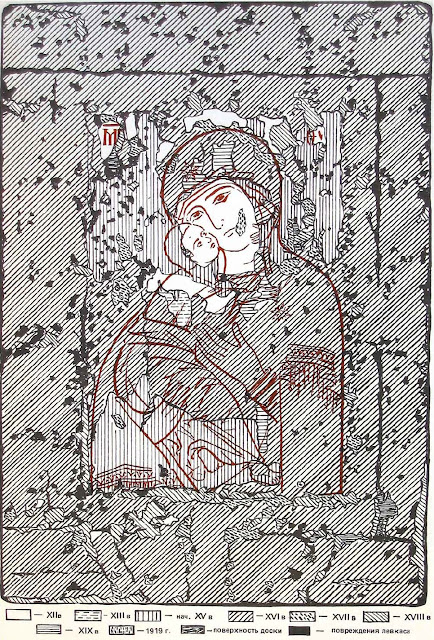
This restorer's diagram shows how very little is left of the original icon.  Only the two faces remain from the original painting.  The rest is the remnant of several re-paintings over many centuries.  The great icon painter Andrei Rublev is said to to have had a hand in restoring this painting at one time.  Like so many ancient  revered sacred images, the Virgin of Vladimir was worshipped almost to death. 


A detail showing the remaining portions of the original painting from Constantinople.


The icon did not remain in Kyiv for long.  In 1167, the Virgin of Vladimir traveled to the city of Vladimir where she resided for about a century.  The icon was transferred to Moscow in the 14th century where it remains today.  


The Virgin of Vladimir was so revered that there were icons painted about it.  Here is a 16th century icon commemorating its 1167 arrival in the city of Vladimir from which it would take its name.  A monastery was later built on the site of the transfer.


One of the reasons for the icon's poor condition is the addition of pious ornamentation over the centuries.  All of this was added with the best and most reverential of intentions, but it badly damaged the original painting every time such ornament was added and removed.  

The riza, or oklad, or as it's known English, the revetment above was made in the 15th century specially for the Virgin of Vladimir, as was the 17th century riza below.

These pious ornaments are themselves works of art.


Here is a copy of the Virgin of Vladimir made in the 16th century for Irina Godunova, sister of Boris.  
It remains fully vested.  This is how people would have seen the Virgin of Vladimir for most of its history, vested and surrounded by flowers and candles.


The Virgin of Vladimir inspired innumerable copies and imitations down through the centuries.  
This one is among the most famous, the Donskaya Virgin by Theophanes the Greek (or Feofan Grek in Russian), one of the very few icon painters who was neither ordained nor in religious orders.


Rumor has it (and I don't think a very credible rumor) that Stalin had the icon flown around city in a plane during the Battle of Moscow in 1942 to defend the city from the Nazi armies at its gates.  Stalin was many things, but I doubt he was so credulous.  But that story points to a significant role played by this icon as a protective image of the city of Moscow and of Russia.  
The icon arrived in Moscow in 1395 to defend the city from the predations of Tamerlane.  Tamerlane spared the city and retreated.  And so did the Nazis in 1942.  They never entered the city.  So who knows.

Until 1930, the Virgin of Vladimir resided in the Cathedral of the Dormition in the Kremlin in Moscow.  After that the icon hung in the Tretyakov Gallery as a work of art and historically significant artifact.  
In 1993, the icon was moved to its present location, The Church of St. Nicholas in Tolmachi where the Tretyakov Gallery and the Metropolitan Patriarch of Moscow share custody.


The Church of St. Nicholas Tolmachi


Interior of the church where you can see the Virgin of Vladimir on display to the left.


Ukraine


Friday, February 25, 2022

Hagia Sophia in Kyiv


The elaborate Baroque exterior of the Cathedral of Hagia Sophia in Kyiv conceals a well preserved Byzantine church from the 11th century, among the oldest churches in the Slavic world.  Byzantine artists and craftsmen from Constantinople built the cathedral as the crowning monument of a campaign by the Orthodox church to evangelize the Slavic peoples in what would eventually be Kievan Rus followed by Ukraine, Russia, and Belarus.


Some of the original 11th century brickwork made visible on the Cathedral's exterior.


A model of the original 11th century cathedral concealed by additions from the 17th and 18th centuries.


The interior of the Cathedral little changed since the 11th century.  Most of the mosaics are 11th century originals.


Christ Pantocrator in the dome with four archangels.


The Virgin Orans in the half-dome of the apse.


Details from the mosaic of The Communion of the Apostles


 Various fathers of the church.


So far as I know, no provision was made to spare or protect this church from the fighting currently going on in Kyiv.  It will eventually pass again into Russian ownership.  This building saw many sieges and invasions over the centuries from Mongols to Tatars to Tamerlane to Stalin, to Hitler, and now to Putin.  In the midst of what historian Timothy Snyder calls the Bloodlands sandwiched between the ambitions of the 20th century's two worst tyrants stands ancient Hagia Sophia, a durable testament to the hope of a glorious fulfillment at the end of a long and dark history.