
Friday, December 21, 2012

Thursday, December 20, 2012
The Penultimate Day
"Don't they know, it's the end of the world..."
Some are saying that the Mayan calendar says that the world ends tomorrow. Meanwhile, the Mayans themselves are still making plans.
Millenialism is a funny thing.
EXTRA:
And you know that you're going to hear this all day tomorrow:
Some are saying that the Mayan calendar says that the world ends tomorrow. Meanwhile, the Mayans themselves are still making plans.
Millenialism is a funny thing.
EXTRA:
And you know that you're going to hear this all day tomorrow:
Wednesday, December 19, 2012
The Consolations of Mary Cassatt
As the residents of Newtown bury their dead this week, Mary Cassatt's paintings are much on my mind, especially her paintings of mothers and children. Her paintings are perhaps even more consoling in this day and age than the older religious paintings. These are familiar experiences, even to those of us who are not parents, and they require no mythic or credal understanding. They are deeply humane images of our most basic experience of love and affection, as children and as parents. They quietly declare these experiences to be good and valuable for their own sakes.
Sometimes Mary Cassatt's paintings of mothers and children are secularized and updated versions of the old Madonna and Child theme. She takes on the old Renaissance painters on their own turf and acquits herself magnificently. Other times, her paintings are more modern candid glimpses into the intimacies of private family life. Sometimes, her paintings are more complex combinations of a variety of influences from the Italian High Renaissance to photography to Japanese prints.
Always her paintings are affectionate without resort to sentimentality. It is a strange irony that this most poetic painter of motherhood was herself childless.
As time goes on, I have a growing respect and affection for the work of Mary Cassatt.

Baby's First Caress, 1890

The Bath, 1891

Sleepy Baby, 1910

Breakfast in Bed, 1897

Mother and Child

The Family, 1887

Mother and Child, 1890

Young Mother Sewing, 1902
Tuesday, December 18, 2012
An Ancient Crime Discovered ...
... and an ancient mystery perhaps solved.
The BBC and other news outlets are reporting this morning that recent CT scans on the mummy of Pharaoh Ramses III reveal a large and deep cut across his throat that was probably fatal. The Pharaoh apparently was assassinated. Until now, the fate of the Pharaoh Ramses III was largely unknown. All of the surviving ancient records describe an attempted coup in 1155 BCE by one of his 2 wives, Tiye and by one of his sons, Pentaweret. The records agree that the coup failed. Prince Pentaweret was captured and committed suicide. The assassination now appears to have succeeded.
 The mummy of Pharaoh Ramses III; the linen around his neck cannot be removed because of preservation issues. Until now, it hid the fatal injury in his neck.
The mummy of Ramses III was among the New Kingdom royal mummies discovered all together in a single tomb in the cliffs of Deir El Bahri. Priests from a later dynasty removed most of the royal mummies from their tombs in the Valley of the Kings in order to protect them from looters (perhaps from mobs of looters descending on the Valley during a time of political and social disintegration). When the cache was discovered in 1875, another mummy was discovered near Ramses III's mummy of an unknown man in a plain unadorned coffin, the Unknown Man E, better known as the "Screaming Mummy."

His mummification had been very hastily done with no evisceration. The embalmers wrapped his body in a goat skin (considered very unclean by the ancient Egyptians) before putting it into the unpainted coffin with no inscriptions. The hands and the legs of the body were bound with leather thongs. He was very young, only about 18 years old. The circumstances of the burial and the striking expression on the withered face gave rise to all kinds of speculation that he had been buried alive.
Recent forensic DNA tests on this mummy indicate that he was from the royal family, and directly related to Ramses III. Scholars now think that this is the mummy of Prince Pentaweret who led the coup attempt. This would explain the shabby treatment of this mummy by the embalmers.
Ramses III was the last great king of the New Kingdom period of Egyptian history. Even before his death, Egypt began to suffer economic decline and foreign predation. Most of his reign was consumed in warfare, repelling invasions by the neighboring Libyans and by the Sea Peoples who may have been seafaring Greeks enduring their own dark age in the wake of the Dorian Invasions. Though ultimately victorious for Egypt, these wars were hard fought and very costly in terms or lives and treasure.
Pharaoh Ramses III's mortuary temple at Medinet Habu near Luxor is the last great monument from New Kingdom Egypt. The king was buried in a secret tomb in the Valley of the Kings, but in this massive temple on the west bank of the Nile, resident priests perpetuated his cult for centuries.


 A relief sculpture from the temple showing the Pharaoh killing captured enemy soldiers
EXTRA:
The mummy of Ramses III was the inspiration for the extraordinary makeup for Boris Karloff in the 1932 movie The Mummy.


EXTRA:
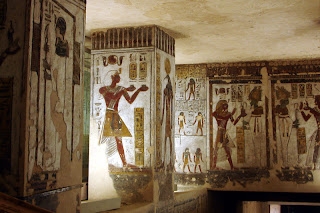
Paintings from the tomb of Ramses III in the Valley of the Kings:

The BBC and other news outlets are reporting this morning that recent CT scans on the mummy of Pharaoh Ramses III reveal a large and deep cut across his throat that was probably fatal. The Pharaoh apparently was assassinated. Until now, the fate of the Pharaoh Ramses III was largely unknown. All of the surviving ancient records describe an attempted coup in 1155 BCE by one of his 2 wives, Tiye and by one of his sons, Pentaweret. The records agree that the coup failed. Prince Pentaweret was captured and committed suicide. The assassination now appears to have succeeded.

The mummy of Ramses III was among the New Kingdom royal mummies discovered all together in a single tomb in the cliffs of Deir El Bahri. Priests from a later dynasty removed most of the royal mummies from their tombs in the Valley of the Kings in order to protect them from looters (perhaps from mobs of looters descending on the Valley during a time of political and social disintegration). When the cache was discovered in 1875, another mummy was discovered near Ramses III's mummy of an unknown man in a plain unadorned coffin, the Unknown Man E, better known as the "Screaming Mummy."

Unknown Mummy E, "The Screaming Mummy"
His mummification had been very hastily done with no evisceration. The embalmers wrapped his body in a goat skin (considered very unclean by the ancient Egyptians) before putting it into the unpainted coffin with no inscriptions. The hands and the legs of the body were bound with leather thongs. He was very young, only about 18 years old. The circumstances of the burial and the striking expression on the withered face gave rise to all kinds of speculation that he had been buried alive.
Recent forensic DNA tests on this mummy indicate that he was from the royal family, and directly related to Ramses III. Scholars now think that this is the mummy of Prince Pentaweret who led the coup attempt. This would explain the shabby treatment of this mummy by the embalmers.
Ramses III was the last great king of the New Kingdom period of Egyptian history. Even before his death, Egypt began to suffer economic decline and foreign predation. Most of his reign was consumed in warfare, repelling invasions by the neighboring Libyans and by the Sea Peoples who may have been seafaring Greeks enduring their own dark age in the wake of the Dorian Invasions. Though ultimately victorious for Egypt, these wars were hard fought and very costly in terms or lives and treasure.
Pharaoh Ramses III's mortuary temple at Medinet Habu near Luxor is the last great monument from New Kingdom Egypt. The king was buried in a secret tomb in the Valley of the Kings, but in this massive temple on the west bank of the Nile, resident priests perpetuated his cult for centuries.

The granite sarcophagus of Ramses III in the Louvre

The mortuary temple of Ramses III at Medinet Habu

The entrance to the temple of Ramses III

EXTRA:
The mummy of Ramses III was the inspiration for the extraordinary makeup for Boris Karloff in the 1932 movie The Mummy.


EXTRA:
Paintings from the tomb of Ramses III in the Valley of the Kings:


Monday, December 17, 2012
Consolation
I don't really believe in "recovering" from grief.
Our culture does not like grief, and puts a lot of pressure on the bereaved to "find closure" (whatever the hell that means), and to get on with life. The angry cynic in me asks, "in whose interest is it to 'put this behind and to get on with life'?"
Sure, we recover from the loss of those we love, like we recover from an amputation. Life goes on, and so do we, but we are never really whole again.
Nothing in this world is worse than for parents to see their children die before them. That is worse than death itself. And now scores of parents are going through that worst of pain right now in Connecticut. I can't imagine anything we could say or do that could possibly mitigate that suffering other than to offer our sympathies and to share their sorrow as best as we can.
For the rest of us who have not been directly touched by this horrific event, but who have been preoccupied with it, here are some images in which we may find some consolation.
The first is by Adolphe Bouguereau, The Virgin of Consolation from 1875.

I must confess that I'm not all that fond of this picture. It's beautifully painted, and yet the sentiment rings hollow. But it is a painting specifically about the loss of children.
At first I thought it was striking how few images there are in art about grieving for the loss of a child, especially from ages where child mortality was much more commonplace than in our time or in Bouguereau's time. Then I realized how much religious imagery really did address that subject directly and indirectly from numerous versions of the Massacre of the Innocents to the Pieta.
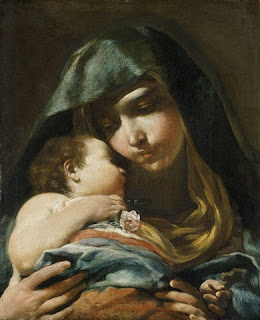
Probably the most common image intended to console the bereaved over the death of children was the Madonna with the sleeping Christ Child. A sleeping Christ Child always foretells His death, which tradition says His Mother foresaw. I've already reproduced one of the finest of these by Giovanni Bellini in a previous post. Here are some others.


My personal favorite consoling image, much on my mind lately, is this detail from Rembrandt's famous "Hundred Guilder Print" showing the entire 19th chapter of the Gospel of Matthew.

Rembrandt shows verses 13 and 14 in this detail:
Behind them, the Rich Young Man sulks after getting an unwelcome answer to his question. The Scribes and Pharisees plot to catch Jesus with legal sophistry. To the right of Christ, the sick and suffering plead for relief.
None of these children is particularly darling except maybe to their mothers. They do nothing to plead for our sympathy or to tug our heart-strings. Rembrandt shows sympathy without resort to sentimentality.
Our culture does not like grief, and puts a lot of pressure on the bereaved to "find closure" (whatever the hell that means), and to get on with life. The angry cynic in me asks, "in whose interest is it to 'put this behind and to get on with life'?"
Sure, we recover from the loss of those we love, like we recover from an amputation. Life goes on, and so do we, but we are never really whole again.
Nothing in this world is worse than for parents to see their children die before them. That is worse than death itself. And now scores of parents are going through that worst of pain right now in Connecticut. I can't imagine anything we could say or do that could possibly mitigate that suffering other than to offer our sympathies and to share their sorrow as best as we can.
For the rest of us who have not been directly touched by this horrific event, but who have been preoccupied with it, here are some images in which we may find some consolation.
The first is by Adolphe Bouguereau, The Virgin of Consolation from 1875.

I must confess that I'm not all that fond of this picture. It's beautifully painted, and yet the sentiment rings hollow. But it is a painting specifically about the loss of children.
At first I thought it was striking how few images there are in art about grieving for the loss of a child, especially from ages where child mortality was much more commonplace than in our time or in Bouguereau's time. Then I realized how much religious imagery really did address that subject directly and indirectly from numerous versions of the Massacre of the Innocents to the Pieta.
Probably the most common image intended to console the bereaved over the death of children was the Madonna with the sleeping Christ Child. A sleeping Christ Child always foretells His death, which tradition says His Mother foresaw. I've already reproduced one of the finest of these by Giovanni Bellini in a previous post. Here are some others.


Andrea Mantegna

Piero della Francesca
In this case, the sleeping Child refers to the recent death of the Duchess of Urbino, Battista Sforza. Her namesake saint, John the Baptist points to the Child and to the empty place where she should be in the painting opposite the armored Duke, Frederigo da Montefeltro, who commissioned the painting.
Sassoferrato
The 17th century artist Sassoferrato painted a number of these, many very beautiful like this one.
Sassoferrato
Another version of the picture above, the same composition reversed
Giuseppe Maria Crespi
My personal favorite consoling image, much on my mind lately, is this detail from Rembrandt's famous "Hundred Guilder Print" showing the entire 19th chapter of the Gospel of Matthew.

Rembrandt shows verses 13 and 14 in this detail:
"Then were there brought unto him little children, that he should put his hands on them, and pray: and the disciples rebuked them.A mother presents her infant while Peter tries to send her away. Behind her, another mother with an infant is directed by her toddler who eagerly strides toward Christ. His dog wonders at the commotion.
But Jesus said, Suffer little children, and forbid them not, to come unto me: for of such is the kingdom of heaven."
Behind them, the Rich Young Man sulks after getting an unwelcome answer to his question. The Scribes and Pharisees plot to catch Jesus with legal sophistry. To the right of Christ, the sick and suffering plead for relief.
None of these children is particularly darling except maybe to their mothers. They do nothing to plead for our sympathy or to tug our heart-strings. Rembrandt shows sympathy without resort to sentimentality.
The Right Lost the Election Because They Can Be Such Assholes, Part 2
Adam Lanza didn't kill all those kids in Newtown, CT. No no.
Secularists and gays did it:
That's right people, it's all your own fault for being such wild lustful pagans. God smacked some sense into you by killing 20 small children and 6 of their teachers.
Sounds familiar. Where have we heard this before?
Oh yeah! Here eleven years ago:
So who's really politicizing a catastrophe here?
Saturday, December 15, 2012
We are a Brutal and Brutalized People
From DDay at Firedoglake:
Somehow, the tea leaf-reading of what frontiersmen living 230-plus years ago thought about gun ownership takes precedence over the actual consequences of a current situation where guns are so easily obtained and used. Just to pick at random, here are a couple headlines at the Hartford Courant site just from the past 24 hours: Woman Shot, Man Dead After Standoff In Rocky Hill. Armed Robbery At Hartford Bank, Two In Custody. It’s not that school shootings like this are abnormal. They are depressingly normal. The fact that there were no shootings in one day in New York City recently was seen as a major achievement, which shows you how desensitized we have become to gun violence as a normal occurrence of daily life.
Subscribe to:
Posts (Atom)