Friday, March 17, 2017

Artists' Berlin 2


Ernst Ludwig Kirchner, The Brandenburg Gate, 1915


Lovis Corinth and Käthe Kollwitz


Lovis Corinth, Self Portrait with Straw Hat, 1923


Lovis Corinth, Self-Portrait, 1925


A painter who pointed a way forward for aspiring artists, who created an alternative to both the obedient civil service represented by Von Werner, and the imitation of French painting championed by Max Liebermann and the Berlin Secession was Lovis Corinth.  Corinth was originally from East Prussia and studied painting in Munich.  But he had his debut exhibition in Berlin in 1899 with the Berlin Secession.  He later moved to Berlin and exhibited regularly at Paul Cassirer's gallery.  Artists saw him as a liberating figure.  Corinth took French Impressionism to an emotional fever pitch that artists like Monet and Pissarro never intended.  Corinth painted very un-Impressionist subject matter from myth and religion that appealed to German sensibilities.


Lovis Corinth, The Walchensee Serpentine, 1920


Corinth took the Impressionist brushstroke that was supposed to equalize every part of a painting, and made it into an energizing force that blew a gale wind of force through both the image and the paint surface.  Far from the detachment required by French Impressionism, Corinth revived the old German Romantic emotional engagement with the larger world using a very idiosyncratic variation on Impressionist form.  In his later work, he would apply that energetic brushwork and a growing distortion of form to some very un-Impressionist subject matter.


Lovis Corinth, Flowers, 1920

Only Corinth could turn a straightforward still life of flowers into a raging storm of brushwork and color.


Lovis Corinth, The Slaughterhouse, 1893
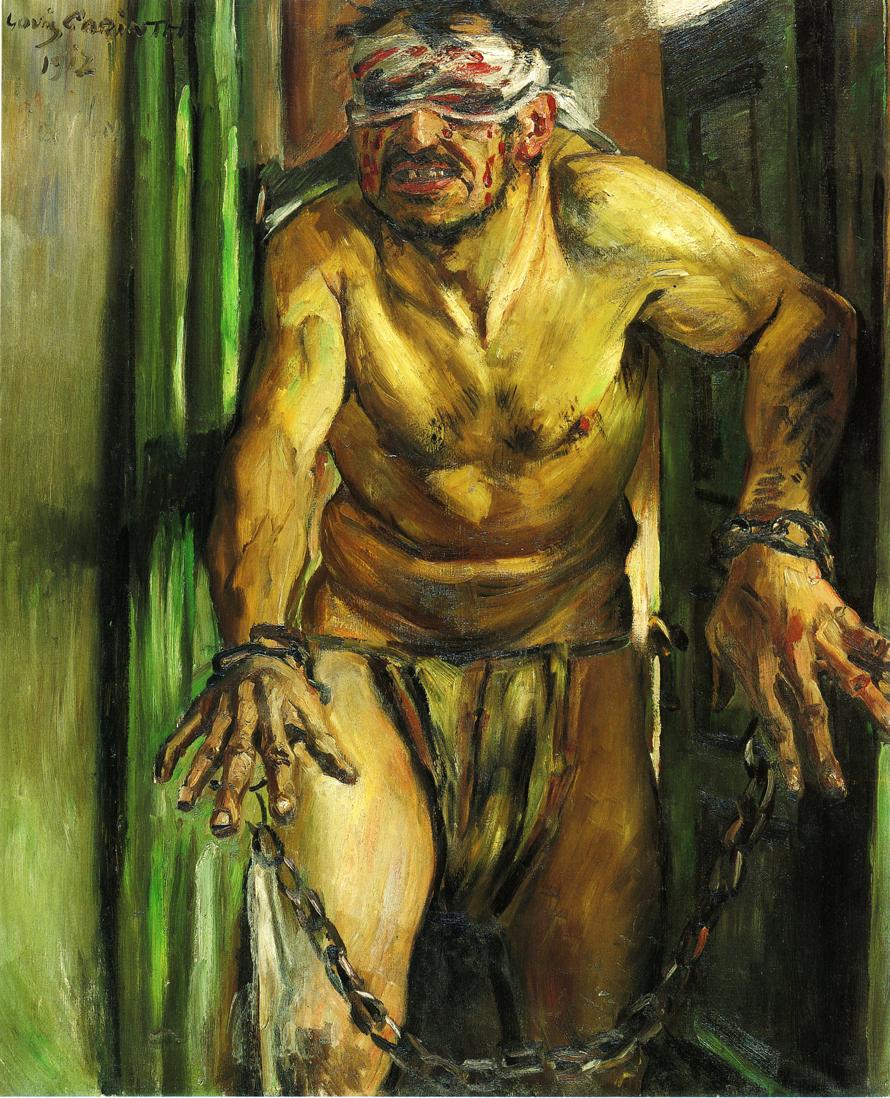


Lovis Corinth, Blinded Samson, 1912


Lovis Corinth, Red Christ, 1922

Younger artists, especially the new generation of Expressionists, loved Corinth's work.  They loved the emotional force that propelled the very rough brushwork and distorted form with its intensity.
Corinth did not love them back.  He kept his distance from the younger moderns frequently attacking their work.

***


Another artist who pointed a way forward for German artists was the great graphic artist and sculptor Käthe Kollwitz.  She remade the great themes of Christian religious imagery that always dominated German art since the earliest middle ages and still resonated deeply with artists and public alike in the early 20th century.  Kollwitz secularized and updated a lot of traditional religious imagery and gave it a new emotional force.  While her secularized Madonnas and Pietas lost their traditional religious meanings, they gained a new powerful empathetic appeal.

Käthe Kollwitz had a long and dramatic life deeply touched by left wing Christianity.  Her father was a mason and house builder whose political sympathies were radically social democratic.  Her grandfather was a Lutheran pastor expelled from the official Evangelical State Church of Prussia for his socialist views.  Her husband Karl was a medical doctor who tended the poor in Berlin.  Their house was next to the clinic where he worked.  The patients at the clinic inspired much of her work.
Käthe Kollwitz was the first woman admitted into the Prussian Academy of Arts, though her gender limited her opportunities for art education when she was young.
In the First World War, she lost her younger son Peter in combat.  In World War II, she lost her grandson, also named Peter.  Her husband died in 1940 from illness.
During the Nazi regime, she was forbidden to exhibit and all of her work was removed from museums and other public collections.  The gestapo threatened her and her family with deportation to a concentration camp.  She received numerous offers to move to the USA, but refused them all fearing reprisals on her family.
In 1945, the Allied bombing of Berlin destroyed her home and forced her to flee the city.  She went first to Nordhausen, and then later to Moritzburg outside of Dresden where she died just 16 days before the War ended.


She was a great master of the print media, especially etching with its lights and darks.  She used the tenebrism of etching to great dramatic effect.


Käthe Kollwitz, Death, Woman, and Child, 1910, etching


Käthe Kollwitz, Woman with Dead Child, 1903, etching

A very powerful print showing a primal almost animal grief over the loss of a child.


Käthe Kollwitz, Man with Dead Wife, 1903


From a series of prints inspired by the Peasants' War of 1524 -1525, probably her best and most powerful print cycle.  Sharp contrasts of light and dark, simple concentrated imagery make these major masterpieces of print. Many of them have a dramatic concentration that anticipates cinema.
Kollwitz uses an episode from the distant German past to speak urgently to its present at the beginning of the 20th century.


Käthe Kollwitz, Sharpening the Scythe from The Peasants' War, 1902 - 1908, etching


Käthe Kollwitz, Raped, from The Peasants' War, 1902 - 1908, etching


Käthe Kollwitz, Outbreak from The Peasants War, 1902 - 1908, etching


Käthe Kollwitz, The Prisoners, from The Peasants' War, 1902 - 1908


Käthe Kollwitz, Searching for the Dead from The Peasants War, 1902 - 1908, etching


Käthe Kollwitz, Lamentation:  In Memory of Ernst Barlach, 1938

Käthe Kollwitz remade Christian subject matter in her sculptures too, and perhaps with even more concentration.  This memorial that she made for her friend and mentor, the sculptor Ernst Barlach shows a simple fragment of her own grieving face held by her hands.


Käthe Kollwitz, Mother With Dead Son, 1937

Probably her most famous variation on the Pieta subject, this sculpture now forms the centerpiece of a remade war memorial in the Neue Wache in Berlin.  Since 1931, this former guardhouse served as a war memorial, first to the military dead of World War I, then in 1970 as a memorial to the "Victims of Fascism and Militarism" during the DDR.  In 1993, the German government remade the Neue Wache into a memorial for all the civilian dead of World War II and made this sculpture by Kollwitz as its centerpiece.  It sits under the open sky though an oculus in the ceiling in all weather.


Käthe Kollwitz's prints and sculptures demonstrate very forcefully the continuing communicative power of imagery.  Seeing a reconstruction of our own experiences of the world, both in terms of our senses, and our emotions, still has an unsurpassed empathetic appeal.  This remains true even in our age saturated with vivid imagery created by technology.  While her politics may have been far left, her art is a conservative triumph.  Kollwitz understood that the distortions of form created by Expressionism, and the Cubist break up of form create emotional distance.  A self-consciousness about form inserts itself between the vision and us.  Of course, form was always there between us and the subject, but in Renaissance and Baroque art, form makes itself invisible as it plays its part in conjuring up a vividly real looking apparition before our eyes.  That self-consciousness about form begins to insert itself beginning with Cezanne's work.  It could be argued that Cezanne and his legacy were necessary correctives to an illusionistic art that lost its contact with experience and with what is real and true.  Kollwitz would probably agree with such a criticism of figurative art.  But, she believed that she had more urgent matters of human need and justice to be served.  She lived most of her life amid human misery.  She ended her days under threat and in the midst of warfare and on the run.  The project to close the gap between form and subject was something that she could not afford, nor could her audience have such a luxury.  She wanted her art to stir feeling above all else.  And what better way to do that than through appealing to our experiences of the world as vividly and memorably as possible.

There is a certain reluctance in much of German modernism to break up form out of the fear of emotional distancing.  Die Brücke painters really stretch form, but they never quite break it.  We see that reluctance to break apart imagery in Max Beckmann's work, in the work of Otto Dix, Christian Schad, and eventually in Anselm Kiefer's work.  If we want to see a radical departure form imagery entirely, we have to go to Munich and see the work of the Blue Rider artists.  But even Kandinsky at his most abstract aspired to connect with people emotionally.  And that great master of graphic invention Paul Klee still wants to tell stories as memorably as possible


***


Die Brücke Comes to Berlin


Twentieth Century modernism arrived in Berlin in 1911 with a small band of young painters from Dresden and their friends and lovers.  They came to Berlin in search of fame and fortune in a much bigger and more sophisticated city.

In 1905, a group of very young architecture students in Dresden (the average age was 19) got together to form the first modern art movement of the 20th century, Die Brücke, The Bridge; and to publish the first (and shortest) of many artists' manifestos in the first half of the last century.  They wanted to do much more than reform art.  They wanted to build an entire way of life that was the exact opposite of the deeply repressed suffocating official culture of Wilhelmine Germany.  All that the culture of Kaiser Wilhelm II wanted to suppress, Die Brücke wanted to liberate.

The other major expressionist movement (and probably the greater one) was Die Blaue Reiter (The Blue Rider) that belonged to Munich.  The Blue Rider had relatively little contact with Berlin, but a much more international network of contacts from New York to Paris to Moscow.

The leader and best artist of Die Brücke was a high strung young man named Ernst Ludwig Kirchner.


Ernst Ludwig Kirchner (seated on the right) came from a very respectable bourgeois family, as did most of the other Die Brücke artists.  His father (seated to the left of the artist in this family photo) was a very successful and highly respected industrial chemist.


This is a photo taken in 1912 in Kirchner's studio in Berlin.  The naked man dancing and smoking may be Kirchner himself, though he's hard to identify here.
Die Brücke was more than a group of like-minded artists.  It was a way of life.  Shortly after they organized, the artists took over an abandoned butcher shop in Dresden and lived and worked together along with their lovers, friends, and many hangers-on.  In 1911, they moved together to Berlin and set up a similar commune.  They shared food, living space, friends, and lovers in a collective dedicated to gratifying all the desires and instincts repressed by conventional society.  They not only painted together, but they also made their own furniture and wall hangings.  Most of the sculpture, furniture, and wall decorations that Die Brücke artists made survive now only in photographs taken by the artists themselves.


Kirchner and Erna Schilling in a corner of his studio with sculptures, furniture, and textiles made by the artists.


An attic bedroom with sculptures, furniture, and textiles on the beds and walls by Kirchner.  Photograph by Kirchner from about 1912.


Their desire to completely remake their surroundings according to their wishes would have a great influence on later modern artists and designers.  The idea of a total integration of fine and applied art would help shape the ambitions of the Bauhaus almost twenty years later.

The Die Brücke bohemia, like all bohemias, was a bourgeois creation.  These sons of German bourgeois respectability pitted bourgeois virtues of independence and initiative against bourgeois vices of hypocrisy and conformism.  They created the 20th century's first of many youth "counter-cultures."  Their lives of unapologetic scandal first horrified the general public, but then quickly attracted a growing popular interest.


E.L. Kirchner, The Street, 1913

Berlin and its busy streets affected Kirchner very deeply.  Their noise, traffic, and crowds thrilled him with a sense of life force, and also frightened him.  That same passion to feel deeply and to connect that drove earlier Romantic artists like Caspar David Friedrich far into the countryside drove Ernst Ludwig Kirchner onto the sidewalks of Berlin.
Berlin's women on the streets fascinated Kirchner.  Women dressed up for display and/or seduction in public on the streets.  Some of the women in his paintings of Berlin streets are street walkers, prostitutes.  Others appear to be women of fashion displaying themselves before an admiring public.

Before Expressionism, art -- even most experimental modern art such as Matisse -- aspired to a kind of calm resolution.  All of the parts of a painting were supposed to work in harmony with one another.  This sense of fulfillment, of completion and self possession became the goal of art as early as ancient Greece.  Kirchner and the other Expressionists valued disruption over calm, noise over quiet, dissonance over harmony.  In Kirchner's Berlin street paintings, the ground plane begins to tip up and fill the painting creating a kind of vertigo where figures stand before and not on the ground plane.  Chiaroscuro vanishes from his paintings.  Sharp slashing brushstrokes of unmixed color on raw canvas become as rough and unresolved as the very street scene that he paints.
The color combinations are jarring instead of harmonious; hot pinks with viridian, blue, black, and white; bright pale yellows with black and turquoise blue; colors that in combination set our teeth on edge.


Ernst Ludwig Kirchner, Women in the Street, 1915


Ernst Ludwig Kirchner, Street Scene, 1913, pastel


E.L. Kirchner, Street Walker in Red, 1914, pastel


E.L. Kirchner, Two Street Walkers, pastel, 1914

An example of Kirchner's electric and sharp drawing technique.  The pencil and chalk strokes are rough and violent.  The forms are sharp as broken glass.  But these drawings -- Kirchner's work in general -- are never crude, never hesitant.

These street scenes show a kind of anxious joy and exhilaration in the noisy chaos of urban street life.  For a young man from the comparatively staid and once beautiful Baroque city of Dresden, Berlin's busy noisy streets must have seemed overwhelmingly dramatic, terrifying, and thrilling.  It is the thrill that comes through in Kirchner's Berlin paintings more than the anxiety.  That kind of intoxicating communion with the life of urban crowds is closer in spirit to Walt Whitman than to the rapturous mysticism of Novalis.  In fact, Kirchner loved Walt Whitman's poetry.  He kept a German translation of Leaves of Grass on his nightstand by his bed, and read from it daily.


Die Brücke Exhibition at Fritz Gurlitt Gallery, Berlin, 1912

Die Brücke got a big break with a major exhibition at an important Berlin gallery in 1912.  The very established and reputable Gurlitt Gallery showed paintings and sculptures by the group attracting a lot of public and press attention for the first time.  A lot of the critical attention was hostile, but not all of it.  Some of it was very supportive and sympathetic.  Their public following increased dramatically and they found themselves playing the role of celebrities.  All of the sculpture that appears in this photo is lost.  Very few of the  Die Brücke group's sculptures survive.

A couple of other members of Die Brücke and samples of their work that they did in Berlin:


Erich Heckel, Glass Day, 1913

Probably his best painting.  A nude figure and some landscape details locate us as sky and  lake become crystalline shards.


Karl Schmidt-Rottluff, Houses at Night, 1912

I've always been particularly fond of Schmidt-Rottluff's work for its combination of rich brilliant color with very dramatic distortions of form.  These distorted houses glow in the ultramarine blue dark with arbitrary colors.


***


Probably the greatest champion and promoter of Expressionism in Berlin was Herwarth Walden.  Born Georg Lewin to a wealthy Jewish family, he changed his name in honor of a favorite book of his, Henry David Thoreau's "Walden."
Walden was himself a gifted painter and poet with many cross-disciplinary interests in music and theater.  He published a magazine Der Sturm that promoted the work of Expressionist artists, creating an enthusiastic audience and market for their work; and just as important, he put the disparate Expressionist movements in Berlin, Munich, and Vienna in contact with each other, and in contact with other modernist movements such as Cubism in France and Futurism in Italy.


A 1917 cover of Der Sturm


The Viennese Expressionist Oskar Kokoschka's portrait of Herwarth Walden


The leader of Munich's Blue Rider group, and a pioneer of abstract painting was Wasily Kandinsky, a Russian artist who lived many years in Munich.  Walden brought his work to Berlin.  Here is his painting Black Lines from 1913.


A performance at Walden's Der Sturm Gallery in Berlin.  A painting by the French Cubist Robert Delaunay hangs in the background.  Delaunay frequently exhibited in Germany, especially in Munich with The Blue Rider group.


Herwarth Walden established a gallery in Berlin, also called Der Sturm that brought the Berlin public and artists in contact with original works by major modern artists of the day, and put original works by younger German artists before the public.  Though Walden frequently featured Die Brücke artists in his magazine, he never exhibited their work in his gallery.

Walden was a very courageous and unfortunate man.  He braved the harsh moralizing censorship of Kaiser Wilhelm II's government, and the blasphemy laws that continued in the Weimar Republic.  The advent of the Nazis forced him to shut down his enterprises and flee the country in 1932.  He went to Russia where Stalin's regime viewed him with great suspicion as a promoter of "bourgeois modernism."  Walden died in 1941 in a Soviet prison near Saratov.


Artists' Berlin 1


Eduard Gaertner, Gendarmenmarkt in Winter, 1857

This project originally began as a single post.  But, as I looked further into this topic, it became ever larger and more fascinating than I had anticipated.  So now, it is a series of posts.

Modern art and design were born independently (if not exactly simultaneously) in several places; Paris, New York, Chicago, Zürich, Munich, Moscow, Barcelona, London, Glasgow, Vienna, Mexico City,  Brussels, Amsterdam, and Berlin.  Berlin, unlike most other cities where modernism began, was less a womb and more of a crucible.  Art and artists were tried in the refining fire of historical events.
Berlin over the course of a little more than a century rose from a backwater military outpost and Prussian royal capital to become one of the most technologically advanced and forward looking cities in the world.  The experiences of this great city would shape the ambitions of artists and the expectations of their publics everywhere.  Transformations in art and design pioneered here would shape the look of cities around the world.


The Prussian Capital


Karl Friedrich Schinkel, On the Banks of the Spree Near Stralau, 1817


Karl Friedrich Schinkel was the pre-eminent architect of Berlin in the years following the War of Liberation against Napoleon's occupation of German territories.  As an architect and as a painter, he participated in the revival of interest in German identity in the renewed Prussian kingdom.  In his architecture, he championed both Greek revival and Gothic revival as virtuous German national styles in contrast to the Neo-Roman imperial splendor of Napoleon's Paris.
Schinkel started out as a painter, and ardently admired the work of Caspar David Friedrich at a time when Friedrich's star was fading and the great old Romantic became increasingly reclusive.
Schinkel learned from Friedrich the use of the fleeting but exhilarating light effects of transitory times of day like morning and evening.  Schinkel became a master of luminous effects, perhaps even more so than Friedrich himself.  However, Schinkel's paintings don't have Friedrich's concentration and singleness of purpose.  The spirit in Schinkel's work is much less anguished and alone than Friedrich.  Instead, Schinkel's paintings are full of anecdotal detail and people doing things.  Schinkel's work comes across as much more convivial than Friedrich's.


Karl Friedrich Schinkel, Schloss am Strom (Castle by a River), 1820

This spectacular painting was the result of a contest between Schinkel and the poet Felix Brentano.  At a dinner party, Brentano dared Schinkel to come up with a picture that could fully illustrate and capture the spirit of any short poem he could improvise.  Brentano claimed that poetry was superior in its evocative powers to painting.  Brentano came up with a poem about a game-keeper at an old castle who had died, and who lay buried on the opposite bank of a river.  A deer wandered into the now abandoned castle grounds assured of his safety.  As in Brentano's poem, Schinkel's painting is filled with Romantic death and resurrection imagery.  Schinkel's painting was widely applauded, but it didn't so much best Brentano's poetry as demonstrate the interconnection of the two art forms.  The interrelation of the arts preoccupied German Romantic poets, musicians, and artists at the time, and would pre-occupy artists again in the early 20th century.


Karl Friedrich Schinkel, Hall of the Stars for the Queen of the Night;
set design for Mozart's The Magic Flute, 1815

Never was that idea of the interconnection of the arts more forcefully demonstrated than in Schinkel's spectacular stage set designs for a performance of Mozart's The Magic Flute.  Schinkel in all of his work had an architect's command of space (more so than Friedrich or his followers), and never is it more forcefully displayed than in this majestic dome of stars in the night sky.


Karl Friedrich Schinkel, Design for the Mausoleum of Queen Louise, 1810


***


Eduard Gaertner, Unter den Linden, a view looking east toward the Stadtschloss, 1853

Gaertner's brilliance combined scrupulous topographical accuracy with a remarkable command of light and atmosphere and point of view.  I can think of few other topographical artists who can convey through the combination of the slightly odd point of view and lighting effects the experience of walking through a great city like Berlin.  My summer evening strolls through the center of Berlin last July immediately brought to my mind the painting below which for some reason, I've known for years.


Eduard Gaertner, Neue Wache, 1833


Eduard Gaertner, Parochialstrasse, 1831


Eduard Gaertner, Klosterstrasse, 1830


Carl Blechen had a very brief but remarkable career as an artist lasting only about ten years before insanity and death cut it short.  From a very poor background working for a few years as a bank clerk, then serving in the military, he first gained fame for fantastic and seemingly haunted subject matter in theatrical lighting like the painting below.


Carl Blechen, Mountain Gorge in Winter, 1825


Carl Blechen, Forest Path near Spandau, c. 1835

Even his local vistas from the region around Berlin have an air of the bizarre about them.  The lighting is very theatrical (Blechen worked for a time in the theater as a scene-painter).  The play between warm and cool lighting in this painting and in much of his earlier work can be extreme and adds to the strange quality of his work.

Looking at Blechen's work (and some of C.D. Friedrich's work), I see where Walt Disney got some of his ideas for making ordinary scenery suggest the magical in so many of his animated movies.  Blechen was a contemporary of another master of the fantastic and horrific, the poet E.T.A. Hoffmann who spent his last days in Berlin while Blechen lived there.


Carl Blechen, Rooftops and Gardens, Berlin, 1835

And then there is this unexpectedly candid study made while looking out of a window.
Blechen makes a fresh and straightforward painting of a very ordinary and unremarkable view in a corner of a suburban Berlin neighborhood.

***

Adolph Von Menzel, a native of Breslau (now Wroclaw in Poland), was the arch-realist of 19th century Berlin.  Degas praised his work.  He stood less than five feet high, almost a dwarf.  He observed Berlin from the position of an outsider as it passed through a series of historical changes from Prussian capital to becoming the capital of a united imperial Germany.


Adolph Von Menzel, The Artist's Sitting Room in Ritterstrasse, 1851

In these Berlin interiors, we can see why Degas found Menzel's work to be so praise-worthy.  The handling of light and the virtuoso brushwork used to suggest the play of outside light in an interior is magical.  These interiors are full of unspoken suggestion, of human presences that have just left the room, if only for a moment.


Adolph Von Menzel, The Balcony Room, 1845


Adolph Von Menzel, Living Room with the Artist's Sister, 1847, painted in oil on cardboard.
Another beautifully evocative painting of an interior in Menzel's house with his sister Emelie leaning on the door and looking down a hall while another sister sits sewing in the background.


Adolph Von Menzel, Victims of the March Revolution Lying in State in the Gendarmenmarkt, 1848

The painting shows a mass funeral ordered by the King of Prussia for victims of a massacre by the Royal Guard who fired on a peaceable demonstration on March 18, 1848.  Anxious over growing public anger over the incident, the King apologized for the 'mistake' and ordered a public funeral.
Menzel's painting remains unfinished.

Adolph Von Menzel began life in poverty.  His father was a teacher who also ran a small lithography business.  The father died when Menzel was 16 leaving the print business to his son.  Menzel, always a hard worker, invested all his energy into the business and made it a success.  He never married and spent his life with his mother and sisters.  Menzel began as a middle class liberal who whole-heartedly supported the 1848 Revolution.  His liberalism soured as the Revolution withered in the violent backlash by the landed nobility, and ended in frustration with the notoriously ineffectual Frankfurt Parliament.  Menzel emerged out of the experiences of 1848 a nationalist authoritarian.  His lifelong admiration for King Frederick the Great became a vessel for his ever more passionate nationalism.  Menzel ended his life an enthusiastic loyalist to the German Empire under the Hohenzollerns.  Menzel left his painting of the funeral of the victims of March 18, 1848 unfinished because he simply lost interest in the cause that they died for.
His work after 1848, and especially during the Empire, becomes larger, more spectacular, and coarser.  That sense of nuance that made his work so magical before 1848 gets lost in large showy displays of virtuosity in big paintings proclaiming the greatness of the rejuvenated Fatherland.


Adolph Von Menzel. The Iron Rolling Mill, 1872 - 1875


Adolph Von Menzel, Supper at the Ball, 1878


Adolph Von Menzel's remarkable painting of his own foot, 1886


The Imperial Capital


Kaiser Wilhelm II (left) with his six sons on Unter Den Linden in front of the Stadtschloss

The Kaiser didn't like modernity in any form in society, politics, and certainly not in fine art.  Kaiser Wilhelm II took art very seriously, and he wanted to use it in his campaign to rebuild Berlin as a national capital, to transform the capital of the Prussian kings into a focus for German nationalism. Through most of its history, Germany was a jigsaw puzzle of small states, kingdoms, principalities, and city states.  After the creation of the German Empire in 1870, the ruling Hohenzollern dynasty wanted to direct German loyalties beyond their local city or region to Germany as a whole, to get Germans to think of themselves as Germans first and Franconians, Prussians, Bavarians, Saxons, Pomeranians, Silesians, etc. second.

Kaiser Wilhelm II's favorite artist was Anton Von Werner.  The relation between the two men was very close.  Von Werner gave the Kaiser painting lessons.


Anton Von Werner, The Proclamation of the German Empire, 1885

Anton Von Werner began his successful career as the establishment artist with his paintings of the proclamation of the German Empire in the Hall of Mirrors at Versailles in 1870 at the victorious conclusion of the Franco-Prussian War.


Anton Von Werner, The Congress of Berlin 1878, 1881

As establishment artists go, Von Werner was a fine one, if not all that imaginative.  His paintings are very well made, very clear, very skillful, with a lot of attention to uniforms and gowns of state as well as the likenesses of Very Important People.  He was the artist to please a head of state.  Anton Von Werner was the Kaiser's perfect model German artist subordinating his vision to the larger interests of patriotism and the state.


The Siegesäule in its present location in Tiergarten Park


This is my very bad photo in less than ideal conditions of Anton Von Werner's 
mosaics on the Siegesäule.


A better photo of the Siegesäule mosaics.


Anton Von Werner, Dedication of the Wagner Memorial in Tiergarten Park, 1908


It was at the dedication of a similar memorial, the Siegesallee also in Tiergarten Park, that Kaiser Wilhelm II expounded upon his ideas about art in 1901.  In typical fashion, he dwells at length upon what he sees as disturbing trends in the visual arts of his day:

If art, now, does no more than portray misery – as it happens so often today – in an even more dreadful light than that in which it is already cast, then it sins against the German people. The nurturing of ideals is at the same time the greatest task of culture. And if we want to be and remain a model to other peoples, we [the German people] must all work for it together. And if culture is to fully fulfill its duty, it must penetrate the lowest levels of society. Art can only do this [however] when it offers its hand, when it elevates, when it does not lower itself into the gutter instead.
It sometimes pains me as sovereign that art – in the person of its masters – does not vigorously resist such influences. In no way do I even remotely fail to recognize that many an ambitious character among the followers of such trends might have the best of intentions. He nevertheless remains on the wrong path. The true artist has no need for ballyhoo, marketing or connections. I do not think that in the area of the [arts and] sciences our great predecessors in ancient Greece, Italy, or the Renaissance ever advertised, the way it is so often done today in the press, so as to draw attention to their ideas. They worked as God intended and let the people say what they would.

The Kaiser wanted a clear unambiguous public art that proclaimed the greatness of the renewed Fatherland.  He wanted artists to fall in line behind his ambition to create a new German patriotism. Artists in Berlin, like artists everywhere always jealous for their independence, refused to be reduced to civil servants in the imperial state.  Instead, many of them focused on what the Kaiser wanted to conceal, or on creating an entirely new way of living and making art.


The Berlin Secession

Modern painting arrived in Berlin in the form a local variation of  French Impressionism that was less about optical science and more about very unClassical random views of middle class life in an increasingly modern Berlin.

Impressionism arrived late in Berlin, in the 1890s when the movement in Paris was already over.  The chief practitioner of the style in Berlin was Max Liebermann, the son of wealthy Jewish parents who used much of his inherited wealth to collect the work of artists like Monet, Manet, and Degas for his large townhouse by the Brandenburg Gate.  Liebermann painted in something like the Impressionist style and actively propagated it in the German art establishment


Max Liebermann, The Flax Spinners, 1887

Liebermann's Impressionism came out of the realist tradition of artists like Von Menzel.  Liebermann's early realism, like that of other painters of the time, had a tinge of social protest about it, enough to irritate the Kaiser.


Max Liebermann, Picnic in a Park, c.1900


This is a very small study on cardboard from an uncertain date.  Liebermann learned from the French painters something like the over-all Impressionist brushstroke that gives equal attention to every part of the painting.  Our attention is not on one part of the picture over another, but on the complete effect of light upon the whole scene.  Unlike earlier German painting (including Liebermann's own work),  Impressionism is much less interested in subject matter or in making some kind of point.  The only story telling in a work of Impressionist painting is about the artist's attempt to reconstruct a fleeting effect of light in a painting.

A major difference between Liebermann's work (as well as the work of other German Impressionists) and the French Impressionists is color.  The Germans did not share the French interest in optical science and divisionism in colors.  In fact, the colors in Liebermann's work compared to the French seem rather wan and a little tone deaf.  American Impressionists frequently did the opposite exaggerating the brilliance of Impressionist color to the point of excess.


Max Liebermann, Beer Garden, 1905


Another import from France that Liebermann exploited was the fragmentary casual composition.  Instead of a composition composed like as stage set (as in Schinkel's paintings above), the Impressionist painter composes his paintings to appear as though they are casual momentary glances.  Japanese prints certainly inspired this alternative way of composing pictures; but even more so, photography suggested to artists a very different way of composing pictures that was truer to actual experience.


Max Liebermann, The Artist's Studio, 1902


Max Liebermann, Self Portrait, 1909 - 1910


Max Liebermann emerged as a leading public figure in German art for many decades.  His views on art and many other matters were cautiously liberal.  He shared the resistance of most German painters to being dragooned into the Imperial civil service under the direction of the Kaiser.  Artists in Germany, as elsewhere, were anxious to preserve their independence.  Liebermann publicly advocated for freedom for artists to pursue their own path without direction from the state or other powers.
However, Liebermann strongly opposed mixing art and politics.  This set him at odds with a lot of younger artists, especially after the First World War.  Liebermann was the first artist to break with the official artistic establishment in Berlin, and yet in later life he resisted much anti-conventional art.
In his later years, Liebermann became something of an establishment figure himself with important official retrospective exhibitions on his 50th, 60th, and 70th birthdays.  The biggest celebration of all was for his 80th birthday in 1927.
In the last years of his life, he witnessed the rise of National Socialism with its torchlight parades through the Brandenburg Gate and  just outside his door.  In 1933, he quit his position at the Prussian State Academy rather than be fired for being a Jew.  He died quietly in his sleep in 1935 at the age of 88.  The Gestapo warned people against attending his funeral in Berlin's Jewish cemetery, but over 100 people showed up anyway to pay their respects, including the artist Käthe Kollwitz.


Another Berlin Impressionist was Max Slevogt.


Max Slevogt, Unter den Linden, 1913


Max Slevogt, Garden in Neu Cladow, 1912


As cautious as these paintings appear to us, they outraged most public and establishment opinion.  Impressionism was already old news in Paris and much of the rest of the world in 1892, but was still not accepted in Germany.  The Imperial government made no secret of its distaste and opposition to this foreign import.  In that same year, leaders of the Verein Berliner Künstler (Berlin Artist's Club) invited the still not very widely known Norwegian artist Edvard Munch to exhibit with them.  The members of the Verein knew Munch for his earlier pointillist work and were only dimly aware of the new direction in his work.  The show opened featuring new work by Munch such as this.


Edvard Munch, Evening on Karl Johann Street, 1892

The public and officialdom were outraged.  The great establishment painter Anton Von Werner led the attack.  Critics and angry moralists demanded that the show be closed.  Liebermann and other members of the Verein defended Munch's right to show his work.  The Verein caved to pressure and closed the show after a week.  Lieberman and ten other artists quit the Verein in protest.  They founded a new organization, The Berlin Secession, and established a headquarters on the Kurfurstendamm.
The angry public row over closing the Verein exhibition earned Munch a lot of free publicity and attention from interested critics and exhibitors from Paris to Vienna.  Munch decided to stay in Berlin and work, and did so from 1892 to 1908 painting many of his most significant works in the city such as  this one.

Edvard Munch, Death in the Sick Room, 1893

Munch's paintings were a revelation to younger German artists, and suggested an alternative direction to the official civil service grandeur that the Kaiser advocated, and the imitation of French styles promoted by the artists of the Berlin Secession.

The modernist project to collapse the distinction between form and content through reductivism was a much more problematic and fraught business in Germany than it was in France or the USA.  German artists down to the present day resisted both reductivism and formalism.

Thursday, March 16, 2017

The Netherlands


I'm breathing a grateful sigh of relief over here across the Atlantic, and I'm delighted at the large turnout for the Dutch elections.


Sunday, March 12, 2017

Howard Hodgkin


The great British painter Howard Hodgkin died last week at the age of 84.  He was never quite the celebrity that Francis Bacon was or Lucian Freud.   Fame and success came to him relatively late in life.  I can't think of any other contemporary artist whose work is such a pleasure just to look at.  These lush beautifully colored paintings are such a joy, that it is surprising to learn how much effort they cost Hodgkin.  The easy unforced quality of these paintings is an illusion.  He would spend months and even years struggling with these pictures, building up their rich surfaces with slow painstaking effort.
Hodgkin fit into contemporary art only with great difficulty.  No claims are being made.  There is no novelty, no expensive technological effects. There are no clever quotations or samplings from other art.  There are no volumes of text.  They are just paintings and nothing more. And yet, painting was seldom more beautiful or so rich an experience than it was in Hodgkin's work.

Though he has now passed away, his work will be around to delight and inspire generations to come.  Critics pronounced the death of painting and wrote its obituary as early as 1839 when photography came along (an invention of painters).  Hodgkin was one of those artists who remind us why we still value painting, why Duchamp's prophecy of someone someday using a Rembrandt for an ironing board has yet to come to pass.  There are just some areas of experience and feeling that only painting can reach.  Thus, even in an age saturated with imagery, with increasingly vivid illusions created by technology, painting flourishes everywhere in all cultures, among all races, and in all classes.  Seldom did it flourish so richly as in the hands of Howard Hodgkin.


After Visiting David Hockney, 1991 - 1992


Venice, Evening, 1995


Learning About Russian Music, 1999


Morning, 2015 - 2016


Italy


Tuesday, February 14, 2017

Thoughts on Details from Monet's Waterlilies


Here are some photos I took a few years ago of Monet's Waterlilies at the Museum of Modern Art in New York.


"Art still has truth, take refuge there." -- Matthew Arnold

 "We have art in order that we might not perish from truth -- Nietzche.

I've never been happy with either of these opposing quotes. Art is a concoction, at times it is smoke and mirrors, a trick. It is not Truth either morally or objectively. But then, we serve ourselves very poorly if we treat art as a "refuge," still less as a palliative for "truth" as Nietzche would have us do.

 Monet painted this large picture of the sky reflected in the surface of the lily pad pond on his estate at Giverny very late in his life. He began working on it in 1914, and only finished it in 1926, just a year before he died. Impressionism as a movement was long over by this time. So much of early 20th century art was already over by 1926; Cubism, Futurism, the first abstract works, even much of Dada. It's a little startling to realize how late this painting is. By this point in Monet's life, the colors are no longer anchored in direct observation, but become symbolic. What he is trying to do is to recapture not just what clouds reflected on the shimmering surface of water really look like, but to reconstruct the experience and especially why so simple a thing should be so hypnotic and engrossing.

Monet's painting is not a path out of experience, but as a way of entering back into it so much more fully. Watching the ripples of light on water has never been the same for anyone since Monet did his work.
That's what all art at its best does for us, and why for anywhere from 30,000 to 60,000 years human beings expended so much time and energy making and looking at something that is entirely useless for survival. No matter what kind, abstract or "realistic," religious or materialistic, spiritual or prosaic, serious or silly, objective or imaginative, art is a way of looking at and thinking about life, and of entering back into it more fully. Art at its best shows us new ways of contemplating and participating in our life in the world in all its fullness.

This is why I resist all these efforts to use art as some kind of "escape" or break from politics. Art is many things, but it is not a palliative.

In the end, my favorite quote about art is from Picasso:
"Art is a lie that tells the truth."

Politics has become an urgent issue these days, and naturally pre-occupies a lot of people including yours truly.  I want to continue to do what I've always done with this blog, think out loud about where all these various aspects of life intersect and how artists articulate them.  Far from being a relief from politics, at times when liberty is threatened and "the terrible simplifiers" are on the march, nothing could be more acutely political than to decide for oneself what to hang on a wall and look at.
Politics have always played a large role in this blog, and I insist that the art essays, the religious essays, and the political entries are all of a piece.  This is one of those moments when history pokes its finger through the page and says, "This is here, and now."

Posting has been light because I've been busy, or I've been ill.  I have a post or two that I've been working on for awhile and hope to publish soon.  I still have the rest of my last trip to Europe to process.

Stay tuned.