Sunday, December 23, 2018

Merry Christmas!


Christmas in Dyker Heights, Brooklyn


"From this high midtown hall, undecked with boughs, unfortified with mistletoe, we send forth our tinselled greetings as of old, to friends, to readers, to strangers of many conditions in many places. Merry Christmas to uncertified accountants, to tellers who have made a mistake in addition, to girls who have made a mistake in judgment, to grounded airline passengers, and to all those who can't eat clams! We greet with particular warmth people who wake and smell smoke. To captains of river boats on snowy mornings we send an answering toot at this holiday time. Merry Christmas to intellectuals and other despised minorities! Merry Christmas to the musicians of Muzak and men whose shoes don't fit! Greetings of the season to unemployed actors and the blacklisted everywhere who suffer for sins uncommitted; a holly thorn in the thumb of compilers of lists! Greetings to wives who can't find their glasses and to poets who can't find their rhymes! Merry Christmas to the unloved, the misunderstood, the overweight. Joy to the authors of books whose titles begin with the word "How" (as though they knew!). Greetings to people with a ringing in their ears; greetings to growers of gourds, to shearers of sheep, and to makers of change in the lonely underground booths! Merry Christmas to old men asleep in libraries! Merry Christmas to people who can't stay in the same room with a cat! We greet, too, the boarders in boarding houses on 25 December, the duennas in Central Park in fair weather and foul, and young lovers who got nothing in the mail. Merry Christmas to people who plant trees in city streets; merry Christmas to people who save prairie chickens from extinction! Greetings of a purely mechanical sort to machines that think--plus a sprig of artificial holly. Joyous Yule to Cadillac owners whose conduct is unworthy of their car! Merry Christmas to the defeated, the forgotten, the inept; joy to all dandiprats and bunglers! We send, most particularly and most hopefully, our greetings and our prayers to soldiers and guardsmen on land and sea and in the air--the young men doing the hardest things at the hardest time of life. To all such, Merry Christmas, blessings, and good luck! We greet the Secretaries-designate, the President-elect; Merry Christmas to our new leaders, peace on earth, good will, and good management! Merry Christmas to couples unhappy in doorways! Merry Christmas to all who think they are in love but aren't sure! Greetings to people waiting for trains that will take them in the wrong direction, to people doing up a bundle and the string is too short, to children with sleds and no snow! We greet ministers who can't think of a moral, gagmen who can't think of a joke. Greetings, too, to the inhabitants of other planets; see you soon! And last, we greet all skaters on small natural ponds at the edge of woods toward the end of afternoon. Merry Christmas, skaters! Ring, steel! Grow red, sky! Die down, wind! Merry Christmas to all and to all a good morrow!"

--E.B. White, 12/20/52


Thursday, December 20, 2018

Yet Another Apologia


The conventional view these days sees the world as an arena of struggle for power, that life is about domination and submission, that language is a weapon, and all other aspects of life are weaponized. This concept appears to be shared across the spectrum.

The left accepts this view of the world with a prosecutorial zeal. The world is divided between aggressors and victims; predation and defense against it is the law of life. The world is a battleground strewn with innocent casualties. Wrongs must be righted and justice done; and indeed they must. By what authority we are obliged to do so remains obscure. Religion marginalized itself by its rejection of modernity and the hypocrisy of its practices. Jacques Derrida among others demolished the philosophical foundations of secular liberal humanitarianism quite thoroughly. So, what is left other than personal instinctive sympathy? Ta-nehisi Coates writing from very painful personal experience comments on this prevailing order of the world with anguished despair. He suggests that we are doomed to live in a world shaped by struggles for power that are never fair and always rigged whether we like it or not.

The right positively embraces this concept of the world as an endless battle for power with a determination to win. They want to dominate, and to force all the rest of the world to submit. Derrida is among Steve Bannon’s favorite philosophers precisely because he demolished the foundations of liberalism; a liberalism that Derrida himself continued to practice despite his own philosophical claims. Bannon and his fellow ethno-nationalists/racists proclaim the most radical of all modern politics. They reject all the Enlightenment ideas that form the foundation of the modern constitutional state; the law as social contract, the supremacy of law, human dignity, equality, democracy, education, internationalism in trade and treaties. What matters to them is national/racial identity and loyalty above all else. The only true peace is through victory and domination. Bannon professes to be a devout Catholic. I wonder if what appeals to him is Catholic Christianity; or if like another of his favorite thinkers Charles Maurras, he’s more interested in the Catholic Church’s authoritarianism.

I am the worst kind of religious believer; one who is loyal not because I am convinced that any of this obscure mishegoss is in any way literally true, but because I wish to. I want it to be true. That pleases neither the orthodox nor the anticlerical. But that is the best that I can do. What keeps me in the Christian faith is its radicalism. It is not a radical worship of identity and power, but a radical hopefulness that takes that whole idea of life as “who may” versus “who must” and throws it out the window. Christianity at its worst is an imperial religion; another identity, another nation – Christendom -- determined to dominate all others. Christ challenged all concepts of identity, power, and domination by which we always find our way through the world. No more nationalism. No more compulsion. Instead, a universal human family, each member a unique unrepeatable image of God. What could be a more radical rejection of the whole formula of power versus powerlessness than God arriving on earth not in some glorious theophany making everything right with the sweep of his irresistibly powerful hand, but as a helpless infant; and more, as a bastard child born to poor migrants forced to travel by some edict from a distant imperial capital. God wants to win the one thing from us that he cannot command, our love.


Luca della Robbia, one of the "Bambini" from the facade of the Ospedale degli Innocenti in Florence from the 15th century.  The "'Spedale" was an orphanage and the world's first hospital exclusively for the care of children.  The institution still exists, though no longer in this building.  The original building designed by Filippo Brunelleschi now houses a museum and offices of UNICEF, The United Nations International Children's Emergency Fund.


Thursday, December 6, 2018

Charles Bewick


During this period of national mourning, I remember Charles Bewick. He was a native of England, from Kingswood in Surrey. He was from an affluent background, what he called "the gin and jaguars set." He knew personally a lot of musicians and dancers including Michael Tilson Thomas, Lynn Fonteyn, and Rudolf Nureyev. He told remarkable stories about some very wild parties he attended with all those folks both famous and not so famous.  I remember one story he told about a party where 6 people shared a bed and passed champagne bottles across the bed.  The bottles each ended up empty by the time they got to the other side.  All six were very drunk, but had presence of mind to suddenly realize that they had to go to a wedding at St. Martin in the Fields by a certain hour.  Among the revelers in the bed were the bride and groom.  They were all so drunk they could barely stand, and yet they made it to their wedding on time.  At the time, Charles was a young City stock broker who made and fortune and lost a fortune, as he described it.

Very unexpectedly, Charles became an Anglican priest.  He was very close to his father, but his father tried to talk him out of it.   Charles persisted and he did his first tour of duty as a priest among auto-manufacturing factory workers living among them and taking a job at the plant. While serving as a priest on the staff of Southwark Cathedral in London, Michael Marshall the Bishop of Woolwich hired Charles to be a chaplain.  In 1983, Charles accompanied the bishop to Saint Louis, MO in the USA to found The Anglican Institute at the Church of St. Michael and St. George. While there, Charles became seriously ill and was diagnosed with AIDS. Bishop Marshall immediately fired him and tried to have him defrocked (only the intervention of William Jones the local Episcopal bishop in St. Louis prevented Bishop Marshall from defrocking Charles) Charles Bewick found himself seriously ill, unemployed, and marooned in the USA. Trinity Episcopal Church in St. Louis hired him as an assisting priest where he lived out the rest of his days.
Charles was a founder and served on the board of directors of Doorways, an interfaith organization that provided housing for AIDS sufferers facing eviction in St. Louis. Most of them were people of color. Charles faced down very hostile racist landlords in order to find housing for AIDS victims at the height of the panic and hysteria over the disease.   He found himself often a target of verbal abuse and threats of violence, but calmly persisted in his work.  Landlords and hostile neighbors described his clients with the N word and the F word, and frequently addressed Charles as the "N word loving F word" and ended their rants with something like "... and you call yourself a priest!" Charles would usually let them rant on and on, and when they were finished or exhausted, he would calmly continue with "this is what we are looking for and this is what we are willing to pay, do you have anything available?"   Sometimes they would storm out of the room, but greed plus the expense of maintaining vacant units would usually overcome their bigotry.

Charles died of AIDS in 1989 at age 42. On his deathbed, he forgave a very penitent Bishop Marshall, and asked him to preside at his funeral, which he did.

I was very privileged to know Charles in the last years of his life. He now rests in peace with the saints in light.


A panel from the National AIDS Memorial quilt commemorating Charles and two other AIDS victims from Trinity Episcopal Church in Saint Louis.


Sunday, December 2, 2018

George HW Bush


Flowers by Henri Fantin-Latour


Former President George Herbert Walker Bush died yesterday at the age of 94.

I remember today a whole lot of people who didn't live to be 94.  Over 507,000 people died of AIDS in the USA between 1987 and 2015; over half a million people, more than the entire population of Kansas City, MO.
Most of those people never lived to see 50.  A lot didn't live to see 30.


Friday, November 30, 2018

The Four Last Things


Painting by Mark Rothko


We all will die, and so will everything else; even the space that contains us. Everything we have down to our own bodies is ultimately on loan and will be paid back. Like most other gay men of my generation, I’ve seen too many people die before their time. Life is short and uncertain, and the absurd and the arbitrary happen. We never know how much time we have left, so how we spend it matters. The people we love and who love us are not forever and should be enjoyed, cared for, and cherished now.
I have no idea if there really is anything beyond the horizon of death. The afterlife may all be a big nothing. Much of the ancient world thought so. Hades, Sheol, and Abzu are all places of shadows where all the dead go regardless of virtue or wickedness; all exist in eternal darkness cut off from the living and the gods. These places seem to me not very far removed from the state of oblivion. They may be simply poetic metaphors for extinction. The Egyptians with their elaborate afterlife were the exception, not the rule in the ancient world. If the afterlife is all a big nothing, then there won’t be any conscious entity left to know it, or to regret it. Still, I treasure the hope that extinction is not our ultimate destiny.


Even so, as a friend of mine said, “It doesn’t matter if you believe in God or not; you don’t want to lie on your death bed knowing you’re an asshole.” Somehow in some way we are accountable for our lives and how we spend them. God’s mercy is infinite, and his justice is perfect.

If there is a Heaven, then I don’t believe that anyone pulls themselves up by their own bootstraps to get in it. Heaven is the free gift of God to all of us. No one earns their way into it. No one “deserves” to go to heaven or is “worthy” of it. It’s not an apotheosis. We’re not heroes winning admission to Olympus and immortality. I’ve never believed golden harps and clouds. I don’t believe in any celestial brothel as some believe. I don’t believe in any warriors’ Valhalla either. I don’t believe in anything like that changeless realm of disembodied light that Dante described. I believe that if there is a Heaven, then it is a place where we will indeed live again; live in every sense of that word. If we go there, we go there because God wants us to be there, not because we earned it or won the lottery. Heaven is like the return of the Prodigal; no matter what reason or where or for how long we wandered, Our Parents are always there waiting and are so happy that we’ve come back. Heaven is like the Wedding at Cana; joy like the best wine anyone has ever tasted, and more of it than all the guests can possibly drink. Heaven is the Bosom of Abraham where everyone belongs and is welcome. In Heaven, no one is lonely and no one is without. As Mahalia Jackson described Heaven “It’s always ‘Howdy! Howdy!’ and never ‘good bye.’”

I’ve never believed in hell, at least that traditional concept of it as an eternal torture chamber created by God to punish the wicked. Demagogues, tyrants, oligarchs, and fanatics use the fires of hell to frighten their subjects into an infantile submission. Salvation became a protection racket, a way of staying out of hell instead of embarking on a journey to meet God. Hell was always a little too useful for keeping people in line. Hell becomes an empty threat when people lose their fear of it, and salvation becomes an empty promise. And yet, I believe in free will. The problem with universalism and its very attractive idea that everyone will ultimately see salvation is that it negates free will. Should someone who doesn’t want it see salvation? Slave and master, victim and predator automatically together in the same heaven with no reckoning is not justice. Perhaps Hell is something that we make for ourselves with great skill and industry. We go there willingly, even eagerly, and it locks from the inside. We find our bliss in our own darkness and isolation cutting ourselves off from our neighbors and from God. We put ourselves there and it is up to us to come out. I could see that for some, leaving would be too much to ask. One thing that always struck me about Dante’s Inferno; as I recall, none of the damned asks to leave. None of them ever say “get me out of here” to Dante and Virgil no matter how terrible their suffering.


Sunday, November 18, 2018

Sunday, November 11, 2018

The Eleventh Hour of the Eleventh Day of the Eleventh Month


The First World War ended a century ago today.


The Belgian countryside near Ypres, 1917


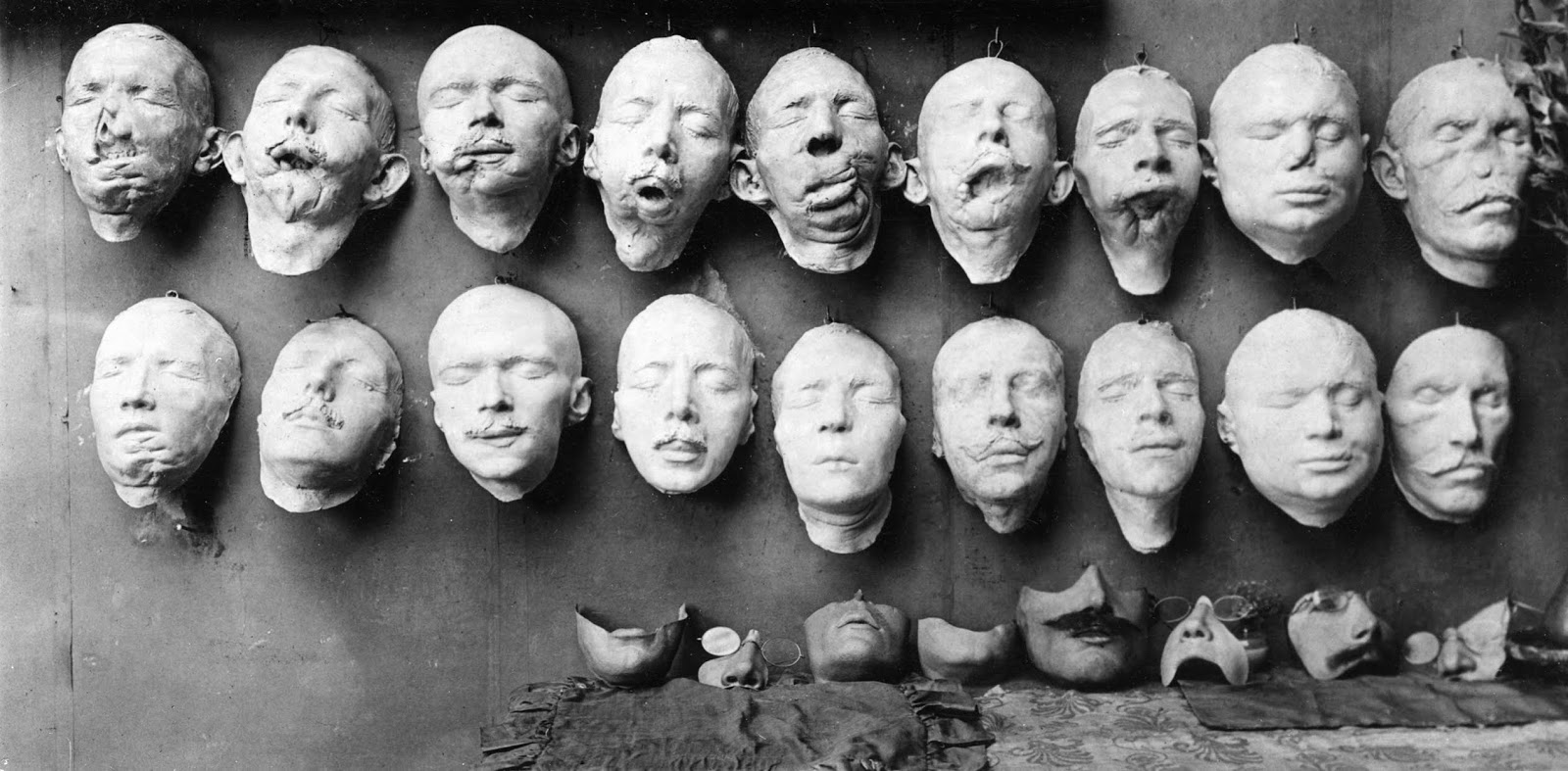
Plaster casts of injured soldiers.


Plaster casts of injured soldiers in the Museé de l'Armee in Paris.


I wrote a post about The Great War four years ago for the centennial of its beginning.