The church of Sant' Andrea al Quirinale is small by Roman standards. Standing on the Via del Quirinale across the street from the Palazzo Quirinale, residence of the President of Italy, it seems to barely qualify as a chapel in a city full of immense churches. Despite its small size, it's among the finest Baroque churches in the city, a late work by Gianlorenzo Bernini who dominated Baroque art and architecture in Rome. Of all the many churches he designed and built, this was his favorite. He built it at the behest of Cardinal Camillo Pamphili with the encouragement of his uncle Pope Innocent X to replace an earlier church associated with the Jesuit Novitiate on the Quirinal hill. It is the third major Jesuit church in Rome after Il Gesu and Sant' Ignazio.
Like the church that preceded it, this church is dedicated to St. Andrew, the brother of St. Peter.
This church uses the round and curved forms of high Baroque design masterfully, as fine as the most singular buildings by Bernini's rival Francesco Borromini. Borromini's dramatic and eccentric buildings began in Gothic number symbolism. Borromini began as a stonemason in a remote part of what is now Switzerland working in the Gothic style still prevalent in many parts of northern Europe.
The curving forms in Bernini's church begin in drama, in presenting a story dramatically. In this case, it's the story of the death and triumph of a religious martyr, St. Andrew.
Unlike so many of Rome's major churches, Sant' Andrea al Quirinale does not sit at the end of an avenue or street, nor does it face a piazza. It sits off to one side of the street.
A Google Maps view of the Via del Quirinale. Sant' Andrea al Quirinale is on the left.
Bernini's early experience in theatrical set design gave him an understanding of how to direct people's attention. The dramatically curved entrance of the church simultaneously sets it back from the street while projecting the main entrance forward. The concave walls flanking the church facade accomplish the same end as the oval colonnades of St. Peter's Square, they direct our attention to the church entrance.
The church entrance projects forward in a dramatic circular porch that inverts the the curve of the apse inside. While the apse recedes from us, the entrance portico projects forward and opens up at the same time. The circle of the portico entablature forms part of the main entablature that runs all around the exterior and interior of the church. The entablature and the curved steps reflect the arch of the window in the entrance, seeming to project forward from the heavy temple-inspired facade. All of this design bids us to come in and see the drama inside.
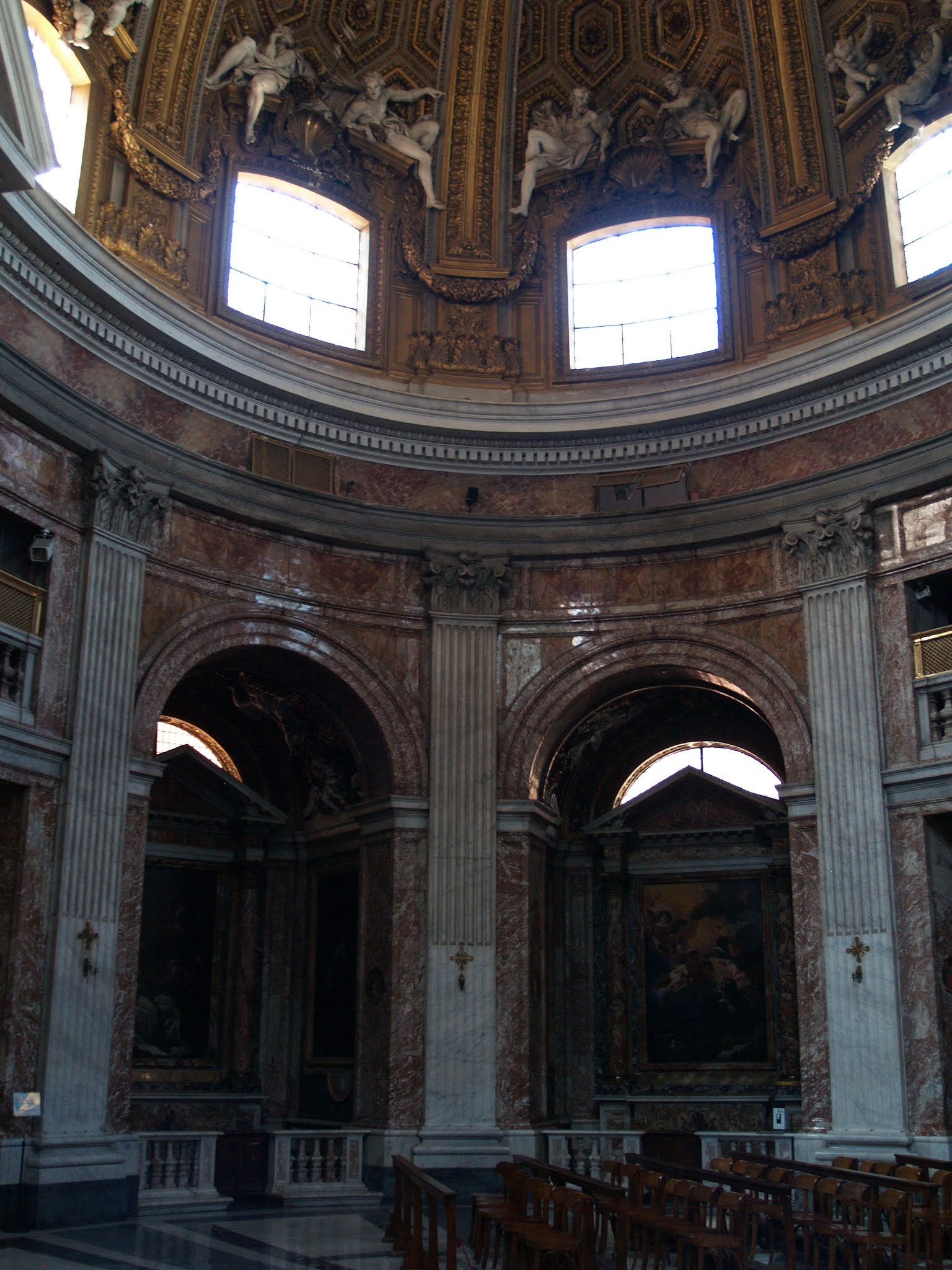
We enter the church and a great oval space opens up before us. The interior is wider than it is long. The distance between altar and entrance is much less than the space between the sides. It's a design loosely based on the Pantheon, and like the Pantheon its forms call to mind the heavens, an "interior sky" as one writer describes these domes. Like the Pantheon, most of the lighting comes from the upper story of the building. The ground level including the side chapels is very dark. Only a thin sliver of arched window behind the altar aedicule lights each chapel interior.
The dome is much lighter, lit not only by an oculus in the top, but a row of clerestory windows of varying size above the entablature around the springing point of the dome. The difference in lighting and the large unbroken entablature around the interior establishes two zones that suggests the contrast between earthly and heavenly realms. Below the entablature is the fatal horror of St. Andrew's crucifixion. Above the entablature is his triumphant arrival in heaven.
Bernini kept the long ends of the oval from distracting our attention by terminating each of them with a large pilaster instead of another chapel.
The focal point of the whole drama is not the altar but the sculpture of St. Andrew ascending into heaven above the entrance to the apse. The architectural setting directs our attention straight to him as the dramatic center of the whole ensemble. The apse pediment curves inward, opening a space for him.
Bernini uses screening columns to set the apse apart from the rest of the church, a device Palladio used in his Venetian churches. Bernini uses the apse as a theatrical stage to set the drama of the saint's death and resurrection and to identify it with the mystery of death and resurrection acted out upon the altar. The columns play a role similar to a parting curtain revealing the drama and mystery at the heart of this church.
A hidden window in a smaller cupola lights up the painted altarpiece of Andrew's crucifixion painted by Borgogne (Guillaume Courtois) a French painter working in Rome employed by Bernini on occasion (his Italian nickname means "The Burgundian"). Another frequent Bernini employee, the sculptor Antonio Raggi carved all the stucco figures in the church including the gilded stucco assembly of angels who seem to hold the painting for our instruction.
Borgognone's painting of the Crucifixion of St. Andrew.
The smaller apse cupola with Antonio Raggi's swarm of descending angels.
One of Raggi's angels descends with the crown of martyrdom.
Saint Andrew rising into heaven.
Bernini takes the great coffered dome of the Pantheon and turns it into a vision of the Christian heaven. As in so many Baroque churches, heaven seems to come down to earth to meet us, sometimes breaking through the ceilings or the walls to do so. The line between art and life is stretched but never broken. Illusionism and spectacle appeal to our emotions, astonishing us and taking our breath away. For true believers in Roman Catholic Doctrine, these spectacles were even more meaningful. They were meant to confirm and encourage people of the rightness of their faith. These spectacles were ultimately for the members, not for outsiders.
There is such a spectacle here in this church, but it is more oblique than the later Baroque ceiling spectaculars painted by Gaulli and Pozzo. The abstract forms of the architecture fully participate in the drama here, and not just as setting. The architecture doesn't break so much as open up to let us see the drama and let the heavens into the church.
The drama of Andrew's triumphant entry into heaven told in imagery and architecture in the dome.
Antonio Raggi carved stucco figures of fishermen with their nets around the base of the dome. They greet a fellow member of their trade into the here-after.
One of the best details from the carved stucco work, putti playing among the garlands on the dome.
The oculus of the dome with the Dove of the Holy Spirit at the apex. More putti descend like bubbles into the interior of the church. Bernini together with Raggi create the impression that all of this is happening in the here and now right in front of us.
The tomb of St. Stanislaus Kostka
On my one and only visit to this church in 1988, I noted a couple of things. First, it is a very desirable location for weddings. They were setting up for a wedding as I visited.
Second, I noted a large number of Polish visitors. It turns out that very important Polish saint is buried here, St. Stanislaus Kostka. Stanislaus was a very young novice in the Jesuit Order. He became a novice on his seventeenth birthday. He died not long after of a fever, supposedly after foretelling his own death.
His piety and faithfulness made him a very popular saint in Poland and among the Polish diaspora.
A painting by Giovanni Odazzi in Sant' Andrea al Quirinale of St. Stanislaus Kostka triumphantly rising into heaven from the early 18th century.
The church of St. Stanislaus Kostka a few blocks from where I live in Brooklyn.
My apartment last spring set up for an online still life painting demonstration. Bonkers makes her cameo.
I'm about to begin my fourth semester teaching painting from home. The college early last semester decided to re-open gradually. My painting classes are among the last to be returned to the campus. At the end of the semester, it seemed as though the Governor of the State of New York was pressuring colleges to open up all at once and I was told to prepare for the possibility of returning to the campus at the last minute. Now, the Governor is on his way out of office and we're going through a whole new covid surge with the Delta variant raging through the unvaccinated population. The Bronx and Staten Island so far are the two worst affected boroughs. I'm told that my classes will definitely be online again. Part of me is very disappointed. I looked forward to seeing students again in the flesh and speaking freely with them. Another part of me is relieved. I don't have to take my life in my hands doing that hour and fifteen minute commute from Brooklyn to the Bronx on the subway.
The online still life demonstration set up from a different angle.
Teaching painting online is about as crazy as it sounds, but I think I've made it work. It's definitely not my first choice for teaching this subject, but the circumstances and constraints unexpectedly created some opportunities and got some surprising results. My students are forced to work on their own. I got some very inventive results with what is normally a fairly dreary exercise of everyone painting from the same still life in class. Now, they have to set up their own still life. I got some very imaginative results.
I personally demonstrate just about every assignment for them. I usually can work pretty fast and finish the painting before the end of class. Sometimes I finish it after class and show the results later. I talk about just about every step in the process of making the painting, especially at the start.
With my advanced class, I can talk about something like landscape composition not only with a slide show, but by demonstrating what I'm talking about by painting a small pastiche usually in monochrome.
I'm trying to avoid the whole Bob Ross thing, I think so far successfully. He taught a formula that appeals to amateurs. I'm trying to teach potential professionals the basics of the trade, especially how to reconstruct three dimensional experience on a flat surface.
My new broadcast camera that turned out to be a lifesaver in terms of clarity of image and mobility.
My set up for a self-portrait demonstration.
A still life of tea things I painted as a demonstration for my students. I sold the painting not long after I finished it.
My bottle still life doing a little exercise in Morandi type composition. I started by dividing my canvas into thirds as he sometimes did.
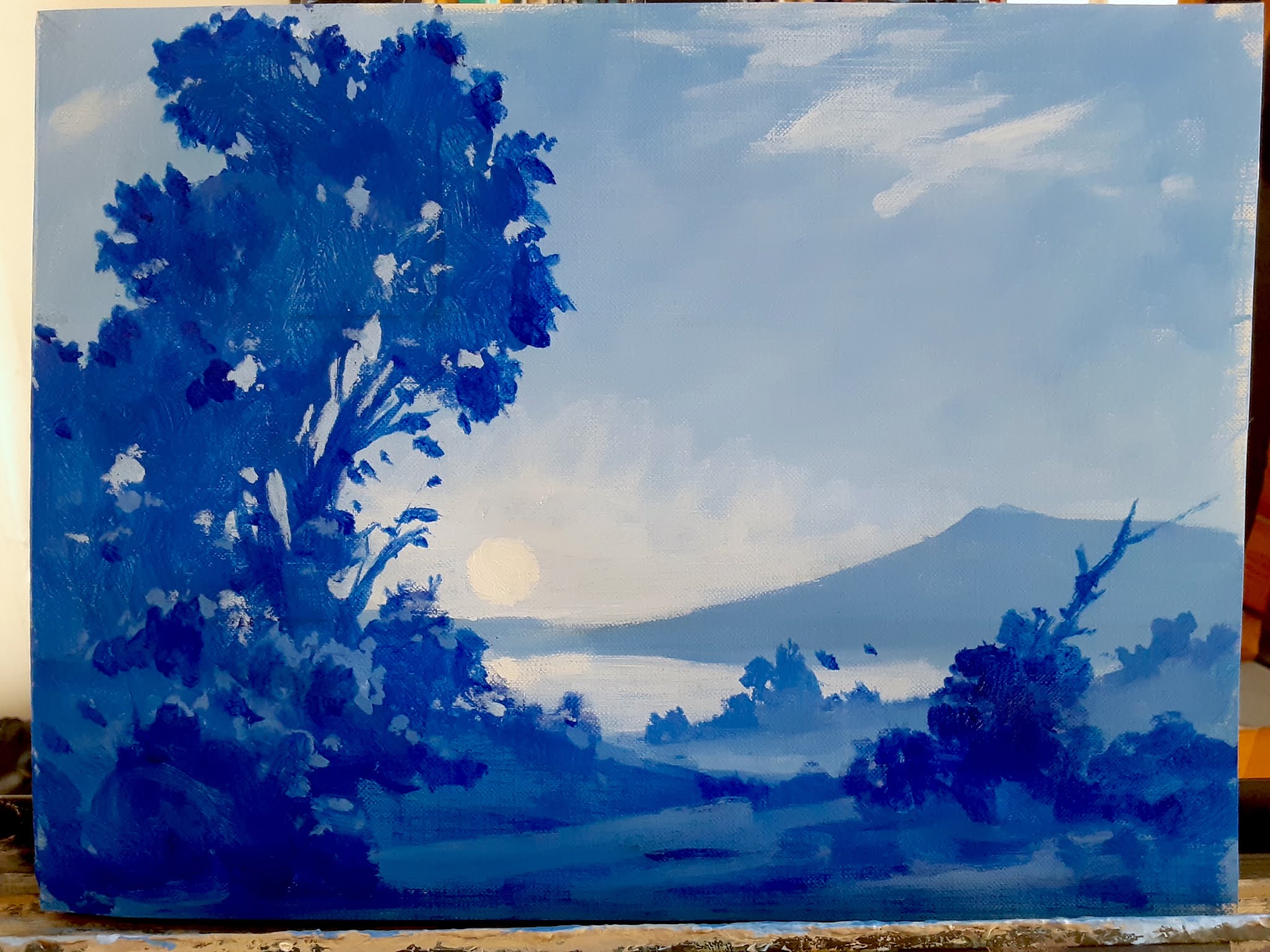
For my advanced class I painted this blue monochrome Claude Lorraine pastiche to demonstrate a landscape compositional formula that he created and endures to the present.
For one of my beginning classes last semester, I painted a volcano for a landscape demonstration.
Michael's nephew Cole is now the proud owner of that volcano painting. He likes volcanoes as do I. If I painting another one this semester, he can have it.
On the top of the Esquiline hill stands the ancient church of Santa Maria Maggiore in Rome.
Giacomo Lauro and Antonio Tempesta, the Seven Churches of Rome, c1655 - 1667
Santa Maria Maggiore is the first great church in Rome or anywhere dedicated to the Virgin Mary. It is one of the seven major churches in the city, and the only one of the group dedicated to her. It is an ancient church used continuously since the present building was first built in the 5th century. Like so many ancient Roman churches in continuous use over many centuries, Santa Maria Maggiore has been modified and added onto many times. Of the surviving ancient church buildings in Rome Santa Maria Maggiore is the biggest and the best preserved. Embedded in centuries of later splendor are some of the earliest surviving images in art of the Virgin Mary, the stories of the Incarnation of Christ, and the only surviving ancient narrative mosaic cycle in a major Roman church.
Pope Celestine I founded the church, and Pope Sixtus III built the present church in the early 5th century to commemorate a landmark doctrinal event, the Council of Ephesus of 431 that resolved lingering arguments over the nature of Christ, the Trinity, and especially the role of the Virgin Mary left over from the previous two church councils at Nicea (325) and Constantinople (381). The Council of Ephesus established the concept of Christ as fully God as well as fully human ("the two hundred percent Christ"), that Christ was not a separate being created by God, but was God made fully human by being begotten through a mortal mother, Mary. Mary the Mother of Christ became Theotokos (Θεοτόκος), the God-Bearer, the Mother of God. Santa Maria Maggiore proclaims those themes in all its parts large and small.
The main facade of Santa Maria Maggiore. It assumed its present form with the construction of a late Baroque facade by architect Ferdinando Fuga in 1746. The 18th century facade did not replace the original 12th century facade. It only updated it and put it behind a marble screen. As is the case throughout much of the church, the original facade survives intact behind the present one. We can glimpse the mosaics on the medieval facade through the upper story, especially at night when they are artificially lit. Most of the original fabric of the ancient church survives, even if it is altered considerably.
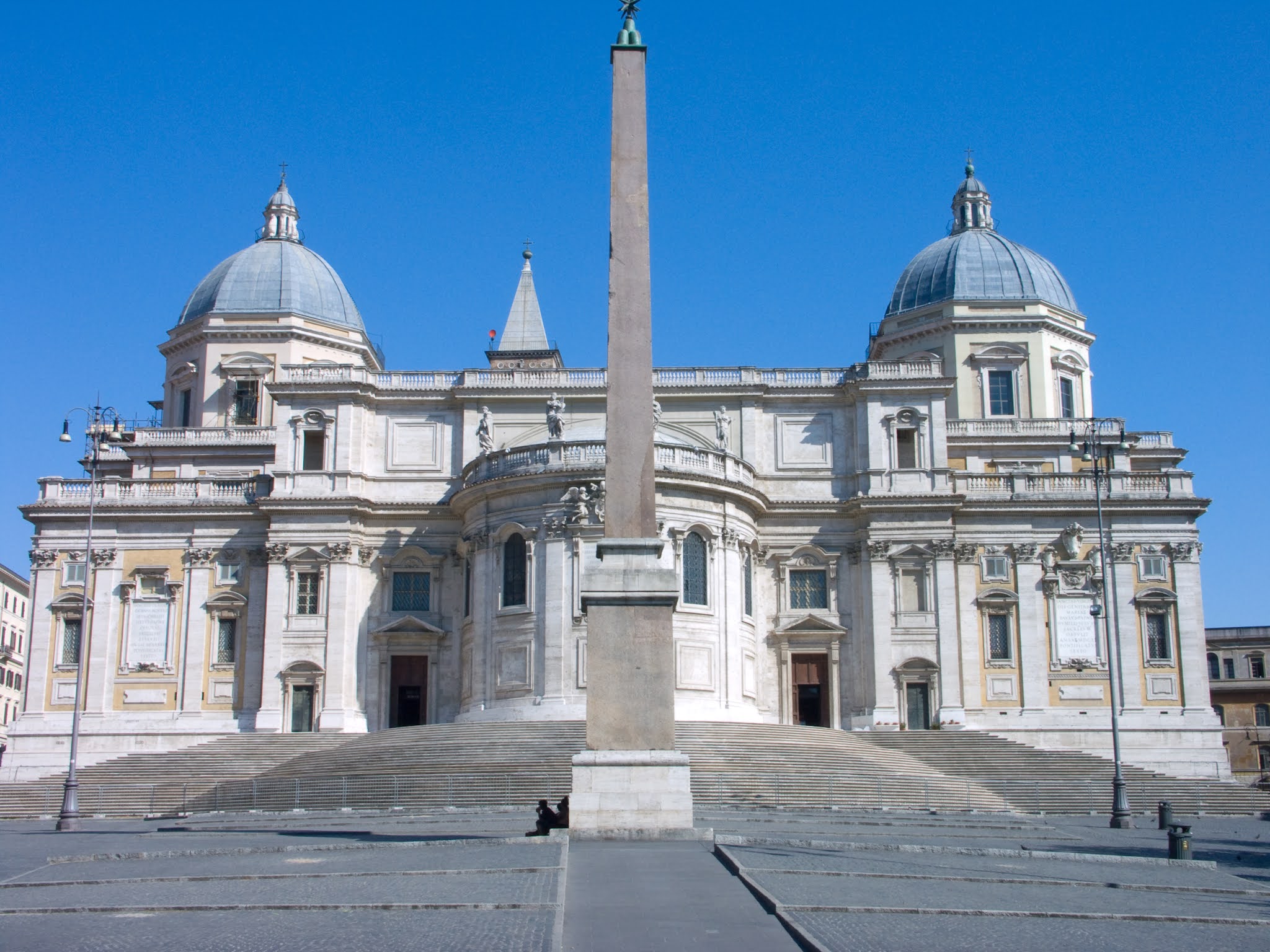
The apse facade of Santa Maria Maggiore mostly designed and built by the architect Carlo Rainaldi facing the Piazza Esquilino. Rainaldi's construction conceals but does not replace the original ancient apse of the church. Counter-Reformation restoration of ancient churches treated them as giant religious relics to be enshrined like all other relics. Over time, the ancient fabric of Santa Maria Maggiore acquired its own sanctity enshrined in later construction. From this end of the church we see the twin domes of the two major early Baroque Counter-Reformation additions to the church, the Sistine Chapel on the left and the Pauline Chapel on the right.
The nave of Santa Maria Maggiore. The columns, the walls and the proportions are all original to the ancient church though much modified over time. The Cosmati-work floor is a medieval addition. The columns are all the originals made from marble from Mt. Pentelikos near Athens, the same quarry that produced the marble from the Parthenon. They are recycled ancient columns though their origin is unknown. Thirty six of the columns are marble and four are granite. To fit them to the taste of the time, Ferdinando Fuga in the 18th century had them all shortened and pared down to make them even. The Ionic capitals on all of them are Fuga's work.
Tourists in the nave near the apse.
A reconstruction from the 1990s of the interior of the Basilica Ulpia in the Forum of Trajan.
There's very little left of the great basilicas of ancient Rome. All of our reconstructions of them like the one above are speculation, but they are speculation informed by Rome's ancient churches.
Basilicas in Rome were secular buildings designed for government functions. Law courts met in basilicas as did legislative assemblies. Sometimes the Emperor would hold audience or the Senate might meet in one. They were large interiors lit by windows in an upper story called the clerestory. Roman tradition determined that basilicas be roofed with truss-timber ceilings, another Roman invention. The truss timber ceiling made the roof into a giant lid that would hold together securely over large interior spaces with no need for interior columns. Tradition determined a definite format and proportions for basilicas that were never forgotten even when the basilican format was transformed from secular to sacred architecture in early churches.
Much of that original ancient Roman basilican format survives in the nave of Santa Maria Maggiore, so much so that at one time scholars thought the nave might be an ancient Roman basilica transformed into a church. Probably no other building in Rome gives us a sense of what the ancient basilicas looked like and felt like in their interiors.
All the major churches of Rome once had mosaic cycles of narratives of stories from the New and Old Testaments, usually together. St. Peter's had a cycle and so did St. Paul Outside the Walls, and the Lateran Cathedral. Only the cycle in Santa Maria Maggiore remains. It is the oldest surviving church mosaic cycle. These are all mosaics from the original 5th century church.
Mosaic cycles in the Byzantine east are about theology and our place in the heavenly hierarchy. Byzantine church mosaics are arranged vertically in descending order from Christ Pantocrator in the dome to minor local saints on the lower walls. The main subject of the art of Latin Christianity is Salvation History. Images are arranged in narrative order to tell a story. The cycle in Santa Maria Maggiore is in that latter category. These cycles are from the Old Testament. Part of the establishment of Mary as the Mother of God was securing a place for the Jewish Scriptures in the Christian faith. Mary in her role as the means of the Incarnation guarantees the continuity between the Jewish and Christian testaments.
Moses Destroys the Armies of Pharaoh in the Red Sea.
These mosaics long predate the emergence of the Byzantine style of mosaics. They are still in the realm of late Roman painting from the Third century onwards. Classical form starts to slowly disintegrate. We still have light and shadow describing form, but compositions become crowded and perspective is almost forgotten as narrative incidents pile up from bottom to top.
Scholars frequently compare these mosaics to manuscript illustrations from about the same time such as those found in the Vatican Virgil from the beginning of the 5th century. Some scholars dispute that comparison, but there's not much other painting left from that period.
The Hospitality of Abraham from the nave wall mosaic cycle. This is one of the earliest religious paintings to show narrative devices that would be common in later medieval art such as conflation, showing multiple episodes of a story in one scene. Abraham appears three times in this mosaic.
The center angel in the upper part displays the earliest surviving oval mandorla in Christian art. The mandorla would also become a commonplace of religious art in the west.
The coffered ceiling we have now is from the Renaissance from the 16th century designed by the Florentine architect Giuliano Sangallo commissioned by Cardinal Rodrigo Borgia (the future Pope Alexander VI). According to legend, it is gilded with the first gold looted from the Americas donated by Ferdinand and Isabella rulers of Spain.
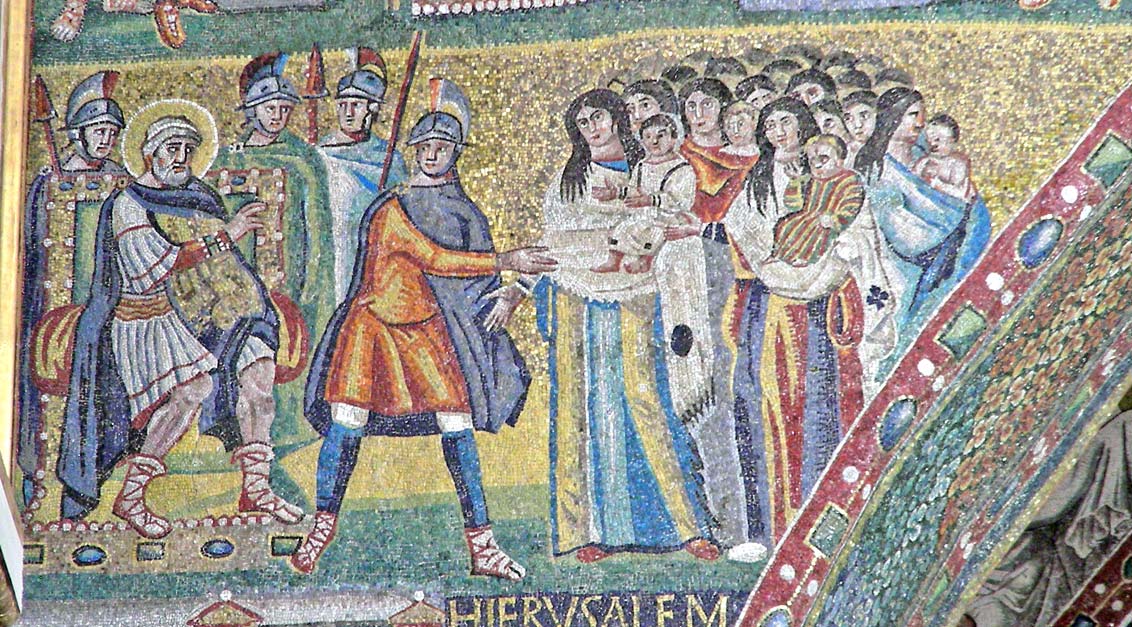
The triumphal arch in front of the apse contains another ancient mosaic cycle of the events of Christ's Nativity. These too are survivors from the original 5th century church.
Mosaic cycles on the triumphal arches of early churches traditionally showed the Adventus Domini, the Coming of the Lord at the end of time in the Second Coming or the Last Judgement. Since the Church of Santa Maria Maggiore is the first major church dedicated to the Virgin Mary, the Adventus here is the First Coming, the events of Christ's Incarnation.
The Annunciation to Mary.
So far as I know, this is the earliest surviving version of what would become a standard subject in Western art for centuries to come. Early Christian art is very triumphalist and this is no exception. The Virgin Mary appears not as a shy young Jewish girl in Nazareth, but as a late Roman empress enthroned and attended by angle chamberlains. Gabriel and the Holy Spirit swoop down from above to give her the news.
The Visit of the Magi.
The infant Christ sits on a throne like a little late Roman Emperor with angel attendants behind the throne. The Magi are oddly dressed not as kings but as magicians or performers. The Virgin Mary is not the blue mantled woman on the right, but the enthroned empress on the left. The star appears above Christ's head.
The earliest depiction of the Massacre of the Innocents.
The dedication inscription and the Etimasia or Prepared Throne from the Ninth Psalm: "He has prepared his throne in judgment; and he shall judge the world in equity, he shall judge the people in justice." The throne is empty but for a cross on a cushion, a reference to the Second Coming. Peter on the left and Paul on the right flank the throne. The inscription says "Sixtus Bishop of the People of God". Behind Peter and Paul are the Evangelists' symbols from the vision of Ezekiel.
The town of Bethlehem on the base of the arch to the right.
The city of Jerusalem on the base of the arch to the left.
Behind the triumphal arch in the apse is a huge magnificent mosaic made 800 years later than the Triumphal Arch mosaics, Jacopo Torriti's Coronation of the Virgin Mary. This late 13th century mosaic was originally the most important and most prominent image in the church. It is now obscured by an 18th century baldachin over the altar.
It is a Byzantine-ish depiction of a very un-Byzantine subject, the coronation of the Virgin Mary at the right hand of God. This subject, always prominent in churches where it appears, is the final destination of all faithful Christians, a coronation at God's right hand. Mary appears as the Queen of Heaven and the First Christian. This immense mosaic is among the most magnificent of all visions of this subject, and the high point of the distinguished Roman school of Italo-Byzantine art in the 13th century.
This great mosaic is hybrid mix of different styles into a single commanding work of art that once dominated the interior of this very large church. It combines Byzantine form in the figures and draperies with ancient classical Roman acanthus scrollwork used as a metaphor for Paradise with a composition that comes out of Gothic France.
The splendid center-piece of the composition shows Mary and Christ enthroned together in a great blue circular nimbus full of stars. They share a throne. She sits to his right equal in size, bending slightly to accept the crown. This is a composition out of French Gothic art with numerous painted and sculpted examples, among them Chartres and Rheims.
St. Francis, Peter, and Paul with Pope Nicholas IV who commissioned the work. At their feet is a remnant of the original 5th century mosaic showing the Tiber river.
From right to left, St. Anthony of Padua, St. John the Evangelist, St. John the Baptist, and Cardinal Giacomo Colonna.
The magnificent angels crowding around the throne.
Detail of the acanthus decoration with a pair of ducks.
A peacock and a crane among the acanthus scrolls.
More of the surviving 5th century mosaic showing the Tiber river with traffic and wildlife.
Jacopo Torriti's signature.
The Dormition of the Virgin, an unusual subject in western Christianity.
The Nativity
The Visit of the Magi
How different this is from the same subject just yards away on the triumphal arch from 8 centuries earlier.
Ferdinand Fuga carefully spared another major of work of the Roman school of Italo-Byzantine art, Filippo Rusuti's 13th century mosaics on the facade of the church when he designed his 18th century facade screen.
Two very early Baroque chapels replaced the transept wings in Santa Maria Maggiore. This one is the Pauline Chapel built as a burial monument for Pope Paul V and his Borghese family. It was built 1606 - 1612 at the very beginning of the Baroque era. Unlike later Baroque monuments usually built under the direction of a single artist (usually Gianlorenzo Bernini in Rome), several artists worked simultaneously on this chapel and its monuments. The basic architecture of the chapel is by the Borghese's favorite architect Flaminio Ponzio. Tomb monuments to Pope Paul V and his predecessor and benefactor Clement VIII flank the chapel sides.
The design of the chapel focuses on a revered icon in the city of Rome, the Salus Populi, a large icon of the Virgin and Child long revered as the protector of the city.
Guido Reni painted the fresco in the dome of the Immaculate Conception. Cavaliere d'Arpino and others painted the rest of the fresco decoration in the chapel.
The tomb monument of Paul V Borghese in the Pauline Chapel made by several artists, among them Gianlorenzo Bernini's father Pietro Bernini.
A detail of the elaboration and even fussiness of early Baroque art in Rome, a tomb monument modeled on Roman triumphal arches, but even more elaborate with some of the complexity and novelty of Mannerism remaining in its design.
The altar of the chapel with the enshrined Salus Populi.
The Salus Populi, largest of Rome's many revered and miracle-working icons, it's about 5 feet high. Pious legend says that St. Luke painted this with the help of angel assistants on the top of a table belonging to the Holy Family from their home in Nazareth. The exact age of this icon remains a matter of speculation. Like so many revered images, it was loved and worshipped to death. It was restored and repainted many times not to preserve the original, but to keep the image fresh and vivid looking for its worshippers. What we see now is mostly a creation of the 13th century, but there are layers of earlier painting underneath that could go as far back as the 9th century.
Pope Francis especially reveres this icon and visits it frequently, especially after traveling.
The older of the twin chapels across the nave from the Pauline chapel is the Sistine Chapel named for the enterprising Pope Sixtus V who hired Domenico Fontana to design the chapel to house the Reserved Sacrament and to place the Christmas Creche every year. It was Pope Sixtus V who rebuilt the city of Rome after the Sack of 1527, repaired and expanded its infrastructure and planned the expansion of the city along broad major avenues that cut straight through the city, the model for L'Enfant's designs for Washington DC and Haussmann's Paris.
A gilded bronze tabernacle held up by four angels designed by Sebastiano Torregiani dominates the chapel in the center. Underneath is a subterranean chapel originally built by the Florentine sculptor and architect Arnolfo di Cambio in the 13th century to house a relic of the manger.
Along a wall of the chapel is the tomb monument of Pope Sixtus V made by a host of sculptors from the last decades of the 16th century.
The theme of the decoration of the chapel is the ancestors of Christ. The dome is mostly a late Mannerist work by Giovanni Nebbia who shows rows of those divine ancestors looking down from heaven into the chapel. The dome paintings are from the 1580s.
The Hypogeum is a crypt chapel under the high altar of the church containing an elaborate crystal and silver shrine holding a relic reputed to be remains of the Manger or the Holy Cradle. The chapel and the reliquary are all from the 19th century, a project of Pope Pius IX. Giuseppe Valadier designed the reliquary.
Giuseppe Valadier's reliquary containing some pieces of sycamore wood said to be Christ's manger or crib.
Michelangelo designed but did not build the large Sforza chapel in Santa Maria Maggiore as a burial place for members of the Sforza family. While the detailing is definitely not his, the sweeping curves of the chapel design are Michelangelo's work and preview the work he would do on St. Peter's as well as influence many Baroque architects such as Bernini and Boromini.
Among Rome's great ancient churches Santa Maria Maggiore is a survivor. Most of the rest were completely replaced over the centuries. There is hardly a scrap left of the St. Peter's Basilica built by the Emperor Constantine, nor is there a scrap left of Constantine's original Lateran Cathedral. St. Paul's Outside the Walls is mostly a 19th century replica replacing an ancient church destroyed in a catastrophic fire and by an even more catastrophic salvaging effort. All that's left of the original church in the high altar with Arnolfo di Cambio's ciborium and the apse with its heavily restored mosaics.
Santa Maria Maggiore stands alone among Rome's great churches as being largely intact though encrusted with centuries of additions and modifications inevitable for any ancient church in continuous use for 1,587 years as of this writing. It is the only large ancient church left in Rome with any of its original mosaic work left. It is probably the only place in the city where we can get some sense of the original splendor of the great ancient churches built by the first generations of Emperors and Popes after Constantine. It's also the only place in the city where we can get a sense of the size and scope of the secular basilicas of the ancient pre-Christian city. It is one of the few places in the world where we can experience a long history through its many transformations in one building.


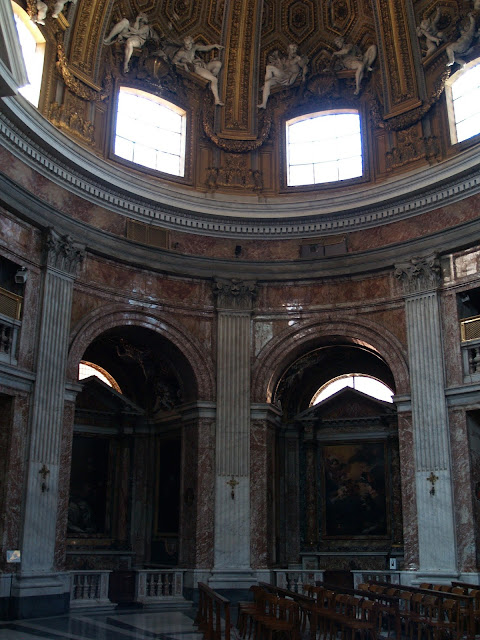




 A painting by Giovanni Odazzi in Sant' Andrea al Quirinale of St. Stanislaus Kostka triumphantly rising into heaven from the early 18th century.