Monday, September 1, 2008

"My God, What an Eye!"

Claude Monet, Poplar Trees, Evening, 1891

My students love Monet. There have been times when I've had to limit the number of papers on him. Monet's paintings in the Metropolitan Museum are the high point of many a field trip.
And who can really argue with them? These are lovely paintings full of color and soaked in light. This painting in particular is one of my favorites in the Met. Monet beautifully and convincingly recreates a very fleeting moment of sunlight. The setting sun brilliantly illuminates the trees in the background, while the trees lining a canal in foreground remain in shadow creating a kind of screen between us and the bright distance.

My students look at all this loveliness, and insist in paper after paper that these paintings are about some kind of spirituality. I'm afraid not. There's nothing the least bit spiritual anywhere in Impressionism or in this picture (unless you want to really stretch the whole spirit-as-metaphor business).
Monet's paintings are about seeing, and in a very literal and direct sense. He studied the new science of optics, everything from Newton's spectrum and color wheel to the theories of Fresnel. He was  acquainted with the new physics of light and color pioneered by Fresnel that described visual light as a series of wave lengths. Red was one wave length and green was another.  Monet discarded the traditional classical palette layout that arranged colors by tone (from white to black on the gray scale), and divided them between warm and cool.  Monet created a new palette based on the spectrum.  He banished black entirely from his palette.  The scientists described black not as a color itself, but as the absence of light and color.  Claude Monet was one of the first artists to take advantage of the wide range of brilliant colors made newly available by industrial manufacturing.  Bright colors were once very expensive, rare, difficult to make, and chemically unstable.  Ultramarine blue was once the most expensive of all pigments, made from imported and ground up lapis lazuli and very difficult to make.  Now the exact same color, identical in chemical content and even superior  in quality, could be made cheaply from coal tar.  New brilliant pigments made from cadmium, chromium, and titanium became available and were relatively inexpensive. 

This painting is about how a whole moment of evening light is made up by the colors of the spectrum.   Just as in the Boulevard des Capucines, everything in the painting is given the exact same attention and the same stroke of the brush.  Now, each stroke contains a separate color from the spectrum creating the warm lights and cool shadows of the early evening light.  The screen of poplars and their reflection in the water in the foreground create a beautifully simple framework on which to arrange these nuances of light and color.
Picasso once said of Monet, "He was only an eye, but my God, what an eye!"

"Black Tongue Lickings"

Claude Monet, Boulevard des Capucines, 1873

It is hard for us to imagine a painting like this causing such a fuss. To us, it is an appealing, and entirely innocuous, example of Impressionism, perhaps the most popular art movement ever. But the critics, and the public of the day, found this picture to be deeply shocking and even offensive.

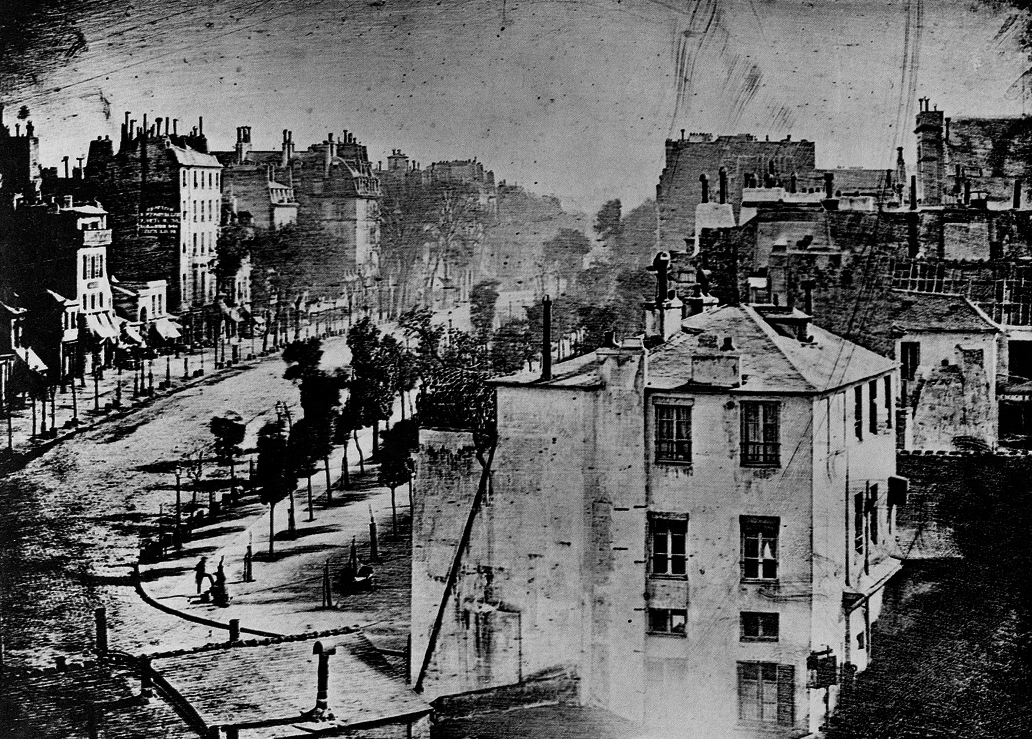
This painting appeared in the first Impressionist Exhibition in April of 1874 held in the studio of the famous photographer Nadar. The subject of this painting is the view out the window of the very studio where this painting was first shown. We can clearly see the influence of photography here. It looks very much like a now famous early photograph made almost 40 years earlier by Louis Daguerre. The camera sees and takes in everything without distinction. Monet gives exactly the same attention, the same broad brush stroke, whether it's trees, buildings, balloons, the sky, carriages, buildings, or people. That is what the critics found so offensive and so shocked the public. Human beings, the human figure, the very center of the Classical aesthetic and the center of the humanist philosophies that sustained it, were now reduced to a few indefinite strokes of paint, "black tongue lickings" in the words of one hostile critic. The people in the street are reduced to the role of color notes equal to every other color note in the painting.
There is no central focus in this painting at all, nothing specific that Monet fixes his gaze upon. The center of this painting is an indefinite mass of umber paint that is supposed to be tree branches. The painting is not about any one thing. It is about the whole over all effect in light and color, an "impression" of the whole scene.

The Impressionists began as a very loose group of about 30 artists, most of whom are forgotten, who wanted to bypass the whole state Salon system (a series of annual exhibitions organized by the government to showcase the nation's talent), and exhibit independently. about the only things they had in common were their attention to the reality of modern urban Paris rather than to myth or history, and a broad sketchiness of execution. If the public was behind, then it was only by one step. They soon overcame their hostility, and by the end of the century the influence of the Impressionists was global inspiring imitators in Germany, America, Russia, Spain, and even in Mexico and Japan.
Claude Monet was not born into money like Edouard Manet. Monet was the son of a grocer. The public hostility cost him very dearly. In his younger years, he was so poor that fellow artist Pierre Renoir stole bread to rescue him and his wife from starvation. He even attempted suicide. By the beginning of the 20th century, he was one of the most famous and successful artists in the world. He was inducted into The Legion of Honor, and the famous and powerful (especially Clemenceau) called upon him at his estate in Giverny down the Seine from Paris.

Sunday, August 31, 2008

Counterlight's Peculiars Endorses...


Let's face it. I'm a middle aged gay artist in New York. An endorsement from me might as well be the kiss of death from a Martian.

Yes, I got issues with him; his retreat on FISA is the biggest one. I'm not happy about him waffling on offshore drilling. I certainly part company with him over the death penalty.

But...

I've voted in every presidential election since 1976 (I voted for Ford; yes, I'm a recovering Republican). I've never been more impressed with a candidate than Obama. It's not just the soaring rhetoric (which after 8 years of mangled English with a bad Texas accent is refreshing; I especially like being addressed as an adult instead of as a dimwit child by Daddy). It's not even the policy positions, though those are very important (National Health Insurance, Ending the War in Iraq, Restoring Equality and The Rule of Law, etc.). I've never seen a more imaginative, bolder, and better campaign than this one. Remember folks, he started out as a come-from-behind long shot with a lot of disadvantages (being black not the least among them). He prevailed over one of the most formidable political machines in modern times (the Clintons). That acceptance speech in the stadium in Denver was a huge political gamble, and it came off as a masterpiece of political theater. Obama's background in community organizing has proved to be a huge asset in motivating and mobilizing hundreds of little independent startup campaigns on his behalf. The splendid poster above is the creation of one of them; it's not an official poster of the Obama campaign, though Obama personally wrote to the artists to endorse it and to thank them.
How a candidate runs his campaign says a lot about his ability to run his presidency and about where his heart and mind really are. I've never seen this kind of spontaneous bottom-up enthusiasm for a presidential candidate.  His campaign doesn't just preach about enfranchising and including the Vox Populi in all its complex variety, they do it, and have made it central to their strategy to win.  I wonder how they will make it work in a strategy of governing.

Sure, he's not the perfect Progressive. But Eleanor Roosevelt and Eugene V. Debs aren't getting up out of their graves to run this year. I'm tired of throwing away my vote in a principled protest only to discover after Election Day that no one gives a rat's ass. I'm ready to turn the page on the Bush/Cheney years, and at least get started with cleaning up the mess. Barack Obama is better than anything I could have hoped for these days.

The artists group responsible for the poster can be found here.

For All My Progressive Friends, VOTE! Yes, it really does matter!


I'm just praying that the American Left won't stick to historical precedent and snatch defeat out of the jaws of victory once again.
On the one hand, being permanently marginalized means that you never have to be responsible for making policy; you can never fail because you can never try. On the other hand, being permanently marginalized means you can't make policy; your dreams will never be anything but dreams. I'm afraid nasty old Machiavelli was right. Politics is about the possible, not about ideology. It's about getting real things done for real people. Sadly, Democracy is a very dull homely date. It's not about saddling up your white horse and riding to the rescue. It's about committees hammering out compromises between competing interests, each with legitimate claims. No one is ever completely happy, but everyone can live with the results.

I'm not expecting a Progressive Messiah, nor do I want one. I voted for Ralph Nader in 2000 and I've regretted it ever since. If boring old establishment Al Gore had managed to keep his election victory in 2000, the Iraq Invasion would never have happened and thousands of people who are now dead might still be alive. Who knows? He might even have noticed that August 2001 memo that said "Osama Bin Laden is right behind you!" and 9/11 might have been nipped in the bud.
Sure, I think the Democrats take Progressives (and lots of other people) for granted. Yes, I think both parties are bought and paid for, but they are clearly NOT the same thing.

VOTING MATTERS.

Lives are at stake. No, I'm not going to be perfectly satisfied by an Obama victory or a Democratic sweep, but this isn't about me. This is about The United States and the people who live in it and make it work.

Saturday, August 30, 2008

For Grandmere

Grandmere Mimi Has Evacuated

She posted her announcement here.

Goodnight Grandmere where ever you are.  Take care of yourself and Grandpere and come back to us safely!

Thoughts, prayers, and best wishes for everyone affected by Gustav from this lunatic art perfesser.

A Night On The Town With Edouard Manet

Edouard Manet, Bar at the Folies Bergere, 1881-1882

Manet takes us out to one of the swankiest spots in late 19th century Paris, the Folies Bergere, a huge establishment, a combination of dinner theater and circus, and what does he do, he spends all his time at the bar painting the barmaid. It is remarkable that Manet, who was born into money and never had to worry about meeting bills a day in his life, had such genuine feeling for the lives of these working girls. One of them is central focus of his last and greatest painting.
She is the only person who we see directly. All that exciting nightlife in the painting is in fact a reflection in a mirror behind her. We only get a tiny glimpse of the floor show, if you look up in the upper left corner, you can see the legs of a trapeze artist hanging down from the top edge. We are alone with her in her isolation from all the glamorous night life going on around her, and that is summarized in that splendid sparkling still life of bottles of champagne and liqueurs, oranges, and roses for sale. In some ways, she is as much on display and available as those bottles. We see ourselves reflected in the mirror already negotiating a sale with her; perhaps a drink, more likely the price of an assignation.
Like a sacred relic or a monstrance on an altar or a saint in an icon, she occupies the dead center of the picture. But she certainly is not there to be worshiped or adored. She is there to be available and accommodating. The most striking part of the painting is her face. It is expressionless as she looks just past us. We are not privy to her thoughts. That is the one thing here that is not available to us. Even if she offers herself to us for sale, she remains ultimately impenetrable and self-posessed. That is the most dramatic aspect of this picture. What for us is a great time, perhaps even the thrill of a lifetime, is for her a job and only a job.