Thank You


 This is the portrait bust of the Emperor Phillip the Arab, one of a succession of about 25 "Soldier Emperors" who came and went very quickly and very violently during the 3rd Century Crisis. Phillip was indeed from what was then called Arabia. He was the head of the Praetorian Guard under his predecessor, Emperor Gordian III. He murdered the emperor and claimed the throne for himself. He, in turn, was murdered 5 years later by his successor. The artists of the 3rd century showed these brutal ruthless men who took over the political life of the Empire with astonishing candor. Phillip wears a scowl of intimidation, with more than a little hint of the frightened animal underneath. Gone is the civilized clemency, curly classical hair, and philosopher's beard of a philhellene emperor like Marcus Aurelius. Phillip is a man who spent his entire life in the army as can be seen in his short military style hair and short stubble beard. The carving is still Classical naturalism at its best, though the carving is beginning to get a little rough. There is none of the old Antonine dynasty polish, and the hair is more suggested with chisel strokes than actually rendered and fully carved.
 Here is Phillip's murderer, the Emperor Trajanus Decius who likewise would be murdered in short order by his successor. The naturalism and remarkable psychological realism are still there, but the carving is getting even rougher with sharper and less natural planes between the lines around the mouth and around the eyes and brows. Again the hair is more suggested than carved. There is already a resort to pattern in the carving of the lines in the forehead.
 Thoughtful and conscientious people of the time abandoned politics and public responsibility to the soldiers who had made such a bloody mess of it. They felt overwhelmed and helpless in the face of the disasters coming down on them from all sides. Philosophers turned to mysticism. Mystery religions and various forms of Gnosticism flourished in this time. It is no accident that the affluent Romans responsible for the first Christian art in the catacombs begin converting in large numbers. Citizens turned their backs on the world to look for that transcendent escape hatch out of the madness. The head above is sometimes identified as the philosopher Plotinus, the last great NeoPlatonist of the Ancient World. Whoever he is, he has an ascetic's hollow cheeks. The eyes become larger and play an ever more expressive role in 3rd century sculpture. They look out in this portrait in what to my mind is a 3rd century version of what was called the "thousand yard stare" in World War II, the faraway stare of the traumatized. It is an image of a man looking beyond the here and now for that escape hatch into something better than this.
 The Crisis came to an end with the reign of the Emperor Diocletian who radically remade the Empire into something that the generations before the Crisis would have hardly recognized as Roman. He remade it according to older Eastern models with a divine ruler at the top. The first Emperor, Augustus went to great pains to assure Roman public opinion that this new alien Asiatic title of "emperor" was not an innovation, but a restoration of traditional Roman values. Augustus went to great pains to have himself portrayed as a primus inter pares, a first among equals, a responsible Roman citizen assuming the burdens of power. The statue above of Diocletian and his 3 co-rulers (the Tetrarchs), now part of a corner of Saint Mark's in Venice, is hardly recognizable as a Roman statue. The old Classical form centered on the independent living human figure is completely gone. We have full-fledged symbolic form here, long before the Empire has become Christian.
 These heads certainly are not portraits. It is hard, if not impossible to identify exactly who is who among the Tetrarchs here. They are no longer independent individuals. They have no life and no meaning apart from the roles they play. Likewise, their forms are reduced to emblematic patterns. None of these 4 figures could conceivably stand alone from the group. They already look like Romanesque carvings almost 800 years too early. In their original state, they may have looked even more Eastern and exotic. The crowns and weapons were probably gilded and bejeweled. The eyes and the hair may have been painted.
 The Emperor Constantine decided to celebrate his victory over his rival Maxentius, and the return to rule by a single emperor by building the last great triumphal arch in Rome near the Colosseum.
 He decorated it by taking crowbars to the monuments of his much earlier predecessors from before the 3rd Century Crisis, stealing the sculpture off of them and putting it up on his own monument. This arch is decorated with sculpture pried off of monuments to Trajan, Hadrian, and Marcus Aurelius. He had the heads of some of the emperors recarved into his own likeness. Above are 2 round reliefs from a monument to the Emperor Hadrian. In the round panel on the left showing Hadrian hunting a boar, Constantine had Hadrian recarved to look like himself. Now Constantine rides in the hunt with Antinous, Hadrian's deified boyfriend, looking off to the left behind.
 In the late 19th and early 20th centuries, archaeologists began finding the cemeteries of Roman Egyptians, at first in the Faiyum and later throughout Egypt. They found scores of mummies with the heads covered not by the traditional mummy mask, but by painted portraits of widely varying quality. Many were of remarkable quality like the one illustrated above still attached to some of the mummy cartonage of a woman named Artemidora. Some of these paintings are amazing and raise the question of what came first. Was the sitter alive when the portrait was painted, or already dead?
 These beautiful and haunting portraits were painted in encaustic, pigment mixed with melted beeswax, creating effects very similar to later oil painting. Most, but not all, of the sitters in these portraits are young. The remains of the deceased found with some of these portraits turned out to be close in age to the sitters in the paintings. Mortality among the young was high, even among these privileged folk. These paintings give us a very tantalizing glimpse into the lost world of ancient Classical painting. What we have left of that long tradition is almost nothing. What if all that was left of the last 500 years of Western painting was a few scraps of wallpaper? That's what we have of ancient Classical painting along with the literary accounts of Pliny and Pausanias, and these portraits from Egypt.
 Almost all of these portraits appear to have been cut down to fit the mummy bindings, suggesting that at least some of them were painted while the sitter was still alive. Gold crowns like the one worn by the young man above, and by Artemidora further up, appear to have been added later, perhaps for the funeral. Some of these portraits, like the one above, had a lot of gilding added to them at a later date, again possibly for the funeral. Crowns and gilding had some kind of religious function, and the act of applying them may have been part of the funeral rites. These were images not only intended for the grieving of the bereaved, but for the rituals of aiding the dead in their transition to the next life. These were not intended to be memorials kept in the home. Remember, these portraits were seen once at the funeral, and then buried with the dead never to be seen again.
 It is possible that these mummy portraits were the direct ancestors of the Orthodox icon. Above is a magnificent 7th century icon of St. Peter preserved in St. Catherine's Monastery on Mt. Sinai. It too is painted in encaustic in technique and form that is very similar to those Roman Egyptian portraits. It too is a picture with a ritual function, not to be buried, but adored. As in the Egyptian portraits, the form of the painting is determined by its ritual uses.
As average folks without a lot of institutional juice, we citizens don't have a whole lot of options. So we do what we can. But there is one thing we should all probably recognize and deal with: the president, the congress and the media of both parties are all in agreement about one thing: they do not like the rabble at both ends of the spectrum making demands. Remember, it's their town.
And I include the president in that for a reason. It's not a matter of him "miscalculating" or failing to understand the nature of the opposition. He, like all establishment politicians, has an interest in maintaining the status quo, and I would imagine that the fear among all establishment politicians is that this phenomenon might actually bring about real change (as opposed to the fluffy, Madison Avenue version they like to sell.) After all, the president has large majorities and a huge amount of power. It's hard to believe that if he wanted to get real health care reform passed that he couldn't do it. It's not 1994 and the Republicans aren't in ascendance and dominating the discourse. It's not outrageous to make the obvious assumption that he's not doing it for the simple reason that he doesn't want to. And it's not ridiculous to think that one of the reasons for that is that it would empower the base of the Democratic Party and inflame the base of the GOP. At this moment that particular problem appears to be the biggest threat to the permanent political establishment of both parties there is.

 The building is a round martyrium church originally containing Costanza's tomb in the center. It was built for a once common ritual in the Mediterranean world, circumambulation, walking around a holy site. Once, every religion did this. Now, only the Muslims do this as far as I know.
 This is the ambulatory of Santa Costanza built for those circumambulating crowds come to pray at the imperial daughter's tomb. The ceiling mosaics above are original to Constantine's time, and they present a little problem.
 The mosaic decoration is very charming and beautiful in places, but it is not very obviously Christian. It looks like the floor decoration of an expensive Roman house moved to the ceiling. Christian imagery is still unformed at this time. The artists who made these mosaics probably were not Christian. And there is still a very syncretic aspect to these pictures. The grape harvest once associated with Bacchus is now in a Christian context and can be associated with any number of vineyard and wine metaphors in Christian Scripture. It is not likely that the artists were aware of those associations.
 These are the ruins of what was once the largest and finest of all Roman basilicas, the Basilica Ulpia built by the Emperor Trajan for his forum and designed by the great Syrian architect Apollodorus of Damascus. As you can see, there is very little left of it.
 Here is the latest in a series of conjectural reconstructions of this once great building based on what remains and on literary descriptions. The Basilica Ulpia, like most Roman basilicas, was a long hall topped with a flat wooden roof. It was a large interior for large public gatherings. In the days before electric lighting, people had to be able to see. That problem was solved by a row of openings or windows just under the ceiling called the clerestory. These lit the interior with the light of the sun so that His Divine Majesty could read his speech and the lawyers, clerks, and magistrates could read their briefs.
 None of the basilican churches from Constantine's time survive, but there are a number of later ones from about the time of the reigns of the Emperors Theodosius and Honorius that do survive in Rome. One of them is pictured above, Santa Sabina. It's a relatively small church built by Bishop Peter the Illyrian for pilgrims and residents in Rome from the Balkans. It has all the features of the old Roman basilica with the new focus upon the altar in the apse.
 The columns in the nave of Santa Sabina are, once again, recycled from earlier buildings. After Christianity was made the state religion in the reign of Theodosius, and church attendance became mandatory, the old temples were closed and began their long careers as quarries of readily available building material. You can see here the clerestory and wooden roof that are holdovers from the pre-Christian secular building type.
 It is a huge church that gives us some idea of the lost splendor of the original St. Peter's and the Lateran Church. The altar is built over a shrine that holds a relic that was claimed to be the manger of Christ's birth.
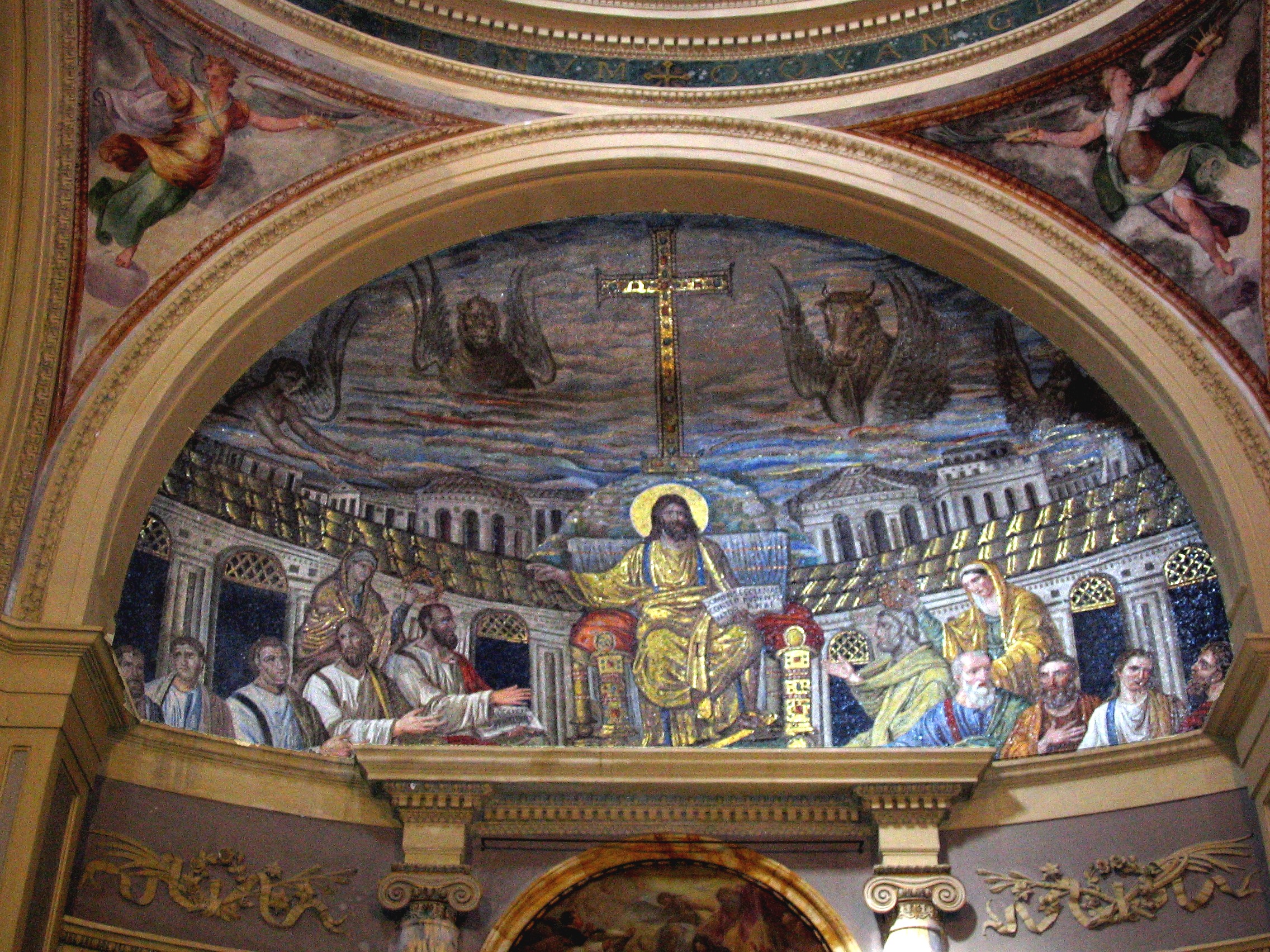
 At this time, there were no set rules on the mosaic decoration of these churches. Like the old synagogue at Dura Europos, the purpose of these images was to teach, to aid in the instruction of the faithful through Scriptural readings and sermons. The arch over the apse faced into the congregation, and became referred to as a "triumphal arch" recalling the victory monuments of pre-Christian Rome. Usually the subject matter on these, and around main portals into the church, was apocalyptic, the triumphant Second Coming in glory. In the Latin church, apocalyptic subject matter became associated with doors and arches perhaps influenced by this passage from Revelations, "After this I looked, and there before my eyes was a door opened in heaven; and the voice I had first heard speaking to me like a trumpet said,'Come up here and I will show you what must happen hereafter.'"
 The Virgin Mary in these mosaics is definitely not the working class teenage mother of the Gospel accounts, but appears garbed and crowned like an empress with angels serving as retainers and servants. The top register in this picture shows the visit of the Magi. Christ sits enthroned like a little emperor on a huge jeweled throne. The Virgin Mary is not the woman in the dark shawl to Christ's left, but the crowned empress on her own throne to Christ's right. Poor Joseph must stand behind one of the visiting Magi to the far left. The angels stand behind Christ like officials at a public audience for the reception of foreign princes. This is a none-too-subtle attempt to conflate Divine and secular authority, to incorporate Church teaching into state ideology.
 This mosaic panel from Santa Maria Maggiore shows Abraham entertaining the Three Strangers who turn out to be angels. This is the earliest of all surviving depictions of this subject. It is a vivid piece of storytelling in bright colors with lots of figures. Abraham and the Three appear twice in the same scene. We see Sarah laying out refreshments and caught laughing at the idea that she could still bear children at her great age. This is also one of the earliest uses in art of the Christian practice of treating Old Testament stories as prophetic prototypes for the New Covenant. The Three Angels were meant to be seen as a prophetic manifestation of the Trinity. The artist makes this clear in the upper group where the three are joined together in the first mandorla to appear in Christian art.
 Here is the 6th century apse mosaic of Saints Cosmas and Damian in Rome. Christ is shown in a dual role as Great Teacher and coming down from the sky in the Second Coming. On the left is St. Paul with the martyred Saint Cosmas. On the far left is Pope Felix IV. On the right is St. Peter with Saint Damian and another martyr saint, Theodorus Tiro. The row of sheep on the frieze below refer to the "flock" of believers in the care of the Church and the saints. The almost symetrical composition, the bright flat colors, look forward to Byzantine art to come soon after this mosaic is completed.
 The basilican church invented during the reign of the Emperor Constantine is still the basic format used by a lot of churches down to the present day. Above is a Roman Catholic Mass in a new church still using a basilican format with apse and nave. As can be seen here, it is designed around and for the processional liturgies of the Western Latin tradition.