Tuesday, September 29, 2015

The Lunar Eclipse

From the beautiful Brooklyn-Queens Expressway in romantic Williamsburg, Brooklyn, I joined my neighbors to watch the lunar eclipse on Sunday night.  Alas, my trusty little digital camera is not built for astronomy.  Here are some of my pictures anyway.


This was the first lunar eclipse that I had watched since I was a child.  There were a lot of people out watching it, and a lot of people ignoring it.  I thought it was pretty wonderful.


Thursday, September 24, 2015

Dear Pope Francis ...

Welcome to the States.  Too bad your stay will be so short and that you can't do a little more sightseeing.  New York is worth it, but so is the rest of the country.  May I recommend the deserts and mountains of the Southwest.

I am not Catholic, never was, and never will be.  We part company on a host of important issues, not just the headline hot button issues like women and gays, but on really fundamental concepts of what it means to be Christian and to be the Church.  On matters of salvation, doctrine, and individual conscience, I am much closer to Luther than to any Roman Church Council since the 16th century.  I have little patience with things like hierarchy, magisterium, and natural law theology.  I can be as anti-doctrinal and even as antinomian as William Blake in many of my views.  I could never join any church (especially yours) that claims to be the One True Church, because I don't believe any such thing exists or ever existed.  Nonetheless, I pay close attention to what you are doing and saying these days.

I don't think what you are doing or saying is the radical  departure that the media describes and some people imagine.  Your pronouncements on the poor and on the environment are consistent with Roman Church teaching for decades.  While your aside on the plane about not presuming to judge gays and lesbians got a lot of attention, the distinction was more one of tone than substance.  What is a dramatic departure from your predecessors is your conception of the Church in relation to the larger world.  Both of your immediate predecessors wanted a smaller church of the doctrinally pure and correct with high thick walls between itself and the modern world.  While they thought of the church as a kind of ghetto of the Elect, you conceive of the church as a vast mobile emergency hospital actively engaged with the world as it is.  To stop the daily bleeding, you are more willing tolerate a little mess and fraying around the doctrinal edges up to a point.  I think it is that more actively compassionate conception of the church that has so caught imaginations around the world including mine.

In the spirit of that famous aside to the press corps about gays and lesbians on the plane awhile back, and in the spirit of that more actively compassionate church you wish to create, I would like to make a request that I don't think is impossible or unreasonable.  Please stop opposing laws that grant civil rights protections to sexual minorities in housing, employment, and public services.  Clearly and publicly oppose violence against gays and lesbians around the world, and especially in Central Africa and Eastern Europe.  Demand that civil laws protect gay and lesbian citizens.   Such stands would cost you and your church little.  The Roman Catholic Church would not have to change its doctrines on sexuality and marriage at all.

The Roman Catholic Church here in New York City led the opposition to local civil rights protections for gays and lesbians from 1970 until the inclusion of gays and lesbians in the city's Human Rights laws in 1986.  Here is a chance to redeem that history and countless others at little cost.  At the least don't finance and encourage violence and discrimination as do so many American evangelical churches.  Likewise, please don't shamefully give tacit support to anti-gay laws and violence through silence as does the hierarchy of the Church of England and other churches.

That aside on the plane may only have been an aside.  Yes, it was only a change of tone and not of substance on the Church's policy toward gays and lesbians.  But it electrified people around the world with the possibility that at the very least, the Roman Catholic Church might no longer play a leading role in the oppression of gays and lesbians.  With all due respect, I please ask that the Roman Catholic Church stand down from that role.  It would cost little and the reward would be great, especially at a time when the Church's moral authority is so badly compromised by crime and scandal.

Finally Pope Francis, there are pictures of you all over the media this week, but I will close with a picture of a young Chilean man, Daniel Zamudio who was murdered in 2012 because of his sexual orientation.  Public revulsion over his death finally overcame opposition in parliament from your church and from evangelical churches to a bill guaranteeing civil rights protections to people like him.  Please consider what I have proposed for his sake and for so many others like him living and dead.


Blessings,

Douglas Blanchard
New York


PS.

Pope Francis, you frequently quote the Golden Rule in your speeches about our responsibilities to the poor and unfortunate, "Do unto others as you would have them do unto you."
Please remember that crucial passage from the Gospel as you consider how to deal with sexual minorities that your church historically has anathematized and victimized, minorities that know mostly persecution and violence, but whose expectations are rising around the world.
Treat us as you would wish to be treated yourself.


EXTRA:

If these accounts of the Pope meeting in secret with Kim Davis turn out to be true, then I'm feeling hoodwinked and betrayed.

EXTRA:

The "secret" meeting turned out not to be true.  His only private audience during his visit to the USA was with a gay couple; a former student from 50 years ago and his partner.


Tuesday, September 22, 2015

A Reading From George Orwell...

From 1984:

  She began to enlarge upon the subject.  With Julia, everything came back to her own sexuality.  As soon as this was touched upon in any way she was capable of great acuteness.  Unlike Winston, she grasped the inner meaning of the Party's sexual puritanism.  It was not merely that the sex created a world of its own which was outside the Party's control and therefore had to be destroyed if possible.  What was more important was that sexual privation induced hysteria, which was desirable because it could be transformed into war fever and leader worship.  The way she put it was:
  "When you make love you're using up energy; and afterwards you feel happy and don't give a damn for anything.  They can't bear you to feel like that.  They want you to be bursting with energy all the time.  All this marching up and down and cheering and waving flags is simply sex gone sour.  If you're happy inside yourself, why should you get excited about Big Brother and Three-Year Plans and Two Minutes Hate and all the rest of their bloody rot?"
  That was very true, he thought.  There was a direct intimate connection between chastity and political orthodoxy.  For how could the fear, the hatred, and lunatic credulity which the Party needed in its members be kept at the right pitch except by bottling down some powerful instinct and using it as a driving force?  The sex impulse was dangerous to the Party, and the Party had turned it to account.

This passage, and few others like it in Orwell's novel, speak to something that's been on my mind for a long time; sexuality as the last bastion against total rationalization, plain horniness as a spring of unending creativity, and efforts to try to control and channel sexual passion into things more "useful."
Of course, commercial culture continues to find new ways to exploit these desires and to turn them into profit.  We always end in grief and infamy when we let our nads do all of our thinking for us.  We are not farm animals, but then, we aren't angels either, and we are at our most beastly when we try to become angels. However, Orwell's writing articulates ideas very much at the heart of the current series of David Wojnarowicz paintings that I am working on.

It seems to me that the kind of controlling puritanicalism Orwell describes in this passage better describes certain autocratic fundamentalist religious sects than most political movements these days (with the possible exception of 20th century totalitarian hold-outs like North Korea).  That transformation of sexual passion into "fear, hatred, and lunatic credulity" describes any number of fundamentalist movements.

Sexuality, and especially long illegal same sexuality, played a very political role in Wojnarowicz's art and writings.  For him gay sexuality was a force for resistance and liberation in an over-rationalized culture full of constraints that rewarded predation and mendacity at the cost of authenticity and justice.  That is how I saw homosexuality for many years.  That anarchistic edge was part of its fun and a big part of the struggle against those everlasting bourgeois vices of conformism and hypocrisy.  The dramatic recent embrace of that formerly criminalized sexuality by larger society is causing something of an identity crisis for me and for others.  How much do we want to be part of a conventional society that values profit over justice, marketing over truth, and confuses survival skills for "values."   There are times when I wonder if gays and lesbians are finally fully enfranchised as citizens, or whether we are simply valuable as a profitable niche market.  There are times when I wonder if the much discussed acceptance of homosexuality by the younger generations is because they really believe in fairness and equality, or because they just don't give a shit anymore.  I don't know.

I'm reading 1984 for the first time.  I've read some of Orwell's work before; Animal Farm, Down and Out in Paris and London, and some short stories, but until now, I've never read 1984.  I wonder if all the many political pundits who invoke this novel have ever really read it.  It certainly is based on Communism, especially the Stalinist kind, but it seems to me that what the book is really about is the capacity of language as a weapon to dominate and control people.

"Do you see that the whole point of Newspeak is to narrow that range of thought?  In the end we shall make thought-crime literally impossible, because there will be no words to express it.  Every concept that can ever be needed will be expressed by exactly one word, with its meaning rigidly defined and subsidiary meanings rubbed out and forgotten... Every year fewer and fewer words and the range of consciousness always a little smaller."  

And further:

"The whole literature of the past will have been destroyed.  Chaucer, Shakespeare, Milton, Byron -- they'll exist only in Newspeak versions, not merely changed into something different, but changed into something actually contradictory of what they used to be...  The whole climate of thought will be different.  In fact there will be no thought, as we understand it now.  Orthodoxy means not thinking -- not needing to think.  Orthodoxy is unconsciousness."


Friday, September 18, 2015

Martin Johnson Heade's "Ominous Hush" Before the Storm

Martin Johnson Heade, who lived from 1819 to 1904, had one of the longest careers of any American painter.  Yet, he enjoyed only modest success in his lifetime, and was completely forgotten soon after his death.  Scholars and the public rediscovered his work about 40 years after his death.  He is usually included in the second generation of the Hudson River School, but in fact he was something of a loner.
He was born on the Delaware River in Lumberville, PA. His father owned the only general store in the town.  He got his first lessons in painting from the great Quaker painter Edward Hicks.  Heade spent many years traveling and studying in Europe, returning to the States to make a career as a portrait painter. He became interested in landscape painting when he met John Frederick Kensett and Benjamin Champney in the White Mountains of New Hampshire.  Heade acquired a studio in the famous Tenth Street Studio Building in New York and became neighbors with Kensett, Frederick Church, and Albert Bierstadt.  Heade's art and life would take a very different path from all of those artists.


Below are my photographs from the American Wing of the Metropolitan Museum in New York.  They are freely available, especially to educators.


Approaching Thunder Storm, 1859

This is one of Martin Johnson Heade's largest works and one of his earliest seascapes.  It is based on a storm he witnessed on Narragansett Bay in Rhode Island in 1858.  A critic in 1860 praised the painting for its "ominous hush... the dread feeling in the coming storm."  The hush is indeed ominous, but no one in the painting seems to register the dread.  The man in the foreground calmly smokes his pipe with his dog watching the approaching storm.  The sail boat and the man in the rowboat presumably head for shore, but neither seem to be in a hurry.  The black water is still with hardly a ripple.
This is one of the strangest and most hypnotic storm scenes I know.  It's like nothing else I know of, not Kensett's storms and certainly nothing like the storms of Bierstadt or Turner.  The disconnect between the sunlit calm foreground and the oncoming atmospheric violence is really striking and strangely unsettling.

Of all the paintings of storms I've seen over the course of my life, this is the closest I know of to my own experiences of watching oncoming thunderstorms.  I've experienced that wonderfully charged moment just before the sunlight disappears and the storm breaks many times, and I've always loved the experience whether it was watching lighting in an oncoming storm in the backyard with my dad in Dallas, or watching the same alone from a tenement balcony in Saint Louis.

Lately, I think writers about this picture over-interpret it as some kind of premonition of the Civil War.  Heade, unlike other Hudson River School artists, seems to have avoided politics.  I seriously doubt that he had anything remotely allegorical in mind in this painting.  Bleeding Kansas and Southern secessionist passions reached him only through the newspapers.


Newbury Meadows, circa 1876 - 1881

Heade painted over 120 scenes of the salt marshes along the Atlantic coast in all kinds of lighting and weather conditions.  He always showed the marshes with mowers cutting the reeds for hay leaving conspicuous haystacks.  
Monet painted a series of haystacks partly out of a conservative French nationalism, but more so to meditate on the changing aspect of vision in different qualities of light.  Heade's work at first look straightforwardly topographical and matter-of-fact, especially compared to the romantic nature reveries of most of the Hudson River School artists.  But, he uses the haystacks as a kind of marker or a foil to give scale for his real interests; the vast expansive flat landscape of the marshes and the large sky with its dramatically changing light and weather.   
In this painting, in many of his marsh paintings, there is again that very strange quiet on the brink of an oncoming storm, the last burst of sunlight before it disappears in the storm clouds.

I've always enjoyed these paintings and seek them out in public collections of American painting from the 19th century.  I love the wide open spaces captured so beautifully on such small panels.  I love the silvery tonality of this painting and others like it.  I love the drama and variety in a deliberately restrictive format.  These paintings rarely fall flat.


Hummingbirds and Passion Flowers, circa 1875 - 1885

In 1863 Heade traveled to Brazil to work on a series of paintings of hummingbirds and tropical flowers intending to send them to England to be copied by printmakers for a proposed book on tropical hummingbirds that never materialized.  Some of these paintings were first exhibited in Rio de Janeiro where they were admired by Emperor Dom Pedro II.  These paintings also enjoyed some success when they arrived in England.  By his own admission, Heade obsessed over hummingbirds and fell in love with the tropics traveling in the Caribbean and eventually settling in Florida in 1883. He spent the rest of his life painting mostly still lives of Southern flowers, especially magnolias.
After his death in 1904, he was buried in Brooklyn according to his wife's wishes.

I enjoy the eccentric weirdness of Heade's bird and flower paintings; very imaginative dream-like reconstructions of the tropics.  They are so different from Audubon's bird pictures with their very 19th century life-or-death-struggle-for-survival aesthetic.  It is the beautiful strangeness of the tropics that seems to have captivated the imagination of this Pennsylvania storekeeper's son.


Martin Johnson Heade, from Wikipedia


EXTRA:

The gallery in the Metropolitan Museum where I've been spending a lot of time lately.  I have no idea why, but I'm really enjoying the experience.


EXTRA:


Tuesday, September 15, 2015

John Frederick Kensett

The very prosaic USA has a surprising streak of mysticism at its heart.  That mysticism usually takes the form of nature spirituality whether it is outright pantheism that declares that nature is God, or a kind of divine immanence within the natural world.  While many countries have some form of blood and soil nationalism, nature plays a unique role in American national identity.  Until the late 19th century, much of North America was still primordial wilderness little changed by the original inhabitants who lived here for millennia.  So much of that wilderness was staggeringly prodigious from the Grand Canyon to Yellowstone to Denali to the sequoia groves in California.  The doctrine of Manifest Destiny proclaimed that this wondrous land abounding in fertility and natural resources was created by Jehovah to be the predestined home of Americans, specifically white Americans.  Artists like Albert Bierstadt and Thomas Cole made dramatic paintings of the wilderness and of the struggles to clear it.  Bierstadt in particular painted the wilderness in very religious terms.

Other artists rejected the dramatics of the Western wilderness for the more familiar and less spectacular inhabited landscapes of the Eastern USA.  However these landscapes were no less spiritual for being longer inhabited.  One of those artists was John Frederick Kensett.  I've admired his work for years, but lately I've been spending a lot of time in the American wing of the Metropolitan Museum looking at it, as well as the work of a lot of other American landscape painters from the 19th century.  Now that the USA is entering a post-imperial era, we need no longer make self-conscious comparisons to European painting anxious about our provinciality.  We can finally appreciate the greatness inherent in this work whether or not it had anything to contribute to the development of modern form.

John Frederick Kensett was among the best, and perhaps the greatest of the group of landscape painters called "Luminists."  He was a very establishment artist, though from humble origins. His father was an immigrant from England and worked as engraver.  Kensett spent his youth working as an engraver like his father.  With a couple of other aspiring artist friends, he raised the money to go to Europe to study.  He spent seven years there, studying the work of Claude Lorraine in France and the 17th century Dutch landscapists, and especially Constable in England.   He became quite a successful artist upon his return.  Kensett was very well known, financially successful, and served on the boards of numerous arts organizations.  He was a founder of the Metropolitan Museum in New York.  He was on friendly terms with many of the most famous and influential people of the day.  He was certainly not any marginalized visionary crank.  And yet for all his success and fame, he was remarkably generous giving away a lot of his money to arts organizations, to support other struggling artists, and to various philanthropical organizations.  Generosity cost him his life.  He died after contracting pneumonia in an attempt to save Mary Lydia Hancock, wife of the artist Vincent Colyer, from drowning in Long Island Sound (alas, she died).

These are all my photos from the Metropolitan Museum except where noted.  They are freely available, especially to educators.


Lake George, 1869

I've known this painting for many years, and it over time it has become one of my favorite paintings in the Metropolitan Museum.  It is the exact opposite of the dramatic and bombastic spectacles of Church and Bierstadt in the next gallery (though I love their drama and bombast as eagerly as the next tourist).  It is a calm luminous vision painted with self-effacing smooth transparent brushwork.  It is a masterpiece of landscape as abstraction; superbly organized masses of light and dark tones.  And yet, it is every bit as detailed as any Church painting of the South American jungles at the foot of the Andes.

This is the largest and probably the best of Kensett's many paintings of Lake George in the Adirondacks of New York.

It is well worth looking at closely in detail.


Lake George, Free Study, 1872

This is a study probably made on the spot, or finished in the studio.  Kensett's painting of Lake George is as full of poetic license as anything that Bierstadt painted, and yet with so different an effect.

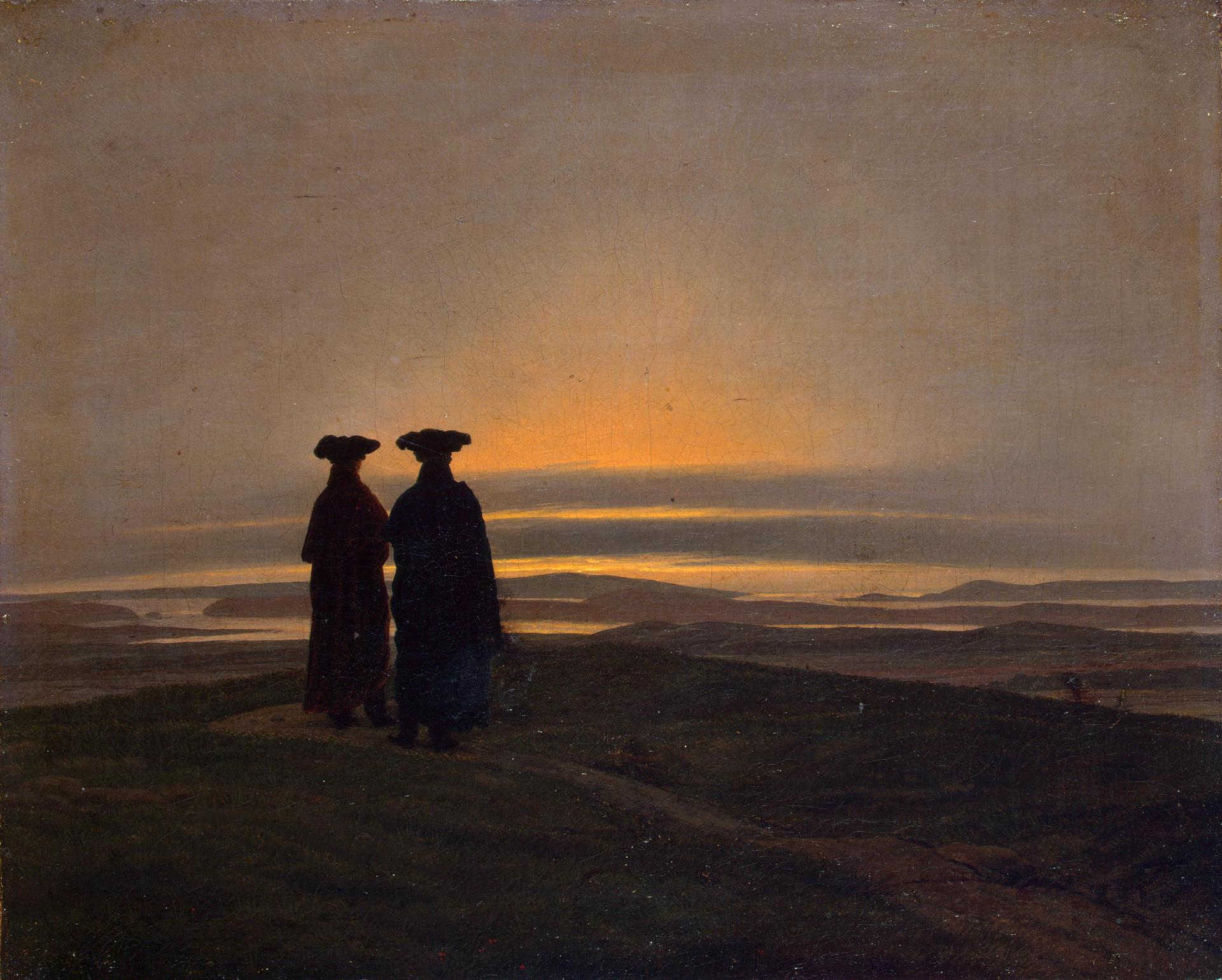
The gallery in the Met displaying Kensett's work contains mostly work from 1872, the last year of the artist's life, and one of his best and most productive.  Most of these landscapes show the Connecticut shore of Long Island Sound where Kensett owned a home and studio.  They are remarkable for their bare simplicity, their quiet, and their richly poetic suggestion.  That emptiness filled with suggestion reminds me a lot of Chinese painting, especially Southern Song dynasty masters like Xia Gui.  They also remind me of the spare emptiness of the work of the great German Romantic Caspar David Friedrich.  Like Friedrich, Kensett takes mostly unremarkable scenery and makes it wondrous.  Unlike Friedrich, Kensett doesn't depend on the evocative light of twilight.  Some of Kensett's finest work in these paintings is lit by high noon.


Gathering Storm on Long Island Sound, 1872

Storms in Kensett's work are very different from the grand violent spectacles of artists like Turner or Bierstadt.   Kensett paints the moment of quiet before the storm breaks.  Instead of piling on the impasto and glazes thick, Kensett's paint remains thin and his brushwork self-effacing.


Eaton's Neck, Long Island, 1872

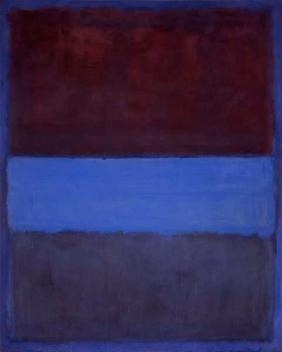
Robert Hughes compares this painting in its stark simplicity to the abstract paintings of Mark Rothko.  That may be true in terms of the bareness of the composition devoid of any extra enlivening detail ("not even a seagull").  But this painting has none of the theatricality of Rothko's work.  It is every bit as self-effacing in its stillness as Rothko's painting is self expressively dramatic with its dark voids and glowing lights.
I think Hughes is absolutely right when he says that anyone who has had any experience of the Sound will recognize the quality of light in this picture.  The sense of tone and corresponding color is so exact in this painting.


As spare and calm as this painting is, it is filled with incident such as the tiny little view of the distant shore in this detail from the painting.


Passing Off the Storm,  1872


Twilight on the Sound, Darien, Connecticut, 1872


Sunset on the Sea, 1872

An amazingly bare painting devoid of any land references or ships..."not even a seagull."
Most of Kensett's work is fields of quietly glowing light like this usually inflected with landscape.  In these last paintings, he shows the field of transparent light without the landscapes or incidents to give them scale and reference.


The Met is one of the few museums to make some of its storage and study collections available to the public.  Much of the storage of the American wing is publicly accessible.  The museum has many more of Kensett's works in storage and some really fine paintings; even more from that amazing year of 1872 on Long Island Sound.  Unfortunately, they are all behind glass and so badly lit that they are hard to see, let alone photograph.  Below is my photo of Kensett paintings in storage followed by two reproductions from the Met's website of pictures that I saw there.


Twilight in the Cedars, Darien, Connecticut, 1872,  Photo from the Metropolitan Museum


Sunset, 1872, Photo from the Metropolitan Museum


The pleasures of Kensett's paintings are not the ecstatic raptures of Bierstadt or Church, nor are they quite the mystical reveries of Friedrich.  They are closer to that more sober and temperate pleasure described by Ralph Waldo Emerson in his essay Nature:

The greatest delight which the fields and woods minister, is the suggestion of an occult relation between man and the vegetable. I am not alone and unacknowledged. They nod to me, and I to them. The waving of the boughs in the storm, is new to me and old. It takes me by surprise, and yet is not unknown. Its effect is like that of a higher thought or a better emotion coming over me, when I deemed I was thinking justly or doing right.
 Yet it is certain that the power to produce this delight, does not reside in nature, but in man, or in a harmony of both. It is necessary to use these pleasures with great temperance. For, nature is not always tricked in holiday attire, but the same scene which yesterday breathed perfume and glittered as for the frolic of the nymphs, is overspread with melancholy today. Nature always wears the colors of the spirit.


John Frederick Kensett in 1866, photo from Wikipedia