Tuesday, August 3, 2021

The Museum of the Bible.


The Museum of the Bible is an institution continuously plagued by scandals from purchasing looted artifacts to Dead Sea Scroll fragments that turn out to be frauds. For all its claims to being “non-sectarian” board members and directors must sign a pledge stating that the Bible is “true.” The major funder of the museum is Hobby Lobby that makes no secret of promoting a very literalist and politicized understanding of the Bible that serves a right wing political and cultural agenda.

I think the central problem of the museum that opens it up to so much fraud and scandal is an idea near and dear to the hearts of Christian fundamentalists, that the Bible as we have it now was passed down intact and unaltered through the ages from around the time of Christ. The problem with that idea is that it is demonstrably untrue. There was nothing like what we would recognize as the Christian Bible until about the 6th century. Even so, the Book of Revelations so central to American fundamentalist orthodoxy did not enter the Biblical canon until after it was officially closed at the end of the 7th century. The Eastern Orthodox Churches still refuse to recognize Revelations (or the Apocalypse) as canonical and do not include it in their Bible or liturgy. 

[Correction:  Eastern Orthodoxy does include Revelations in their Biblical canon, but not in their liturgy.]

 The Christian Bible in its present form came out of generations of argument and conflict, some of which remains unresolved. How many Gospels would be included? Which Gospels? In what order? What are the criteria by which decisions are made? Should the Jewish Scriptures be included? Which ones and in what order? Which Epistles would be included? Why? Who wrote them? All these questions were fought over for centuries before they were resolved, sometimes arbitrarily. Some books that were very popular and widely read among early Christians did not make it into the Biblical canon such as The Shepherd of Hermas and the Letters of Ignatius of Antioch. 

 The problem with the Museum of the Bible is that it searches for evidence to prove a pre-conceived idea instead of letting the evidence speak for itself.  This leaves them open to all kinds of fraud peddled by con-men who tell them what they want to hear.


Saturday, July 31, 2021

The Porta Maggiore Basilica


Before the Christian religion adapted the basilican building format for religious purposes, a small secretive mystery religion used it first for their worship.  The Porta Maggiore Basilica is a three aisled structure carved from the bedrock about 40 feet (12 meters) underneath the railroad yard of the Stazione Termini in Rome near the ancient Porta Maggiore.  Railroad workers discovered it in 1917 when a passageway to the basilica caved in as they were building another rail line.  The Statilius family, close to the Emperor Augustus may have built the structure sometime in the 1st century BCE.  The scholarly consensus says that they built the Basilica for Neo-Pythagorean rites.  Neo-Pythagoreanism was new at the time, an attempt to revive ancient Pythagorean mysticism combined with aspects of Platonism.  The members of the sect were ascetics who renounced all worldly pleasures in the pursuit of a mystical union of the soul with its divine source.  The rites that took place here were probably secret.  The significance and the identity of a lot of the imagery in the basilica is forgotten.


Beautifully carved stucco images cover the interior of the Basilica.  The artists added ground up mother-of-pearl to the plaster mixture to give the carved stucco a lustrous quality.  Some of the carved figures can be identified such as Hercules and Orpheus, but most of the rest and their significance remain unknown.

Unlike the the third string house painters who made the later Christian catacomb art, these artists were first rate befitting an important family with ties to Augustus like the Statilius family known for their patronage of mystical and magical practices.

Since its discovery in 1917, preservation and restoration of the Basilica proceeded in fits and starts.  A recent campaign added a concrete shell around the structure and ventilation to prevent radon gas build-up and to control humidity.  It is now open to small groups of visitors who must make reservations in advance twice a month.


Wednesday, July 28, 2021

The Best Cafe

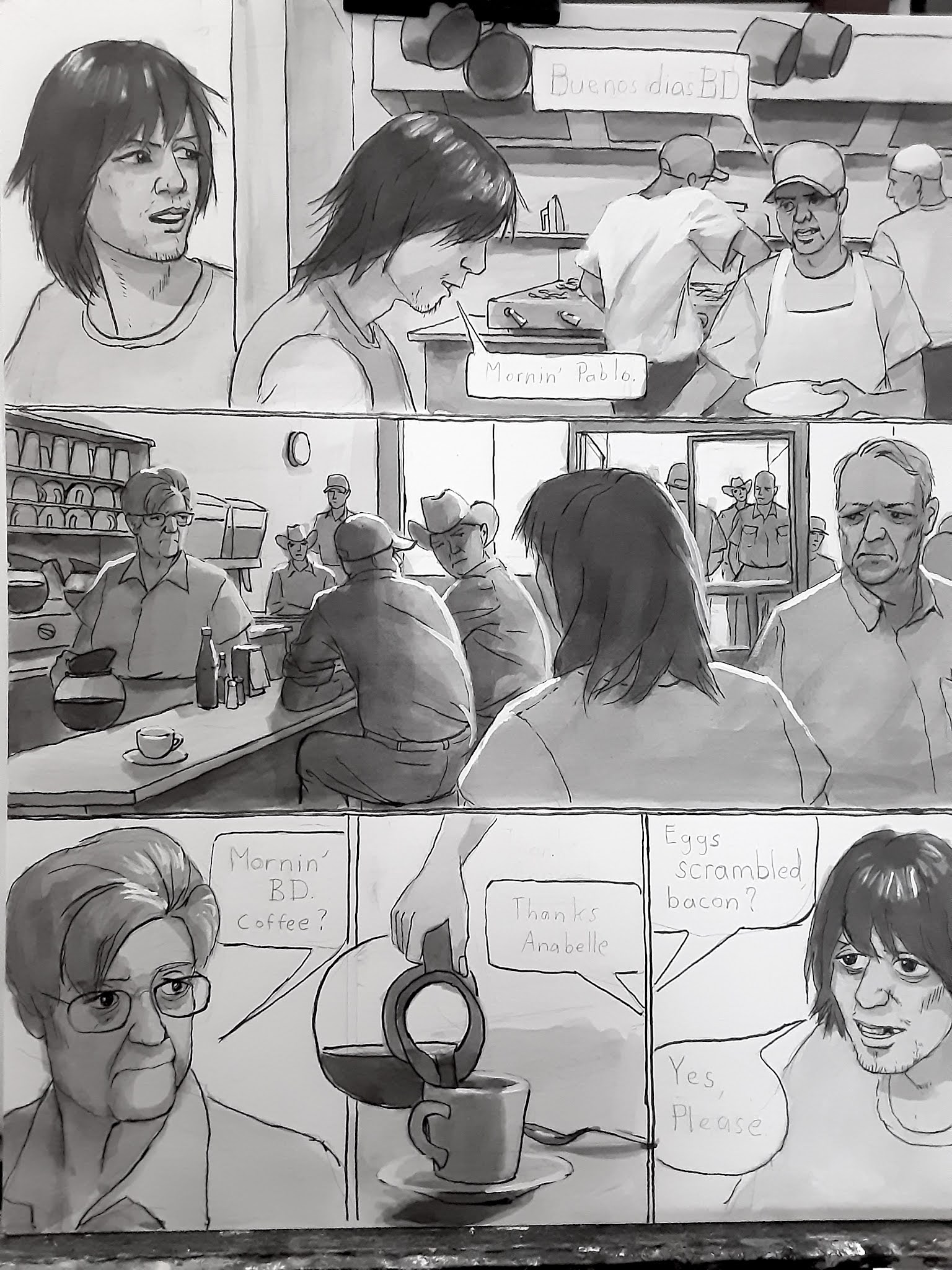
A new long-term project, a graphic novel...or more likely a story, some kind of story anyway.
I've tentatively titled it The Best Cafe and it's set in Hargis, Texas sometime in the 1970s.
It's about two young men who are lovers reunited after being separated by a scandal four years earlier.  They are two people whose lives derailed and they've struggled to find a new path ever since, and now they are figuring out how to go forward together.

I called it The Best Cafe since one of the two lead characters lives in a one room apartment above a small town diner called The Best Cafe.  Much of the drama takes place in that apartment. 

Below is a sample of the panels done so far.  They are all hand-drawn.  I have neither the technical skills nor the money for Illustrator, so I'm doing them all by hand using felt tip pens and ink wash with some white gouache.  I haven't put in any text yet.  All the text is there on each panel in pencil, but it's not presentable right now.  I'm figuring out how I want to do the text.  Lettering is not my forte, but I want clear and legible text, and I want to do expressive things with it too.  At the moment I'm drawing the pictures and saving the text for when I have it all figured out.

There will be a lot of sex in this story.  It's sex that separates these two guys from the rest of their town.  Sex is the big contending issue between them and everyone else, the distinction that so complicates and derails their lives.  Sex is also their path back to each other and to making a new future for the both of them.  So, I have no qualms about dwelling on it.  


Sunday, July 25, 2021

Sant' Ignazio, Rome


The great church of San Ignazio in Rome is a Jesuit church designed and built by Jesuits for other Jesuits.  Pope Francis is a Jesuit, a member of the Society of Jesus, the largest and most famous of the preaching orders that came out of the Catholic Counter-Reformation of the 16th century.  The Jesuits built the church to mark the canonization of their founder St. Ignatius Loyola in 1622.  They built it attached to the College of Rome that later in the 17th century moved to a new location and became the Gregorian University in Rome.
A Jesuit professor of mathematics at the College of Rome Orazio Grassi designed the church with some consultations from Carlo Maderno who was invited to submit proposals for the church.


Like Giacomo Vignola's Il Gesu, the mother church of the Jesuit order across town, Sant' Ignazio is a big hall church built for preaching.  An enormous uninterrupted hall space forms the bulk of the church with chapels on the side.   A three bay nave terminates in a crossing with an apse that is as high and wide as the nave, very much like an earlier prototype for these Counter-Reformation preaching churches, Sant' Andrea in Mantua built at the end of the 15th century.   Both Sant' Andrea and Sant' Ignazio were designed to accommodate very large crowds, giving them clear views of the altars and pulpits.


Today Sant' Ignazio is most famous for the contribution of another Jesuit, a lay brother named Andrea Pozzo who painted the spectacular fresco cycle in the church, the last great painted spectacle in Baroque Rome.  He spent nine years from 1685 to 1694 working on the ceiling, apse, and a tromp l'oeil dome.

The nave ceiling painting, The Apotheosis of St. Ignatius Loyola is a masterwork of quadratura illusionism that uses architecture and perspective that influenced similar ceiling painting projects all over Europe into the 19th century.


When viewed from a spot in the floor of the nave marked by a marble circle below, the illusion of the painting comes together.


Viewed from that spot, it's hard to tell where the nave vault ends and the painting begins.  It looks as if the ceiling opens up into the wider sky with figures floating upward like bubbles in seltzer.
It's an undeniably spectacular and irresistible effect.  The painting is supposed to be a complex allegory of the global mission of the Jesuit order, but all that is lost in the dazzling theatrical spectacle set out before us on the ceiling.


Saint Ignatius Loyola received into heaven in the dramatic center of the painting.  Four rays of light emanate from him to the four allegorized continents of the earth (as known at the time, Australia and Antarctica appear on maps much later than this painting).  Down on the lower right I presume is St. Francis Xavier sent by St. Ignatius to India.


This detail spells out a major theme of the painting, a passage from St. Luke's Gospel that meant a lot to Jesuit missionaries, "I have come to set the world on fire."


St. Francis Xavier looks down at the large woman on the lower right edge who stands for Asia.


The Name of Jesus carried by an angel.


The continent of Europe.


Africa rides a crocodile


A very beautiful detail.  Pozzo may not have been a great painter, but he was a very good one.


Asia riding a camel with St. Francis Xavier looking down at her.


Another fine detail.


America (north and south) wears feathers and rides a jaguar.


The whole painting on the nave ceiling once again.


The tromp l'oeil dome painted on canvas mounted onto the ceiling.  I'm guessing it's oil painting, but I'm not sure.  Orazio Grassi originally planned a tall dome over the crossing.  A quarrel with the Ludovisi family funding much of the church's construction prevented the construction of the dome.  So, Andrea Pozzo painted this tromp l'oeil substitute.


The apse and high altar with paintings by Andrea Pozzo.


In the half-dome of the apse, St. Ignatius appears in glory to the people of Rome.  Below is a cartouche with the words spoken by Christ to St. Ignatius appear in Latin:  Ergo Vobis Propitius Ero (I will be favorable to you [at Rome]).


Above the high altar is St. Ignatius' Vision in the Chapel of La Storta that began his religious calling.


St. Ignatius sends St. Francis Xavier to India


St. Ignatius receives Francesco Borgia who will become the first "general" of the Jesuit order.


Andrea Pozzo's painted spectacles in Sant' Ignazio were art for the masses.  They thrilled religious pilgrims, the Roman public, and Jesuit seminarians just as much as they thrill tourists today, and that was the point.  These kinds of spectacles were not the least bit interested in reflecting real life back to their audiences. They were about making the stories and doctrines of the Roman Catholic Church as vividly real as possible, so real they seem to fly over our heads.  The illusionism stretches the boundary between art and reality without quite breaking it.  
Writers describe Baroque art as "theatrical" all the time and rightly so, but it's a specific kind of theater, machine theater, the theater of special effects.  Hollywood uses the same concepts when producing summer blockbuster movies.  The point is not to reflect real life back at their audience, but to make their worlds of fantasy and story so vivid that they seem to fly out of the screen and into the theater.

Respectable critics and academics have frowned on this kind of art for over two centuries, and still do.  The idea that simple paint on a wall or ceiling could produce something so vivid and appealing so immediately and so broadly thrills the imagination of this painter.


Andrea Pozzo's proud self portrait


The beautiful Rococo Piazza San Ignacio in front of the church.


Note:  All of these photos come from Wikimedia Commons.


The Spitting Dictators


A fountain of dictators spitting at each other in a park in Arnhem in the Netherlands.  
The dictators are Stalin, Hitler, Franco, and Louis XIV.

The Spanish artist Fernando Sanchez Castillo made this and titled it "Spitting Leaders."


Wednesday, July 21, 2021

The Sun Setting in the Smoke


A photo I took yesterday from the fire escape of my home in Brooklyn of the sun setting in a hazy sky full of smoke from the wildfires in the west.


The Cult and the Epidemic


The Trump GOP from the beginning politicized the pandemic.  They made it a test of loyalty to the Beloved Leader.  Don't take the vaccine created by those Jew liberal fags that you hate so much.  Believe the Leader.  You don't need no stinkin' evidence.

And now as we're heading into yet another covid surge, the Leader cult is turning into a death cult and a suicide pact.
Here's testimony from someone on the frontlines in Birmingham Alabama:

I'm admitting young healthy people to the hospital with very serious COVID infections. One of the last things they do before they're intubated is beg me for the vaccine. I hold their hand and tell them that I'm sorry, but it's too late. A few days later when I call time of death, I hug their family members and I tell them the best way to honor their loved one is to go get vaccinated and encourage everyone they know to do the same. They cry. And they tell me they didn't know. They thought it was a hoax. They thought it was political. They thought because they had a certain blood type or a certain skin color they wouldn't get as sick. They thought it was 'just the flu'. But they were wrong. And they wish they could go back. But they can't. So they thank me and they go get the vaccine. And I go back to my office, write their death note, and say a small prayer that this loss will save more lives.

None of this had to happen.  Over 600,000 dead was not necessary.  That the epidemic surges again in a lot of localities in the USA did not have to happen.

I'm fully vaccinated, but I'm watching on social media people I know online coming down with the virus still over a year and a half into the epidemic.  But for the ambitions of some demagogues and their willfully bamboozled followers, my mother might have lived the remainder of her life to its proper finish among family and friends instead of alone and isolated gasping for breath in a covid ward. 

If I survive this epidemic, I will never forget nor forgive.