I've posted on this subject
before, but I'd like to flesh it out a little more here.
On a certain level, Christ is unimaginable and unpaintable. A Lutheran friend of mine, Jeff Bessler, always asserted that that the Church proclaims a 200% Christ; He is 100% human and 100% God. What in the world would that look like? For awhile, believers and artists seemed to be daunted at the prospect of creating an image that would do justice to that concept. They perhaps found encouragement in this task from admonitions like this one from the opening of the Gospel of John: "No one has ever seen God, but God's Son who is nearest to the Father's heart, he has made him known."

Warner Sallman,
Christ, circa 1948
Here is the standard issue Protestant Jesus by Warner Sallman that I was raised with in the Methodist Church. Copies of it hung in church halls and appeared in Sunday school handouts.
Where did this image of a young man with a beard and long hair in a white night gown that we all readily identify as Jesus come from?
No one knows what the historical Jesus of Nazareth looked like. There are no reliably authentic physical descriptions of Him. All we really know about Him for sure is that He was from a working class background, and apparently from a low version of that. His public career was very short, perhaps as short as a single year. He died young, somewhere around age 30 to 33, maybe even younger.
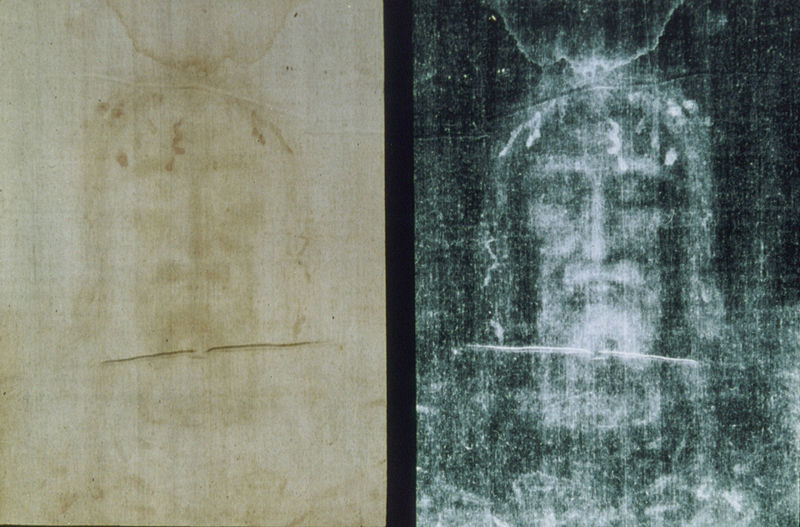
I've never believed in the
Shroud of Turin image precisely because it looks so much like the traditional pictures. If there really was a miraculous image of Christ around, would we recognize it as such? I wonder.
Christ almost never appears in early catacomb art except through the metaphor of the Good Shepherd, which as I've noted before, is a borrowing from classical art.
I've always wondered if early Pre-Constantinian and Pre-Nicene Christianity could pass all those litmus tests and pop quizes that modern Christian "orthodoxy" wants to impose on the rest of us. I doubt it. The earliest surviving image of Chirst in art reveals to us, in ways that perhaps make us uncomfortable, the syncretic and free-form nature of the earliest Christianity, expecially when the classicals themeselves began converting in large numbers.

Here is a mosaic from the catacombs under St. Peter's in the Vatican. It dates from the mid 3rd century. This is the oldest surviving Christian mosaic, and so far as I know, the earliest surviving image of Christ in art. It's about contemporary with all those Good Shepherds in the other catacombs and at Dura Europos. It's definitely not what we expect. It shows a figure carrying a blue orb of the world in his left and driving a 4 horse chariot across a golden sky surrounded by grape vines. How do we know this is Christ? This could be Apollo in his role as Helios, god of the sun. It could also be Sol Invictus, the Unvanquished Sun, from a religion popular in the Roman military. Scholars use the evidence of the presence of the grape vine, and the very cruciform looking halo as their evidence. The grape vine makes no sense with either Apollo or Sol Invictus. But, the vine makes a lot of sense with Christ who used the grapevine metaphor a lot in His preaching. The grapevine would also allude to the central Christian mystery ritual of the Eucharist.
Judging from this very syncretic image, I seriously doubt that the early generations of Christians were any more agreed about the content of "The Faith once delivered to all the saints" than we are, and probably less so. It also appears to me an early manifestation of something that will be common throughout Christian history; old gods are not so much supplanted as baptized into the new faith.
Christ appears front and center in the new monumental art created in the reign of Constantine and his immediate successors.

This is the very expensive and elaborately carved marble sarcophagus of a high Roman official named Junius Bassus from about 359, long after the Edict of Milan of 313 that legalized Christianity and gave it imperial patronage. We now have Christian imagery that we can readily recognize as Christian. We see Adam and Eve on the lower left and Daniel with the lions on the lower right. Above all, we see You Know Who front and center on both levels; entering Jerusalem on the bottom, and triumphant in heaven on the top level.

Here is Christ in Heaven from the top center of the Junius Bassus sarcophagus. We have a type of composition that already looks familiar to us, Christ enthroned between Saints Peter and Paul. But, there is still a lot of the old syncretism of Pre-Nicene Christianity. Christ rests His foot on a a bearded classical sky god, perhaps Atlas holding up the canopy of the Heavens. And what about Christ Himself? He looks a little more Christlike in pose and action, but He's still a long way from that bearded figure we are all familiar with. He looks so much younger than the figure we see on the church handouts. Where does that come from?

Above is an amazing recent discovery, the cult image in gold and ivory of Apollo from his great sanctuary at Delphi from the 6th century BC. The temple was destroyed by fire sometime in the 4th century BC, and the charred remains of the old cult image were ritually buried. That burial was discovered about 25 years ago, and the cult image carefully reconstructed from the surviving fragments. This would have been the religiously sanctioned prototype for other images of the god like the splendid one below that is almost contemporary with the Delphi cult image.

This is the earliest surviving Greek life size hollow cast bronze statue, and one of my favorite images of Apollo. He originally carried a bow in his left hand.
Apollo was always shown as a very young man with long golden hair. The early Christians were looking for some kind of an image that could contain and express that idea of the 200% Christ, the Man-God. Apollo seemed to be the perfect answer. Apollo is young as was the historical Jesus. The Greeks refined the image of Apollo as the embodiment of everything that they valued most in their culture; strength, grace, courage, wisdom,
sophrosyne or that balanced knowledge of one's strengths and limitations,
arete or the pursuit of excellence within the bounds of fate. These qualities were ascribed to the god himself and were thought divine. Apollo is the prototype for a god-man.

Some scholars have very daringly suggested that the prototype for the young Christ that prevails in the earliest Christian art is Antinous, the Emperor Hadrian's boyfriend. Above is one of the best of the many surviving statues of the young man, from Delphi. The Emperor had the Senate deify Antinous after he drowned in the Nile when he was in his early 20s. Most of the sculptures are posthumous. This idea is possible. The cult of Antinous was popular in the East and continued into the post-Constantine Christian era. It is not a far stretch of the imagination that one image of a man who died young could be baptized and remade to stand for another.
My one problem with it is that since most of the images of Antinous are posthumous, it is likely that a lot of them were made to look more like Apollo than the actual youth. The statue above is a case in point. Antinous is posing as the god Apollo. The statue probably originally held a lyre or a bow.

Here is a statue of Christ from about 370 that really makes me wonder if there might be truth to the idea that Antinous may have been a prototype. The original context of this sculpture is unknown. It certainly looks like Apollo given clothes and cast in a new role. But that very youthful face and curly golden hair just might come from Antinous.
The Christ-Apollo had a very long life, longer than we would expect.

The last and most magnificent surviving image of the youthful Christ-Apollo is from the mid 6th century from the Emperor Justinian's magnificent church of San Vitale in Ravenna. He is the most important figure in the whole church in the vault of the apse over the altar, dominating the interior. He sits enthroned upon the globe of the world clad in the imperial purple as Christ Pantocrator. Angels flank him like court officials as Christ presents Vitalis with the crown of martyrdom and Bishop Ecclesius who built the church presents a model of it to Christ. Justinian wanted this image to be the manifestation of triumphant orthodoxy and imperial sovereignty in recently German and Arian Ravenna.
So where does the beard come from?

This is the apse mosaic of the Church of Santa Pudenziana in Rome from the beginning of the 5th century. The church and the mosaic were extensively restored and modified in the 16th and 17th centuries, but the central portion of the mosaic is still largely original. Christ sits enthroned as a divine ruler and teacher amidst an assembly of saints. Behind Him is a rocky hill topped by a bejeweled gold cross, perhaps Calvary. The Evangelist symbols appear in the sky behind Him.

Here is Christ from that mosaic. I suspect that the decision to put a beard on Christ was largely a matter of taste. The young Christ-Apollo may have seemed too callow a figure. So somewhere someone decided to alter the Apollo image by putting on Jupiter's beard, to give the figure of Christ the gravitas and majesty of the "father of gods and men." That decision proved successful and popular, eventually eclipsing the older beardless Christ-Apollo.

The same figure shows up between Peter and Paul in a 5th century painting in the Catacomb of Sts. Peter and Marcellinus in Rome. Catacomb burials continued long after the Edict of Milan. The imagery looks much more like what we would recognize as Christian. Traditions are being created right before our eyes.

By the 6th century and the reign of Justinian, the Christ figure that is familiar to us is fully formed. Here He is in a magnificent 6th century icon, one of the very few to survive from Justinian's reign, and to survive the Iconoclastic controversy.
None of these images was intended to stand for the historical figure of Jesus of Nazareth. That figure did not interest the early generations of Christians. They were much more interested in the Risen Christ and in the Apocalyptic Christ, reigning and returning in glory. The suffering Christ is conspicuously absent in this art. The persecuted Christians of the catacombs and the Christians of the imperial establishment after the Edict of Milan wanted the same thing, an image of triumph. All of these first images of Christ are very triumphant and triumphalist. The image of Chist becomes standardized and codified at the same time that the Christian faith becomes standardized and codified into the Christian religion in order to satisfy the needs of the Roman imperial state for both a cult and an ideology to hold the Empire together. Even before the reign of Justinian, the comparison between Sovereign Christ Pantocrator and Sovereign Roman Emperor becomes explicit.
 Christ and St. John, German, circa 1330