Saturday, April 21, 2012

Rembrandt Comes to Town

One of the pleasures of living in New York is that every once in awhile a major work of art visits the Met.   One of Rembrandt's greatest self-portraits, the so-called Kenwood Self Portrait, saved me the trouble of having to fly across the Atlantic to see it.

These are all my pictures taken with my trusty little digital camera.


The painting was covered with glass, so what looks like blue dust in this picture, and the one below, is reflections in the glass.


Rembrandt painted this self-portrait in 1661 when he was 63 years old.   He made this self portrait as he was bankrupt and impoverished after decades in which he was the toast of Amsterdam and one of the most famous artists in Europe. In this year, Rembrandt's last major commission, The Conspiracy of Julius Civilis for the new Amsterdam City Hall (now the Royal Palace), was rejected and sent back to him. His son Titus and his second common law wife, Hendrickje Stoeffels, tried valiantly to protect Rembrandt from further predations by his creditors.

It was in these last lean years that Rembrandt painted some of his boldest and most brilliant work.  This painting was one of the most daring of the 17th century.   Just a few well placed massive strokes of the brush suggest his left hand holding brushes, a palette, and a mahlstick.  The grainy texture of his face, with the thick paint almost sculpted into form with the back end of his brush, glows with the reflected sunlight coming into the room.

The Amsterdam public and critics dismissed work like this as old-fashioned and the clumsy attempts of a senile has-been to recapture something of his former glory.  Rembrandt looks very unbowed in this self portrait.  He knew how good he was even if the rest of the Dutch public clamored for polished neo-classicism in those days.  The circles in the back of the painting may refer to an old story in Karel Van Mander's Lives of the Artists in which someone asked Giotto to prove his skill with a brush.  Supposedly he did so by drawing a perfect circle free hand on the wall of his studio with his brush.  So Rembrandt in those circles, and in this painting, proves to us that he belongs in Giotto's company.

Debussy


"The Engulfed Cathedral" performed by the late great Paul Jacobs


Victor Hugo, Lighthouse, drawing

Thursday, April 19, 2012

Yom Hashoah

Today is Yom Hashoah, Holocaust Remembrance Day. Below is one of the most disturbing images from a time full of disturbing imagery.


These are Jewish women photographed just before their murder on Skede beach near Liepaja, Latvia in 1941. They were photographed by one of their killers just before they were led off and shot over a mass grave that extended for a kilometer along the beach. The Germans together with Latvian collaborators began killing off the Jews of Liebaja in a series of massacres as soon as they succeeded in taking the town. This photograph is one of many that were stolen or illicitly copied from German troops by the local townspeople, and kept hidden away until the end of the war.

There are no exact figures on the total number of dead in the Holocaust, no final agreed upon list of all the casualties. Though these numbers are still contentious, the current consensus among scholars for the total number of dead is 17 million, out of which 6 million were Jews. At first that would appear to argue against the particularly Jewish nature of the Holocaust.   But there is another way to look at that number. Six million was two thirds of the total Jewish population of Europe at the time. There was not a single Jewish inhabitant of continental Europe who was not affected by the catastrophe. Over a thousand years of Jewish civilization in Central and Eastern Europe was completely destroyed in 4 years or less. The centers of Jewish life moved from Europe to Israel and the Americas. Before the Holocaust, the dominant language of the Jewish world was Yiddish. After the Holocaust, the dominant languages of Jewish culture would be English and Hebrew. Few other groups have experienced so profound an uprooting and transformation in recent history.

 There certainly were other victims: the Romani (i.e. Gypsies) lost millions in numbers still unknown, millions more Russian Prisoners of War perished, as did other POWs from the east; political dissidents of all kinds were massacred; Jehovah’s Witnesses were singled out, as were homosexuals; millions of the mentally and physically handicapped were the first victims. The numbers of all of those groups and more add up. And yet, it remains true that the primary target of the Nazis was the Jews.

 The Nazis considered the Jews to be the first front of the war that they started. Even as late as 1945 with defeat and destruction staring them in the face, the Nazi regime gave first priority of railroads and resources to transports of Jews to death camps, even over desperately needed military transportation. The Nazis sold the German population, and others, on an apocalyptic vision of a great historic death struggle between the Jews and the “Aryans” for the domination of the world. One people must win, and the other must die.

There is a certain amount of revisionist history now about the Holocaust that seeks to minimize the event, or to deny its particularity.  Some revisionist historians point out, very reasonably, that there were other larger massacres in the 20th century. Body counts under Stalin and Mao Zedong were larger than Hitler’s (though no one seems to count the casualties in the World War that Hitler started against him); the death toll from the famine that followed Mao’s Great Leap Forward, a catastrophically incompetent drive for industrialization motivated by ideology, may have cost the lives of 20 million people, the worst famine in recorded history. The brief reign of the Khmer Rouge in Cambodia cost the lives of a relatively meager sum of people, about 3 million. But that was a quarter of Cambodia’s population at the time. In the United States in the 19th century, the Westward Expansion cost the lives of unknown thousands of indigenous peoples whose land and resources were seized. The proponents of Manifest Destiny inherited the Puritan view of the Indians as part of the wilderness to be cleared. Part of that clearing effort for settlement included numerous massacres. Millions of Africans perished in the Middle Passage, abducted from their homelands to be shipped to the Americas as slave labor. Unknown numbers died from the brutal conditions of their servitude. The USA as a White Christian Republic was built on the corpses of millions who were neither white nor Christian.

And yet, I remain convinced that the Holocaust was uniquely evil and a central formative event of the 20th century and modern history. 

 A state made its central mission, its first policy before all others, to physically destroy an entire people, not to steal their land or resources, but simply to wipe them off of the face of the earth.  The Holocaust was not a by-product or an effect of the Nazi regime, it was the heart and soul of the whole movement.  The Nazis wanted to remake the human species in the image of their racist ideology.  That could only be accomplished beginning with the total annihilation of the Jewish people.  For the first time in history, modern technology and industrial methods, all the resources of an advanced and powerful industrial state, were applied to destroying a whole people.  The Nazi war on the Jews was the culmination of nearly a century of populist antisemitism in Central and Eastern Europe.  That antisemitism didn't end in 1945.  In 1946, about 40 returning Jews were murdered in the town of Kielce in Poland initiating a mass exodus of Jewish survivors from Poland to other parts of Europe and to British Palestine.

 The Jews were the primary victims, but they were not the only victims.

 I once knew a veteran of the Second World War who was a veteran of the Wehrmacht, and a gay man. He died some years ago, and I will call him Hans. Hans found himself drafted in 1943 at the age of 17 soon after the disastrous German losses at Stalingrad. Hans had long counted on his mother’s Swiss passport to protect him and to be his ticket out of Germany should the war affect him. He had every intention of leaving for Basel on the first train out the next day. His father who was no Nazi party member or sympathizer refused to let him go telling him that he must stand by the Fatherland in its hour of peril. Hans was inducted into the army and never spoke to his father again.
Hans grew up fast back then. At 17, Hans was already a sexually active gay man, and very attractive. He used that attractiveness and sexual availability to survive the war. He cultivated relationships with influential officers who protected him.
 Hans was sent to Occupied Italy to help fight the partisan forces and the invading Americans in 1943 – 44. He was at the Battle of Monte Casino mostly watching the fighting from an artillery placement on a nearby hill. Hans painted a very different picture of the German Army from the one depicted in the movies. Far from the robotically efficient evil fanatics of fiction, the German Army was rife with corruption and incompetence in the War’s last days. Hans said that everyone knew the war was lost, but no one could say so for fear of being accused of “defeatism,” a capital offense. Hans himself was arrested for “defeatism,” but was saved from a kangaroo court and summary execution by the intervention of one of his officer-lovers. Most officers and soldiers were anxiously preparing for the inevitable end, trying to place themselves in the way of the advancing Americans and British, and as far away as possible from the oncoming Russians. Hans described sitting in a bunker above the Battle of Monte Casino below. Some soldiers and officers sat playing cards while a bunker portal remained opened. Hans told them to close it, but they refused saying that the summer heat was unbearable. As soon as Hans left that room in the bunker, an American shell burst through that very portal and exploded killing all the men in the room and badly injuring Hans.
 Hans survived the War and worked for the American Occupation government in southern Germany. He began an affair with an American officer, and left Germany with him to live at Fort Leonard Wood in Missouri. Hans decided that he would never live in Germany again, and for a long time refused to go back to even visit. When his lover left the military, the two of them moved together to New York where Hans went into business. His lover predeceased Hans who spent the rest of his life in New York.  How much of this is exactly true, I can't say, but this is the story Hans always told me.

Hans always said that if you take all the official estimates of the numbers of gay men and lesbians murdered by the Nazis during their reign, and doubled those numbers, then you would have a conservative estimate of the numbers who actually died. He pointed out that most of those deaths were not recorded since most of them did not die “officially.” Most were murdered by fellow troops, by police, by the Gestapo, or by their neighbors. In a world where people were dropping dead like autumn leaves everywhere, where all semblance of law and order had completely devolved and criminality was everywhere, who would notice one more corpse, especially a gay one? He reminded people that gay men alone among all the concentration camp survivors were sent back to prison under Paragraph 175 of the German penal code (millions of Russian POWs who survived German death camps were sent straight to the Gulag by Stalin upon return).

 Millions upon millions of people died for no crime, no reason other than simply being themselves.

 Among them was Erwin Schimitzek, a store clerk from Breslau (now Wroclaw in Poland) who died in Auschwitz in 1943 at age 24 for the crime of being gay.


Wednesday, April 18, 2012

Pushback

First, here is an expensively produced spot telling us that fags are good only for burning:


And on this clip that's been making the internet rounds a Catholic hierarch dickhead sings Onward Christian Soldiers, and for men only:


One of the things I've always complained about Roman Catholics is their reluctance to challenge their hierarchs, even when they are such an embarrassment to their faith.

Perhaps my complaints have been heard.

Six churches in the Seattle Diocese are refusing to cooperate with their bishop in his drive to gather signatures on a petition to put Washington State's new marriage equality law up for a vote.
It's not much, but it's a start, and a brave one. What's more, these priests who pulled out of the petition drive appear to have the full support of their parishoners.

About 250 priests in Austria signed a "Call to Disobedience" that so rankled the Vatican that the Pope went to the trouble of publicly condemning the effort during Holy Thursday Mass in St. Peter's. The priests are part of an Austrian and German dissident Catholic movement called Die Pfarrer-Initiative. They may be few, but they are clearly enough to get under the skin of the Grand Inquisitor. Remember, the Reformation began with one man burning an excommunication letter from the Pope.

I noted in an earlier post that the murder of Daniel Zamudio galvanized Chileans to turn out to support, and to successfully pass, legal measures to guarantee civil rights for gays and lesbians in housing and employment, and to include violence against gays and lesbians in hate crimes laws. These are federal guarantees, something that the USA does not yet have. These measures were first introduced into the Chilean legislature in 2005 and faced determined, organized, and well financed opposition from the Catholic hierarchy and evangelical organizations. It is shameful that it took the brutal murder of a young gay man to move people on this issue, but at least they did move, and Daniel Zamudio did not die in vain.

And what about everyone else who isn't Roman Catholic?

As I've noted on this blog, the very presence of Jay Bakker belies the idea of "monolithic unity" among evangelicals on the gay issue, as well as a lot of other issues. And he is not alone. There is Evangelicals Concerned. But, for the most part, the evangelical community remains a desert for gays and lesbians.

The internal struggles of the old "mainline" churches over their gay and lesbian members have gone largely unnoticed. These struggles have been going on within these churches for decades beginning in the early 1970s (in some places like San Francisco, since the early 1960s long before Stonewall). In the vanguard are the Quakers and the United Church of Christ (ironically the historic descendents of the Massachusetts Puritans who persecuted the Quakers). Both of these churches have fully integrated their gay and lesbian members into the full life of their churches at all levels including leadership and marriage. After them is the Episcopal Church which consecrated as bishop an openly gay man in a non-celibate relationship in 2003, and an open lesbian in 2010. Episcopal bishops from James Pike to Paul Moore to John Shelby Spong publicly championed the cause of gay civil rights outside the church and gay acceptance inside the church. It looks to me like the Methodists in the USA are bringing up the rear.

In Britain, there is an ongoing internal struggle within the Anglican Churches over gay acceptance with an organization specifically advocating for gay Anglican Christians called Changing Attitude. Not all of the change is coming from the ground up. Recently, the Anglican Archbishop of Wales called for a dramatic reconsideration of the way churches treat homosexuality, and more importantly, the way they've treated gays and lesbians. He suggests that it is time for the Church of Wales to seriously consider gay marriage.
Here is Archbishop Barry Morgan's full address to the governing body of the Church of Wales. This is a choice passage from his address among many:
But can celibacy be imposed? Shouldn't it be freely undertaken as a personal vocation by heterosexuals and homosexuals alike? As Rowan Williams once put it, "anyone who knows the complexities of the true celibate vocation, would be the last to have any sympathy with the extraordinary idea that sexual orientation is an automatic pointer to a celibate life: almost as if celibacy before God is less costly, even less risky to the homosexual than the heterosexual." And is not separating mind and body or feelings or orientation from practice a kind of dualism which the church has condemned in the past since human beings are a unified whole and cannot be compartmentalised in such a way. If that is true of humanity in general, why should we expect people of a homosexual disposition to be singled out in this way?


There are active gay movements in other religions, including Islam.


These efforts are small and vulnerable, but they are a start. I am always mindful of the epigram from Ovid:

Gutta cavat lapidem non bis, sed saepe cadendo (A drop hollows out a stone not by falling twice, but many times)

Our persistence will finally break this rock hung round our necks, maybe not tomorrow, but eventually. Who better than us to draw the fangs from our deadliest enemies in the pulpits?

Let us remember that other spiritual movement in ancient times which began not with success, but with failure and defeat, with the execution of its Founder, and the scattering of His followers.


EXTRA:

There are a host of small independent gay affirming evangelical churches in Brooklyn and the Bronx that primarily serve gays, lesbians, and transgenders of color. I remember reading an article on a couple of these churches in the NY Times (I think). I'm not able to find it. I doubt it was in the Voice, but I can't think where else I could have seen it.

MORE EXTRA:

Even in Oklahoma City, no gay paradise, there is a religious effort to protest the visit of one of the bloodiest of all our enemies, Scott Lively.

Kudos to that eminently fair minded atheist Joe Jervis for keeping up with all of these things and publishing them on his blog, JoeMyGod.

Tuesday, April 17, 2012

The Bodies Keep Piling Up


Nova Scotia activist Raymond Taavel was found murdered this morning in Halifax.


And there is another high profile gay teen suicide in Iowa, Kenneth Weisuhn.


Maggie Gallagher or somebody said something about right wing Christians feeling "oppressed?"
Perhaps they should feel ashamed.

Your Tax Dollars At Work

From Richard Ross' Juvenile Injustice


The United States has the world's largest prison population and the world's highest incarceration rate. The USA is the only country in the world that makes juveniles (those under 18) liable to the death penalty and life without parole. Of the enormous population of juvenile offenders in the prison system, only 12% are accused of violent crimes.


It's tax day. Time to pay up for all of those prison contractors; for those government contractors who make the Freedom Bombs and the drones and planes to drop them. Time to fork it over for all of those government subsidies to the oil industry and to Wall Street, for all of those tax breaks for the wealthiest. Time to pay for barbed wire and for all of those canisters of pepper spray and tear gas. Time to pay for tasers and handcuffs and security cameras. "How much money do I need to spend before I can feel safe again?"


"Prisons are built with stones of Law, brothels with bricks of religion" -- William Blake

Saturday, April 14, 2012

Visiting St. John the Divine With A Camera


Illness cheated me out of a trip to San Francisco this past week. So I had to spend my Spring break in bed here in New York. New York is certainly not a beautiful city like San Francisco (Everything comes together perfectly in San Fran like no other city in the USA, architecture, natural setting, climate, everything). What New York does have is magnificent architectural spectacles, and among the most prodigious and spectacular is St. John the Divine, the Episcopal Cathedral of New York.

I've always loved this big lummox of a cathedral on top of the hill in Morningside Heights. Of course, part of the reason why it's so lummocky is because it remains unfinished after being under construction since 1892. So many local Episcopalians visit here, and some go here regularly (a contingent from my parish goes to Evensong here every Sunday). And yet, how many of us take the trouble to look around the place? St. John's, together with the Anglican Cathedral of Liverpool, is the 4th largest church in the world, even in its unfinished state, and is one of the most magnificent churches in the USA.

So, feeling the need to get out of the house, I went to look around the cathedral and I took my little digital camera. All of these are my pictures.


The Cathedral from the corner of Amsterdam Ave. and 110th street


The south side of the Cathedral; you can see clearly where 2 sharply different designs for this building meet; to the right in the back is one of the giant arches left over from the original Romanesque revival design by Heins and LaFarge. To the left is the bulk of the nave designed by Ralph Adams Cram for his vision of the Cathedral.


The massive almost flying buttresses on the nave exterior


The east end of the Cathedral; the bulk of this is from the original Heins and Lafarge design, though Cram modified it extensively to fit with his design for the nave.


The angel Gabriel blowing the Last Trumpet tops out the east end of the Cathedral.


The west front of the Cathedral facing Amsterdam Avenue


Some of the oldest sculpture on the west front is on the Portal of St. Peter. I have no idea who the sculptor or sculptors are.


Jamb statues from the Portal of St. Peter on the west front


One of Ralph Adams Cram's best insights into Gothic architecture was his realization that there is no such thing as a "typical" Gothic cathedral, that they are each unique. Instead of the usual carved tympanum, he designed for an open-work sculpture in front of a small rose window over the entrance. Here is John the Divine's vision of Christ of the Second Coming described in the opening passages of the Book of Revelations.


Carved on the trumeau of the main entrance just below the Apocalyptic Christ is the man of honor, the mysterious author of the Book of Revelations, John the Divine, whoever he was. The whole Cathedral in its design and imagery is centered on this last and most controversial of all books admitted into the New Testament canon.


The jamb statues on the main portal are all recent, from the 1970s and 80s. I have mixed feelings about them. They are very self-consciously medieval, and yet very modern, and even expressionistic at the same time.


Some of the recent painted sculpture above the jamb statues on the main portal; most medieval sculpture was indeed painted.


The smaller sculptural details from the main portal are delightful, like this reference to the Kabbala.


Here is downtown New York, complete with the old Twin Towers on a sculptural detail completed sometime in the early 1980s.


This is one of a pair of magnificent bronze doors designed by Henry Wilson and cast by the same Paris company that put together the Statue of Liberty. These doors are all scenes from Genesis.


Scenes from the Creation from the Genesis doors


Adam and Eve name the animals from the Genesis doors


The Gospel doors designed by Henry Wilson


The Crucifixion and Resurrection from the Gospel doors; these doors look very early 20th century to me, despite all the Gothic detailing. I've never paid much attention to them before, and I'd never heard of Henry Wilson before. I looked him up after this trip. I think these doors are really splendid. Supposedly, they are Wilson's last and greatest work.


The Baptism of Christ from the Gospel Doors


The enormous nave looking east from just inside the main entrance


The icon at the entrance to the nave


Votive candles in the nave


St. John the Divine is definitely not "textbook" Gothic architecture. Ralph Adams Cram's design for the nave is brilliantly original. He combined memories of German hall churches with the Cathedral of Bourges to create a double-aisled nave wall that is like nothing else. I'm not sure how the earlier pioneers of the Gothic revival from the 19th century like Augustus Pugin and Richard Upjohn would feel about this kind of inventiveness.


Part of the reason why it's taking so long to build St. John's is because all of the parts are made by hand in the old original way of cathedral building. These are the stone ceiling vaults 124 feet above the floor.


A carved altarpiece from one of the side chapels in the nave: there are a lot of old pieces like this that are real triumphs of carving and cabinetry, and I know nothing about any of them.


The National AIDS Memorial in a side chapel dedicated to St. Mark


The book listing the names of all of the AIDS dead begun in the 1980s, and sadly still being written.


The Firefighters' Memorial with a sculpture commemorating FDNY dead from a 1967 fire


The so-called "Pearl Harbor Arch"; construction on the Cathedral stopped abruptly on December 7th 1941 leaving this arch unfinished. Construction since then has been in fits and starts. Today there is no active construction on the Cathedral, only restoration and maintenance.


The "Pearl Harbor Arch" with the nave looking west; I love it when they keep the electric lighting in this place to a minimum (I'd prefer none at all). The natural sunlight coming though the windows in the nave creates the very bluish twilit hue that you see here. It contrasts so dramatically with the immense darkness of the crossing. All of this disappears when they turn up the lights for services.


The rose window in the west end of the Cathedral; the Cathedral has magnificent windows, and I haven't been able to find anything about who made them, not online anyway.


The smaller rose window over the main entrance; this is the window behind the open-work sculpture of the Apocalyptic Christ.


The Cathedral apse or choir seen from the crossing; this is all part of the original Romanesque design by Heins and Lafarge that was abandoned when Ralph Adams Cram took over the design. The huge crossing was originally to be topped by a dome concealed in a spired crossing tower. Today, an immense "temporary" dome covers a space large enough to accommodate the Statue of Liberty if she should ever want to come down off of her base and attend Eucharist or Evensong here. Cram modified the choir to make it fit more with his nave. He rebuilt the choir vaults raising them an extra story, and replaced the Romanesque barrel vaults with Gothic ribbed vaults.


The choir with the Romanesque arches from the Heins and Lafarge design with the extra story and ribbed vaults added by Cram


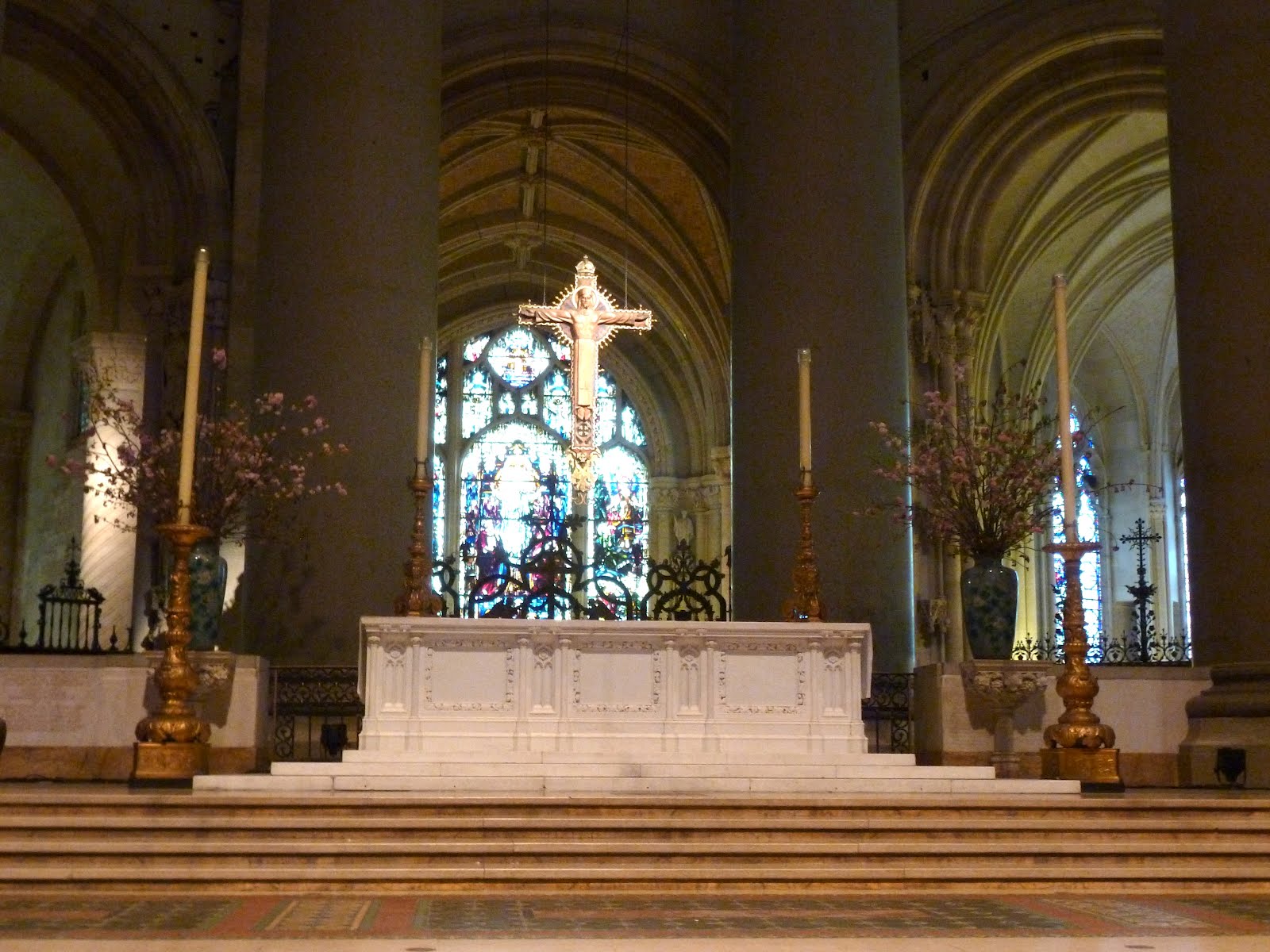
The high altar


One of a pair of menorahs donated by Adolph Ochs, the owner of the New York Times


The 55 foot high pillars around the altar each made from a single piece of stone quarried in Maine


The Cathedral apse with the 7 hanging lamps, the 7 lights of God described in so much Jewish and Christian apocalyptic literature; the windows just behind the pillars are a series of magnificent windows showing visionary subject matter from Revelations. My photo does not do them justice here. Once again, I have no idea who designed them.


Christ of the Second Coming, the center window in the apse


The Woman Clothed in the Sun from the apse windows


Apocalyptic Angels in the apse


Carvings from the choir showing from right to left, Shakespeare, Washington, Lincoln, and Gandhi with Martin Luther King Jr.


Detail of the above with Martin Luther King and Gandhi with 2 other figures I can't recognize


The St. Savior Chapel, easternmost part of the Cathedral; center of seven chapels originally dedicated to various nationalities who settled New York City. Today, the St. Savior Chapel is dedicated to the city's African and Asian descended people. Originally, it was intended to be a tribute to the Eastern Church from which so much of the liturgy and theology of the Episcopal Church comes (by way of the Episcopal Church of Scotland at the end of the 18th century).


The Transfiguration from the center of the window in the St. Savior Chapel; this is one of the older windows in the Cathedral so I will guess that it's from Tiffany and Company, though I have no idea who the artist would be. A magnificent window.


A small side window in the St. Savior Chapel filled with seraphim


The St. Columba Chapel, originally dedicated to the city's Irish descendents


The magnificent grisailles windows in the St. Columba Chapel


The Keith Haring triptych in the St. Columba Chapel; this is one of the very few works of modern art made with the Cathedral in mind. Other modern works look out of place and overwhelmed by their surroundings in the Cathedral. I must admit that I usually like Keith Haring better than his work, though I've always been very fond of this piece, one of 9 editions. It was one of his last works. It's made of cast bronze plated in gold, in this edition, white gold. The subject appears to me to be a very personal interpretation of something like the Christian Apocalypse with Love triumphing over all in the end.
Haring's funeral was held in St. John the Divine.


The Chapel of St. Ambrose originally dedicated to the city's Italian descendents


The Baptismal font in the Baptistery, one of the most beautiful parts of the Cathedral


The beautiful rib vaulted ceiling and lantern of the Baptistery


The columbarium attached to the Baptistery, one of 2 in the Cathedral; cremation has made possible the return of the ancient custom of burials in church.


St. John the Unfinished


The base of the unbuilt north transept; in the background, the stump of the unbuilt north tower


The unfinished south tower on the west front


A pile of stone in the now vacant stoneyard; these stones have probably sat in this pile since the 1980s. They were probably destined for the unfinished south tower.


Will St. John's ever be finished? I have no idea. Right now, the prospects for finishing it are not good. The cathedral has just been extensively cleaned and restored in the wake of a fire in 2001 that destroyed the gift shop once housed in the base of the unbuilt north transept. No further construction is planned that I'm aware of. The scaffolding came down from the south tower years ago. The work sheds and all the heavy lifting equipment are all still there in the old stoneyard, but they are growing rusty with idleness. Construction began on the Cathedral in 1892 fifteen years before construction began on the now completed National Cathedral in Washington DC. St. John the Divine is nowhere near completion. Only one of the towers planned for St. John the Divine is even begun. It's that lack of major vertical elements that gives the Cathedral its large clumsy quality on the exterior. The prospects for ever completing it are not good.

When it comes to major cathedrals, I would be reluctant to say "never." Florence's cathedral began in 1296 and was not fully complete in its present form until the completion of the facade in 1887. The Cathedral of Cologne in Germany was begun in 1248 and not completed until 1880. As cathedrals under construction go, St. John the Divine is still very young, and so much is already finished, though its construction departs in important ways from the traditional east to west construction (the nave finished before the crossing is very unusual). There are many reasons why it takes so long to build a cathedral. St. John's is being built the old fashioned way out of stone shaped by hand. The masons today, unlike then, use power tools, but the requirements of skill of hand remain the same. Each piece is unique, a sculpture in and of itself. That kind of skilled hand labor is slow and expensive; and always was. St. John's is slow for the same reason cathedrals have always been slow to build. Money runs out and history happens.
What finally drove the completion of the Cathedrals of Florence and Cologne was not religion, but nationalism. The Italian Risorgimento and the German nationalist revival of the 19th century drove the completion of both cathedrals. There's no reason to assume that something like that either out of religious revival or civic pride or both will not come along in the future to finish St. John's. One thing I am sure of and that is that no one alive now will be around to see the Cathedral finished, if it is finished.

St. John the Divine is a relic of a former incarnation of the Episcopal Church. When construction began on it, the most powerful man in the United States, and one of the most powerful in the world, was an Episcopalian born and bred. Banker and businessman JP Morgan was a regular at Grace Church on Broadway and 10th street in Manhattan. The great antagonist of the business elite in the White House in the 1930s, Franklin Roosevelt, was also an Episcopalian born and bred. The great New Deal mayor of New York City, Fiorello LaGuardia, was Episcopalian born and bred (his parents were converts). The Cathedral of St. John the Divine was conceived when the Episcopal Church, together with the Presbyterian and Congregational churches (and to a lesser extent the Methodist and Lutheran churches) formed the de facto national church of the United States. The Episcopal Church was the church of the WASP Establishment and of the ruling Plutocracy. The Establishment and the Plutocracy abandoned the Episcopal Church over 50 years ago when Episcopal clergy began actively supporting the Civil Rights Movement and opposing the Vietnam War (the earliest opposition to the war came from religious groups). The Establishment and the Plutocrats have now all gone over to the Evangelicals and to a lesser extent, the Romans (Wall Street remains as secular as it always was). The Roman hierarchy and the Southern Baptist Convention now compete for that status of de facto state church.

The Episcopal Church is a very different institution from the one JP Morgan knew or FDR knew. It is much smaller (from 3 million, never large, to around 2 million today). It is more catholic in every sense of that word. It is much more middle class. The Episcopal demographic is mostly white, college-educated, middle class, professional, and not in a position to finance the completion of a major cathedral. The majority of Episcopalians now are converts, including me and all of the clergy at my parish, and the Presiding Bishop. Born and bred Episcopalians are comparatively scarce. The Episcopal Church is not quite as American as it used to be with dioceses in Haiti, Honduras, Colombia, Ecuador, Taiwan, and Europe. The Episcopal Church in Europe was once entirely for American ex-pats. Now, the Episcopal churches in Rome and Florence have services in Italian as well as English. There is talk of creating an Italian language Episcopal seminary in Rome, and a Polish language Episcopal seminary in Cracow.

St. John the Divine, like all other cathedrals, was built by and for the local rulers, in this case of New York City and the United States. Every cathedral reflects the power and glory of the ruling prince or oligarchy as well as the pride of the city as much if not more than the glory of God. St. John the Divine is an architectural anomaly, a very modern variation on a historic style built in a technological age with skilled hand labor. It engages our emotions and imaginations in a way that no glass and steel box ever could, no matter how gratifying its proportions. The architects, artists, and master craftsmen of St. John the Divine, as in all cathedrals, give the building its glory and create that sense of God's presence throughout the building.

Cathedrals are vain things. And yet, we should be so much poorer without them.

From 2nd Chronicles 6 (NIV):
18 “But will God really dwell on earth with humans? The heavens, even the highest heavens, cannot contain you. How much less this temple I have built! 19 Yet, LORD my God, give attention to your servant’s prayer and his plea for mercy. Hear the cry and the prayer that your servant is praying in your presence. 20 May your eyes be open toward this temple day and night, this place of which you said you would put your Name there. May you hear the prayer your servant prays toward this place. 21 Hear the supplications of your servant and of your people Israel when they pray toward this place. Hear from heaven, your dwelling place; and when you hear, forgive.