-- No, we are not the most victimized country in the world. We weren't 14 years ago, and we certainly aren't now. The new and newish architecture in the city centers of London and Hamburg reminded me that 70 years ago, September 11th happened every day in those cities. The entire death toll from that day in the USA adds up to the dead on a city block in either of those cities during World War II. Our losses from that day pale in magnitude compared to the blood bath taking place in Syria now, or with the losses in all the warfare and violence in Iraq since our invasion.
-- After we got sucker-punched 14 years ago, we did indeed hit back, but at who? We didn't think that through, and as for the people who did think it through, we ignored them. Our invasion of Iraq made as much sense as an invasion of Bolivia after Pearl Harbor. We had our longed for big victory moments in Iraq. We got all that was denied us in Vietnam. Our tanks rolled victorious into the enemy capital. We tried and hanged the evil dictator after pulling down his statue. We put those poor people under American rule and tutelage. So why is it that after all the money and blood spent there, after so clear and glorious a victory, things are worse now than ever? We went to war on "terrorism," and we ended up with ISIS turning eastern Syria and northern Iraq into human abattoirs. Instead of Al Qaida, now we have Al Nusra, Boko Haram, Al Shabab, and any number of independent freelancers in addition to ISIS. We waved the banner of "FREEDOM!" when we went into Iraq and Afghanistan with guns blazing, and now there is less of anything remotely like that in the region than ever. The Middle East now has all the brutality, cynicism, fanaticism, and bloody chaos that anyone could possibly want.
-- The attacks of September 11th brought together the inhabitants of a great city built by social Darwinism. I personally witnessed extraordinary acts of selflessness and solidarity between groups of people who normally hated each other (e.g. East Village punks and cops). In times of national emergency Ayn Rand and Herbert Spencer be damned. People really do come through for each other and turn out to be a little better than the experts tell us.
We had the good will of the world with us in the wake of the attacks. So why is it that all that international good will was squandered so quickly? Why is it that the USA is more polarized now than ever, perhaps since the Civil War?
-- How patriotic is it really to keep an overseas tax shelter in a time of national emergency?
-- It's really easy to be patriotic when it's someone else's kids who get sacrificed on the battlefield and other people bear the burden so that we can feel "free." It's easy to talk seriously about our need to make sacrifices when we know that we won't have to give up a thing.
-- Accountability is for little people. The people responsible for the biggest foreign policy disaster since the Vietnam War got to walk away from it and left it to others to clean up the mess. All the people who supported and cheerlead the whole mess still have their jobs and reputations. They paved the way for all the crooks in the international finance industry who crashed the global economy and got great big government checks instead of jail time.
-- But Afghanistan is so far away. It can't have anything to do with us. It's now the world's largest producer of opium thanks to American occupation. And so our country is flooded with cheap heroin. Our insatiable decadent demand for narcotics funds ISIS, the Taliban, Afghan warlords, and brutal Mexican drug lords. Some of those same piles of money we spend on getting high comes back to us in the form of real estate purchases in New York, San Francisco, Los Angeles, and Chicago driving up already sky high rents and housing prices in those cities and across the country. I'm sure there are people in all of those cities paying rent to El Chapo without even knowing it.
-- Osama Bin Laden may be dead, but he won September 11th. We gave him everything he wanted thanks to our national winning combination of fear, stupidity, and arrogance.
-- One more thing. I think we can finally drop all the pretense that somehow we are the "good" empire. For one thing, there is no such thing as a good empire. All empires, including ours, are nothing more than organized smash-and-grabs. For another, we lost any claim to moral credibility when we began torturing and killing prisoners of war. No one in the world is fooled by our pretensions to innocence and virtue except us. The terrorists didn't steal our souls. We sold them for a cheap promise of safety and revenge. When we look at our enemies these days, we look into a mirror very darkly.
Friday, September 11, 2015

Tuesday, September 8, 2015
Friday, September 4, 2015
Migrants

This is the now famous photograph of Aylan Kurdi, 3 years old, lying dead on a beach at Bodrum, Turkey. He was buried today in his hometown of Kobane in Syria, a Kurdish town near the Turkish border along with his mother Rehan and his brother Ghalib who died with him. His father Abdullah is the sole survivor of the family. They were trying to cross 10 miles of open sea to Greece on a flimsy raft at night. They were fleeing a town that was seized by ISIS last year and then again by Kurdish forces more recently. Aylan and his family were Syrian Kurds. They applied for asylum in Canada, but were turned down, and so they decided to try the perilous journey to Western Europe across Turkey and the Aegean by way of Greece. That journey ended at Bodrum in Turkey.
It's hard to look at this photo and not feel moved.


I've always been puzzled by the indifference or hostility to these refugees by European governments, a sentiment not shared by their own peoples. In a forceful demonstration that people are frequently much better than their governments, many Europeans have spontaneously gone to great lengths to help the desperate people arriving on their shores, along their roads, and at their railroad stations.

The world is facing the biggest refugee crisis since the Second World War. Bashir al Assad and ISIS are destroying Syria. Iraq and Yemen are proxies in the warfare between Iran and Saudi Arabia. Boko Haram, Al Shabab, and the Lord's Resistance Army terrorize Africa. Eritrea's government terrorizes its own people. Libya and Afghanistan continue to disintegrate and fall into the hands of violent religious fanatics. The Rohingya of Myanmar Burma flee oppression in Southeast Asia. These are just a few of the crises plaguing the world now. Innocent people are ground between the wheels of competing ambitions and ideologies. Ordinary people caught up in these upheavals are voting with their feet and shaking the dust off at the fanatics, warlords, tyrants, and aspiring philosopher kings trying to determine their futures. They see the possibility of a new life for themselves and their children in the despicably liberal and decadent West.
While Germany has been very generous, especially to Syrian refugees, most of the rest of Europe remains stingy with their welcomes. The USA might consider cracking open its golden door for these people. Instead of binging on xenophobia and jingoism, maybe the USA might be better served if we remembered this poem:
'Not like the brazen giant of Greek fame,
With conquering limbs astride from land to land;
Here at our sea-washed, sunset gates shall stand
A mighty woman with a torch, whose flame
Is the imprisoned lightning, and her name Mother of Exiles.
From her beacon-hand
Glows world-wide welcome; her mild eyes command
The air-bridged harbor that twin cities frame.'
'"Keep, ancient lands, your storied pomp!" cries she
With silent lips.
"Give me your tired, your poor,
Your huddled masses yearning to breathe free,
The wretched refuse of your teeming shore.
Send these, the homeless, tempest-tost to me,
I lift my lamp beside the golden door!"
This poem never reflected official American immigration policy which was always only slightly more generous in its welcome than other countries, and at times much less.
It does remind us a lot about what we are as a people on this continent. Unless you are Arapaho, Lakota, Inuit, Navajo, Iroquois, Lakota, or Pawnee, then your family at some time arrived here homeless, poor, and unwelcome as refugees or migrants -- not much different than the Kurdi family from Syria who died at sea.
An ancient text reminds us:
"Thou shalt neither vex a stranger, nor oppress him: for ye were strangers in the land of Egypt."
EXTRA:
Amanda Taub at Vox takes the USA to task for doing so little to relieve the human suffering it helped to create through its actions and inactions:
The death of any child is devastating. But these children’s stories are particularly painful to read about, because they carry a reproach for readers like us: We let this happen. We left those innocent children to this fate. We knew refugee children were in danger, and did nothing, and this is the result.
And make no mistake: We did know. As the refugee boats have crossed the Mediterranean, photograph after photograph has showed rescue workers cradling tiny babies and toddlers rescued from the water. We knew desperate families were bringing children on these journeys. We knew they would keep coming, because what could drive a parent to bring a child on such a dangerous crossing except fear that staying behind would be worse? And we knew that if we didn’t do more to help them, many of those children would die — and so would their families.
But apparently those children weren’t dead enough to hold our attention. An infant saved from a boat wasn’t good enough for us: We needed to see one dead on a beach, lying alone, face down, in the surf.
And so the world has treated the refugee crisis as a sort of bureaucratic inconvenience, a problem that someone else really ought to be handling. But the truth is that those are just excuses we tell ourselves to feel better about the fact that we’re not doing the right thing. Because make no mistake: This is a situation where there is a right thing to do. And we are not doing it. Germany is now beginning to show moral leadership on the refugee crisis, and to call on other countries to come forward and do their part before more children and their families die. But the United States, like much of Europe, has not followed suit. Our silence and inaction are shameful.
EXTRA:
Another thing to note, the Kurdis and most of these other migrants on their way to or in Europe are people who could afford to pay smugglers. They are the last remnants of Syria's middle classes; professional people and small business people. There are thousands, even millions more, in refugee camps in Turkey, Lebanon, or on the Syrian border, who do not have the funds even for so impoverished and perilous a journey as the one that ended so fatefully for the Kurdis.
A Martyr is Born

Jail is probably the best thing that ever happened to Kim Davis. When she gets out, the right wing media will crown her as a saint and a martyr. She will make ship-loads of money off the book that she will eventually write, from celebrity talk show appearances, and on the lucrative public speaking circuit.
Already the professional paranoids are claiming that their wildest fantasies about Persecuted Christians are coming true, that the Gaystapo will be loading up the cattle cars with Good Christian People starting next week.
A lot of people with little experience of the South and even less of Kentucky are calling for the state legislature to impeach her. It will do no such thing. More likely, it will pass a resolution commending her.
Even more than Kim Davis, the rule of law will suffer the most. Gay and lesbian couples are paying the real price for her intransigence. They must accept second class citizenship, less than full rights and protections under the law so that her convictions might not feel threatened. A county clerk unilaterally decides that a law that she does not like is void in her county. She effectively makes herself her own legislature and court deciding that what is best for her is right for everyone else. She is setting a precedent that will come back to bite the very people singing her praises now. Imagine some day a Muslim county clerk deciding that he will not grant Christians marriage licenses because he believes that they are infidels, and that to accommodate them violates his religious faith. Or, another county clerk refuses to recognize interracial marriages, despite the 1967 Loving vs. Virginia decision, and claims to do so on religious grounds. Both clerks would be able to cite Kim Davis and unilaterally nullify established law and legal precedent.
And in the end, what difference will any of this make? This is one clerk in one county out of 3,143 counties in the USA. All the others are following the law and granting licenses to same sex couples, even in gay hostile states. Even in Davis' own Rowan County in Kentucky, the county clerk's office employees are doing their job, and doing it quite willingly, granting licenses to those couples that are legally eligible, including same sex couples.

Tuesday, September 1, 2015
Christian Martyrs
For the sanctity of which of her 4 marriages will Kim Davis claim the palm of martyrdom?
I relish being preached at by multiple divorcees and serial adulterers about my love life and my sexuality.
I just love how members of autocratic fundamentalist congregations with harsh penalties for any deviation from the Straight and Narrow bang on about "freedom."
I'm thrilled that the Roman Catholic Church is remaking itself as a fertility cult led by celibate old men.
And in the end, I think none of this has anything to do with religion or morality. It is all about identity, about tribe; who's Us and who's not. It's all of a piece with the white identity politics that dominates the Republican Party these days. The one time party of the chamber of commerce now remakes itself into a far right national front party focused on a threatened racial, gender, religious, and class supremacy. The use of the tax code to redistribute the wealth from everyone else to the top of the food chain is part of that supremacist agenda. Ayn Rand evicts Adam Smith from his old seat at the GOP.
So too is the focus on gays. Gays are the ultimate beneficiaries of liberal cosmopolitanism, the very personification of that detested liberalism that puts universalism ahead of identity; humanism ahead of sectarianism. The Bible has comparatively little to say on same sexuality as compared to a lot to say about adultery and divorce as well as social justice issues. But that disproportionate focus on one small thing, putting it at the center of the Christian faith right there with the Resurrection and the Trinity, is central to the anti-cosmopolitanism of the supremacist far right. The white American race through its Christian mandate claims a manifest destiny to rule, according to this school of thought. The universal proclamation of salvation as the free gift to all by a self-sacrificial God becomes barely recognizable beneath the distortions imposed on it by the necessities of supremacist identity politics.
As I've said before, "religious freedom" is just code for the liberty to be a pious asshole and to feel superior while treating other people like shit.
EXTRA:
Dan Savage on the whole Kim Davis fracas:
EXTRA:
And a martyr is born.
I relish being preached at by multiple divorcees and serial adulterers about my love life and my sexuality.
I just love how members of autocratic fundamentalist congregations with harsh penalties for any deviation from the Straight and Narrow bang on about "freedom."
I'm thrilled that the Roman Catholic Church is remaking itself as a fertility cult led by celibate old men.
And in the end, I think none of this has anything to do with religion or morality. It is all about identity, about tribe; who's Us and who's not. It's all of a piece with the white identity politics that dominates the Republican Party these days. The one time party of the chamber of commerce now remakes itself into a far right national front party focused on a threatened racial, gender, religious, and class supremacy. The use of the tax code to redistribute the wealth from everyone else to the top of the food chain is part of that supremacist agenda. Ayn Rand evicts Adam Smith from his old seat at the GOP.
So too is the focus on gays. Gays are the ultimate beneficiaries of liberal cosmopolitanism, the very personification of that detested liberalism that puts universalism ahead of identity; humanism ahead of sectarianism. The Bible has comparatively little to say on same sexuality as compared to a lot to say about adultery and divorce as well as social justice issues. But that disproportionate focus on one small thing, putting it at the center of the Christian faith right there with the Resurrection and the Trinity, is central to the anti-cosmopolitanism of the supremacist far right. The white American race through its Christian mandate claims a manifest destiny to rule, according to this school of thought. The universal proclamation of salvation as the free gift to all by a self-sacrificial God becomes barely recognizable beneath the distortions imposed on it by the necessities of supremacist identity politics.
As I've said before, "religious freedom" is just code for the liberty to be a pious asshole and to feel superior while treating other people like shit.
EXTRA:
Dan Savage on the whole Kim Davis fracas:
I say this with sadness, I say this as the son of a preacher, I say this as a former seminarian: This pathetic bullshit is what passes for Christianity in America today. Thanks to the efforts of hate groups like the American Family Association, the Family Research Council (co-founded by a tortured closet case and lately the employer of a kid-diddling serial adulterer), the 700 Club, the Moral Majority, the National Organization for Marriage, the National Association of Evangelicals, etc., and the mousy, near-complicit silence of left-wing and progressive Christians, "Christian" is now synonymous with "anti-gay bigot."
To be a good American Christian like Kim Davis—or a good Alaskan Christian like Bristol Palin—you don't have to stay in your first marriage, you don't have to stop getting knocked up by randos who aren't your husband, you don't have to deny marriage licenses to straight people who are remarrying or marrying outside the faith or obtaining marriage licenses for Godless secular marriages. Nope. You just have to hate the homos. Hate the homos and you're right with the God of Tony Perkins and Josh Duggar, hate the homos and you're good with American Jesus. (Toss in support for capital gains tax cuts and Jesus loves you even more.) You don't have to feed the sick, clothe the naked, house the homeless—you don't have to do any of that shit Jesus actually talked about—you just have to hate the homos hard enough togo to jail for for your beliefscash in on your bigotry.
EXTRA:
And a martyr is born.
Saturday, August 29, 2015
Katrina 10 Years Ago

Hurricane Katrina, the most destructive and third deadliest hurricane in US history (1. Galveston Hurricane of 1900, 2. Okeechobee Hurricane of 1928), hit New Orleans and the Gulf Coast ten years ago this weekend. The official death toll was over 1800 with about 1400 of those deaths in New Orleans. The death toll and destruction were compounded by poor engineering decisions from decades earlier, by late and muddled government responses, by corruption, and by callous racism. It was a natural disaster made into a catastrophe by human bungling and corruption.
Most of the coverage of the anniversary of the hurricane is upbeat stories about recovery. Our culture just doesn't do sad very well, and sees grief as a disease to be treated rather than as an inevitable part of life and mortality to be suffered. New Orleans and the Mississippi Delta will never be the same again, if for no other reason than those 1800 and more lives can never be replaced. I also fear that the hurricane became a real estate development opportunity transforming a large mostly Black city into a smaller Whiter, and wealthier city with skyrocketing housing costs. Many of the original residents of the city who fled can no longer return.
Here is Bessie Smith singing "Backwater Blues" which she wrote in 1927 after witnessing a record flood of the Cumberland River in Nashville, Tennessee on Christmas day, 1926. The song soon became associated with another major natural disaster compounded by human negligence and callousness, the great Mississippi Flood of 1927.
Wednesday, August 26, 2015
Oslo
More than a year later, here is my last post on my 2014 trip to Europe. I end these posts where I began my trip, in Oslo, Norway.
All the photos are mine except where noted and are freely available.
 The Dramen Fjord south of Oslo.

 A container ship probably full of newly manufactured cars for sale in eastern Europe headed down the Dramen fjord for the North Sea and the Baltic.
 What 9PM looks like in June in Svelvik, Norway. It never really gets dark in the summer, so everyone sleeps with heavy shades pulled down.
 Bill Paulsen's family and extended family in Svelvik where we dined on such Norwegian dishes as hotdogs, hamburgers, and steaks. This was the first of many cookouts we enjoyed across Europe.
 Our hosts in Oslo, Erik Hugin and Lasse Lauten, old friends of Bill's for years. Of all the couples and families that we met in Oslo, they were the only couple formally and legally married.
Erik works as a nurse in a local hospital and is hard of hearing, however he can lip read in about 5 languages. Lasse is a computer genius who does consulting around the world and travels to the States frequently on business. They were both marvelous and very generous hosts.
 I especially enjoyed visiting the Viking Ship Museum on the outskirts of Oslo. The museum contains two large ships and two smaller ones excavated from burial mounds in the early 20th century.
 The famous Oseberg Ship, as magnificent in design as a Greek temple, and unlike a Greek temple, was intended to be seen in motion upon the water.
The hull is made from thinly cut oak timbers fastened with iron nails. Pine wood planks make up the deck. The ship has portals for 30 oars, 15 on each side, and a mast for a sail. It was a fully sea-worthy vessel, but does not appear very worn. It may have been used only for ceremonial occasions and may be older than the 9th century burial that contained it.
 The magnificent stern of the Oseberg ship with a steering oar.
The remains of two women were found buried with the ship. One was elderly (60- 70 years old). The other was in late middle age (in her 50s). The older one was apparently of great importance considering the remains of the garments buried with her. The other younger one was less elaborately clad. The relation between the two women remains unknown (mistress and servant? mother and daughter? lovers?). According to dendrochronological tests of the timbers in the burial chamber, they were buried around 834.
 The magnificent carved ornamentation on the bow of the Oseberg ship consisting of serpentine interlace pattern that appear across Europe in the 7th through 10th centuries, including in Gospel books of the time.
 A close up of the carved ornament on the Oseberg ship. The ornament extended below what would have been the waterline.
 from Wikimedia
The Oseberg Ship under excavation in about 1904. While the excavation was done in only one summer, extracting and restoring the ship took 21 years. Recent examinations by museum curators revealed that the restorers shortened the length of the ship.
 The Gokstad Ship, an even bigger ship with 16 pairs of oar portals used for the burial of a man in his 40s who probably died in battle sometime in the 10th century. The posts on the bow and stern are restorations. The originals were long ago destroyed by the conditions of burial. The bow and stern posts may have originally looked something like those on the Oseberg Ship.
 Another view of the Gokstad Ship.
The Vikings were among the greatest of all pre-modern sea-faring peoples. Their only rivals in distances traveled were the Polynesians in the South Pacific. Ships like this carried them from Constantinople to Labrador and down the Volga river. They left remains of settlements on the Atlantic coast of Canada and carved runes into the marble of Hagia Sophia in Constantinople.
 The remains of 2 smaller boats found buried with the Gokstad Ship in the background.
 The museum has not only the ships, but all of the surviving goods from both burials. Here is the only surviving Viking cart from the Oseberg burial.
 A carved head from the cart
 One of a series of poll ornaments from the Oseberg burial. These were all very different from each other and strikingly carved with ferocious monster heads that must have looked even more ferocious when they were brightly painted.
 A detail of the monster head from the post above; even with the once painted eyes now blank, it still seems to audibly roar.
 Another poll ornament covered with interlace carving
 The snarling beast from the above poll ornament.
 Another monster even more elaborately carved with inlaid metal eyes.
 An amazing sled with inlay work and interlace carving everywhere.
 A street in Oslo near where I stayed, and on the way to Frogner Park.
 The main drag of Oslo, Karl Johann street viewed toward the west and the Royal Palace.
 from Wikipedia
The same view on Karl Johann street painted by the great Norwegian artist Edvard Munch in 1890, a little further up the street from where I was.
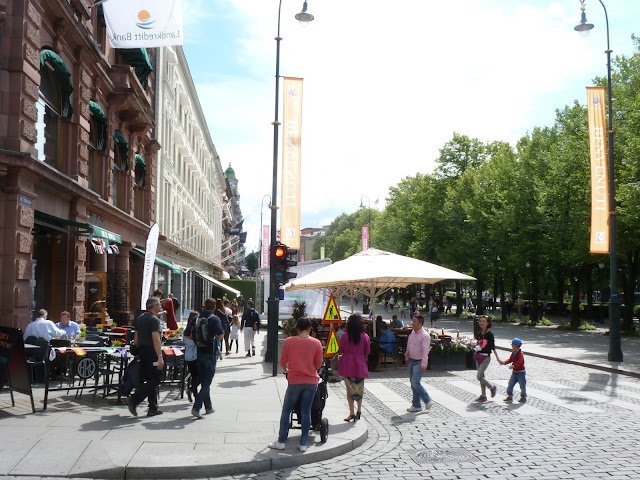 Looking east on Karl Johann Street toward the Norwegian Parliament
 from Wikipedia
The same view painted by Munch in 1893 with the Parliament building more visible to the right.
Without resort to any of the usual rattling bones and grinning skulls of conventional horror, Munch transforms the respectable citizens of Oslo out for a stroll on a summer night into a threatening hoard of ghosts. The shooting perspective of Karl Johan street only adds to the claustrophobic effect of the oncoming crowd.
 This small modest building is the National Gallery in Oslo, smallest of all the museums that I visited. Inside is one of the most famous paintings in the world, the "Mona Lisa of Modern Art."
 And wouldn't you know it, photography is permitted everywhere in the museum except in this gallery housing many of Edvard Munch's most famous paintings.
 And there it is photographed from outside of the gallery, Edvard Munch's The Scream from 1893.
All of the painting reproductions are from Wikipedia. I saw a lot of major paintings by Munch in that little gallery in that small museum. I could not photograph any of them.
 from Wikipedia
Edvard Munch painted 4 versions of The Scream in 1893 (he painted over 40 more versions later in his life), 3 of those original versions are in Oslo divided between the National Gallery and the Munch Museum. The 4th is in a private collection.
This is the first and most famous version painted in oil and pastel on cardboard (it must be a conservator's nightmare). To my mind, it is also the best retaining all the original emotional power of the dark epiphany that inspired this image. Munch originally gave this painting a German title, Der Schrei der Natur (The Scream of Nature). In his diary in 1892, Munch described the experience that inspired this painting:
"I was out walking with two friends -- the sun began to set -- suddenly the sky turned blood red -- I paused, feeling exhausted, and leaned on a fence -- there was blood red tongues of fire above the blue-black fjord and the city -- my friends walked on, and there I stood, trembling with fear -- and I sensed an endless scream passing through Nature."
The place where this vision happened is usually identified as a road above the Oslo fjord on the Ekeberg hill near an insane asylum where Munch's sister Laura Catherine was a patient.
The Scream is Munch's most reductive and distorted subject. He never did anything quite like this again (other than repeated versions of this painting). Everything Munch describes in his diary entry is there; the fiery sunset, the blue-black fjord, the two friends walking on, everything except the figure screaming in the foreground. It is a blank featureless, sexless, ghost of a figure that seems to rear up suddenly in front of us. We seem to be levitating above the ground as the friends walk down the shooting perspective of the road and off the picture. Munch reduces the landscape to a pattern of swirling and sweeping shapes that begin to collapse the distinction between land and sky, and between near and far. Munch took a very personal experience and sought to universalize it by making it into a pattern that he believed could successfully describe the anxiety that inspired this vision more authentically than a conventional figurative painting.
"Show me an angel and I will paint it," declared the artist Gustave Courbet. Edvard Munch replied, "The camera cannot compete with the brush and canvas so long as it cannot be used in heaven and hell." Munch took the confident materialist positivism of his age to task arguing that we cannot separate the world from the eye and the mind that perceives it, that no one is a camera, a blank mechanism looking at the world. We cannot help but look at the world through the lens of our own memories, experiences, and imaginings. The health and happiness of our perceiving minds -- or the lack of it -- is an inextricable part of the world we live in.
Munch's paintings, including The Scream, are mostly autobiographical and personal. Munch grew up in dire poverty surrounded by illness, insanity, and death. Munch's mother died of tuberculosis when he was five. His favorite sister, Sophie, died of the disease when Munch was fourteen. Munch's father was a morbidly religious man who always warned his children that their mother was weeping in heaven over their disobedience. Munch's sister Laura Catherine became mentally ill and his brother Andreas died of tuberculosis soon after his wedding. Munch financially supported the remaining members of his family out of his earnings as an artist all of his life.
 from Wikipedia
Munch's Madonna 1894, is a deliberately blasphemous image that is also very neurotic and misogynistic. Munch went through a lot of bereavement at the very same time he went through adolescence and sexual awakening. An older woman tried to seduce him when he was still a teenager. Those experiences together with his father's very dark piety caused him to see sexuality and death inextricably intertwined. He saw life as a dance of death with no escape. He saw woman as the portal of death through sexuality. In this he was not much different from many other artists and writers in a deeply misogynistic age where the femme fatale played a large role in male imaginations. In this painting, a seductive young woman emerges from the swirling background with black snaky hair and a face that begins to turn into a death's head. She wears and infernal red halo; a deliberately ironic inversion of the halo of the Virgin Mary.

from Wikipedia
Death in the Sickroom 1895
This painting is a reminiscence of the death of his beloved sister Sophie from almost 20 years before. She dies in the chair on the right with her back to us. On the left center dominating the painting is Munch's sister Inge. Munch shows her as she was in 1895, not in 1877 when Sophie died.
The floor plane tips up and chiaroscuro is kept to a minimum flattening the forms of the picture into a kind of pattern. Though a sweeping rhythmic line ties most of the figures together, they all grieve separately in isolation.
What struck me about the painting most when I saw it was the complexity of the color. A large palette of colors went into creating that over-all jaundiced sickly color effect. The black mourning clothes don't have a scrap of black in them. They are all thinned out washes of blues and purples, even a little green here and there. They become black in the overall context of the painting.
 from Wikipedia
Moonlight, 1893
A favorite painting of mine, a girl in a black dress fades into the surrounding darkness and becomes a ghostly menacing figure. The shadow behind her is even more menacing and seems to have a life of its own. The moon appears reflected in the window behind her on the right. Again, reproduction fails to convey the complexity of means that went into making such a seemingly simple color effect; a lot of washes, glazes, and scumbling.
I've always loved Munch's work, but I was surprised by how moved I was by it when in the presence of the originals. Munch may have died in 1944 at 81 years old, an international art star and a Norwegian cultural treasure, but he certainly didn't start out that way. The grief and anxiety that produced these pictures was a high price to pay, and those emotions are still very palpable in the presence of these pictures.
 Christian Krogh, The Sick Girl, 1880 - 1881
Krogh was a close friend of Edvard Munch, and like Munch made probably his best painting out of the tuberculosis epidemic that swept Europe at the end of the 19th century. Krogh shows a girl with tuberculosis with a lot of clues that her illness will not end in recovery; the rose and the point of view which subtly suggests an open coffin.
 A detail of Krogh's The Sick Girl.
 There are some fine works by Caspar David Friedrich in the Oslo museum including this view of the artist's hometown of Greifswald in the moonlight; a small picture.
 A beautiful old lecture hall in the National Gallery in Oslo.
 Bill Paulsen and I visited the home of Vidkun Quisling, the Fascist Norwegian Prime Minister who willingly collaborated with the Nazi occupation and whose name has become synonymous with treason. The home and estate are now a Holocaust studies center. Norway's Jewish population was so small that most of it was transported in one trip on a single ship to Poland and to Auschwitz.
 from Wikimedia Commons
Quisling with Hitler in Berlin. The Norwegians don't have a death penalty, and haven't had one for decades, but they made an exception for Quisling. He was tried for treason after the war and shot.
 One of the strangest and most spectacular sights to see in Oslo is Frogner Park featuring the work of Gustav Vigeland whose sculptures fill this park. He worked with a small army of sculptors and stone cutters to create this installation in the park, a life's work. It is as odd as it is spectacular swarming with nude figures of men and women of all ages in a huge sculpted spectacle that has something to do with the human condition. He even designed the paving, ironwork fences, and balustrades in the park.
 The centerpiece of the Vigeland sculpture installation in Frogner Park, The Monolith carved from a single piece of stone over 46 feet high and composed of the intertwined bodies of 121 figures.

The Monolith with one of many equally striking sculptures that surround it.

Needless to say, these sculptures can get very suggestive sometimes. How could a swarm of intertwined nude figures not be suggestive?
They are all types. None of them are particular or individuated.
 A closer view of the Monolith.
 from Wikipedia
Gustav Vigeland with a sample of his work.
All the photos are mine except where noted and are freely available.


Erik works as a nurse in a local hospital and is hard of hearing, however he can lip read in about 5 languages. Lasse is a computer genius who does consulting around the world and travels to the States frequently on business. They were both marvelous and very generous hosts.


The hull is made from thinly cut oak timbers fastened with iron nails. Pine wood planks make up the deck. The ship has portals for 30 oars, 15 on each side, and a mast for a sail. It was a fully sea-worthy vessel, but does not appear very worn. It may have been used only for ceremonial occasions and may be older than the 9th century burial that contained it.

The remains of two women were found buried with the ship. One was elderly (60- 70 years old). The other was in late middle age (in her 50s). The older one was apparently of great importance considering the remains of the garments buried with her. The other younger one was less elaborately clad. The relation between the two women remains unknown (mistress and servant? mother and daughter? lovers?). According to dendrochronological tests of the timbers in the burial chamber, they were buried around 834.


The Oseberg Ship under excavation in about 1904. While the excavation was done in only one summer, extracting and restoring the ship took 21 years. Recent examinations by museum curators revealed that the restorers shortened the length of the ship.


The Vikings were among the greatest of all pre-modern sea-faring peoples. Their only rivals in distances traveled were the Polynesians in the South Pacific. Ships like this carried them from Constantinople to Labrador and down the Volga river. They left remains of settlements on the Atlantic coast of Canada and carved runes into the marble of Hagia Sophia in Constantinople.





The same view on Karl Johann street painted by the great Norwegian artist Edvard Munch in 1890, a little further up the street from where I was.


The same view painted by Munch in 1893 with the Parliament building more visible to the right.
Without resort to any of the usual rattling bones and grinning skulls of conventional horror, Munch transforms the respectable citizens of Oslo out for a stroll on a summer night into a threatening hoard of ghosts. The shooting perspective of Karl Johan street only adds to the claustrophobic effect of the oncoming crowd.


All of the painting reproductions are from Wikipedia. I saw a lot of major paintings by Munch in that little gallery in that small museum. I could not photograph any of them.

Edvard Munch painted 4 versions of The Scream in 1893 (he painted over 40 more versions later in his life), 3 of those original versions are in Oslo divided between the National Gallery and the Munch Museum. The 4th is in a private collection.
This is the first and most famous version painted in oil and pastel on cardboard (it must be a conservator's nightmare). To my mind, it is also the best retaining all the original emotional power of the dark epiphany that inspired this image. Munch originally gave this painting a German title, Der Schrei der Natur (The Scream of Nature). In his diary in 1892, Munch described the experience that inspired this painting:
"I was out walking with two friends -- the sun began to set -- suddenly the sky turned blood red -- I paused, feeling exhausted, and leaned on a fence -- there was blood red tongues of fire above the blue-black fjord and the city -- my friends walked on, and there I stood, trembling with fear -- and I sensed an endless scream passing through Nature."
The place where this vision happened is usually identified as a road above the Oslo fjord on the Ekeberg hill near an insane asylum where Munch's sister Laura Catherine was a patient.
The Scream is Munch's most reductive and distorted subject. He never did anything quite like this again (other than repeated versions of this painting). Everything Munch describes in his diary entry is there; the fiery sunset, the blue-black fjord, the two friends walking on, everything except the figure screaming in the foreground. It is a blank featureless, sexless, ghost of a figure that seems to rear up suddenly in front of us. We seem to be levitating above the ground as the friends walk down the shooting perspective of the road and off the picture. Munch reduces the landscape to a pattern of swirling and sweeping shapes that begin to collapse the distinction between land and sky, and between near and far. Munch took a very personal experience and sought to universalize it by making it into a pattern that he believed could successfully describe the anxiety that inspired this vision more authentically than a conventional figurative painting.
"Show me an angel and I will paint it," declared the artist Gustave Courbet. Edvard Munch replied, "The camera cannot compete with the brush and canvas so long as it cannot be used in heaven and hell." Munch took the confident materialist positivism of his age to task arguing that we cannot separate the world from the eye and the mind that perceives it, that no one is a camera, a blank mechanism looking at the world. We cannot help but look at the world through the lens of our own memories, experiences, and imaginings. The health and happiness of our perceiving minds -- or the lack of it -- is an inextricable part of the world we live in.
Munch's paintings, including The Scream, are mostly autobiographical and personal. Munch grew up in dire poverty surrounded by illness, insanity, and death. Munch's mother died of tuberculosis when he was five. His favorite sister, Sophie, died of the disease when Munch was fourteen. Munch's father was a morbidly religious man who always warned his children that their mother was weeping in heaven over their disobedience. Munch's sister Laura Catherine became mentally ill and his brother Andreas died of tuberculosis soon after his wedding. Munch financially supported the remaining members of his family out of his earnings as an artist all of his life.

Munch's Madonna 1894, is a deliberately blasphemous image that is also very neurotic and misogynistic. Munch went through a lot of bereavement at the very same time he went through adolescence and sexual awakening. An older woman tried to seduce him when he was still a teenager. Those experiences together with his father's very dark piety caused him to see sexuality and death inextricably intertwined. He saw life as a dance of death with no escape. He saw woman as the portal of death through sexuality. In this he was not much different from many other artists and writers in a deeply misogynistic age where the femme fatale played a large role in male imaginations. In this painting, a seductive young woman emerges from the swirling background with black snaky hair and a face that begins to turn into a death's head. She wears and infernal red halo; a deliberately ironic inversion of the halo of the Virgin Mary.

from Wikipedia
Death in the Sickroom 1895
This painting is a reminiscence of the death of his beloved sister Sophie from almost 20 years before. She dies in the chair on the right with her back to us. On the left center dominating the painting is Munch's sister Inge. Munch shows her as she was in 1895, not in 1877 when Sophie died.
The floor plane tips up and chiaroscuro is kept to a minimum flattening the forms of the picture into a kind of pattern. Though a sweeping rhythmic line ties most of the figures together, they all grieve separately in isolation.
What struck me about the painting most when I saw it was the complexity of the color. A large palette of colors went into creating that over-all jaundiced sickly color effect. The black mourning clothes don't have a scrap of black in them. They are all thinned out washes of blues and purples, even a little green here and there. They become black in the overall context of the painting.

Moonlight, 1893
A favorite painting of mine, a girl in a black dress fades into the surrounding darkness and becomes a ghostly menacing figure. The shadow behind her is even more menacing and seems to have a life of its own. The moon appears reflected in the window behind her on the right. Again, reproduction fails to convey the complexity of means that went into making such a seemingly simple color effect; a lot of washes, glazes, and scumbling.
I've always loved Munch's work, but I was surprised by how moved I was by it when in the presence of the originals. Munch may have died in 1944 at 81 years old, an international art star and a Norwegian cultural treasure, but he certainly didn't start out that way. The grief and anxiety that produced these pictures was a high price to pay, and those emotions are still very palpable in the presence of these pictures.

Krogh was a close friend of Edvard Munch, and like Munch made probably his best painting out of the tuberculosis epidemic that swept Europe at the end of the 19th century. Krogh shows a girl with tuberculosis with a lot of clues that her illness will not end in recovery; the rose and the point of view which subtly suggests an open coffin.


Quisling with Hitler in Berlin. The Norwegians don't have a death penalty, and haven't had one for decades, but they made an exception for Quisling. He was tried for treason after the war and shot.


The Monolith with one of many equally striking sculptures that surround it.

Needless to say, these sculptures can get very suggestive sometimes. How could a swarm of intertwined nude figures not be suggestive?
They are all types. None of them are particular or individuated.


Gustav Vigeland with a sample of his work.
Subscribe to:
Posts (Atom)